
Chef Lupita
Agua de Alfalfa
Ciudad de México's highland market agua fresca, fresh alfalfa blended with pineapple and lime until bright green, strained clean, and poured cold from the vitrolero.
A cooking platform built around craft, culture, and the stories behind what we eat.
Created by
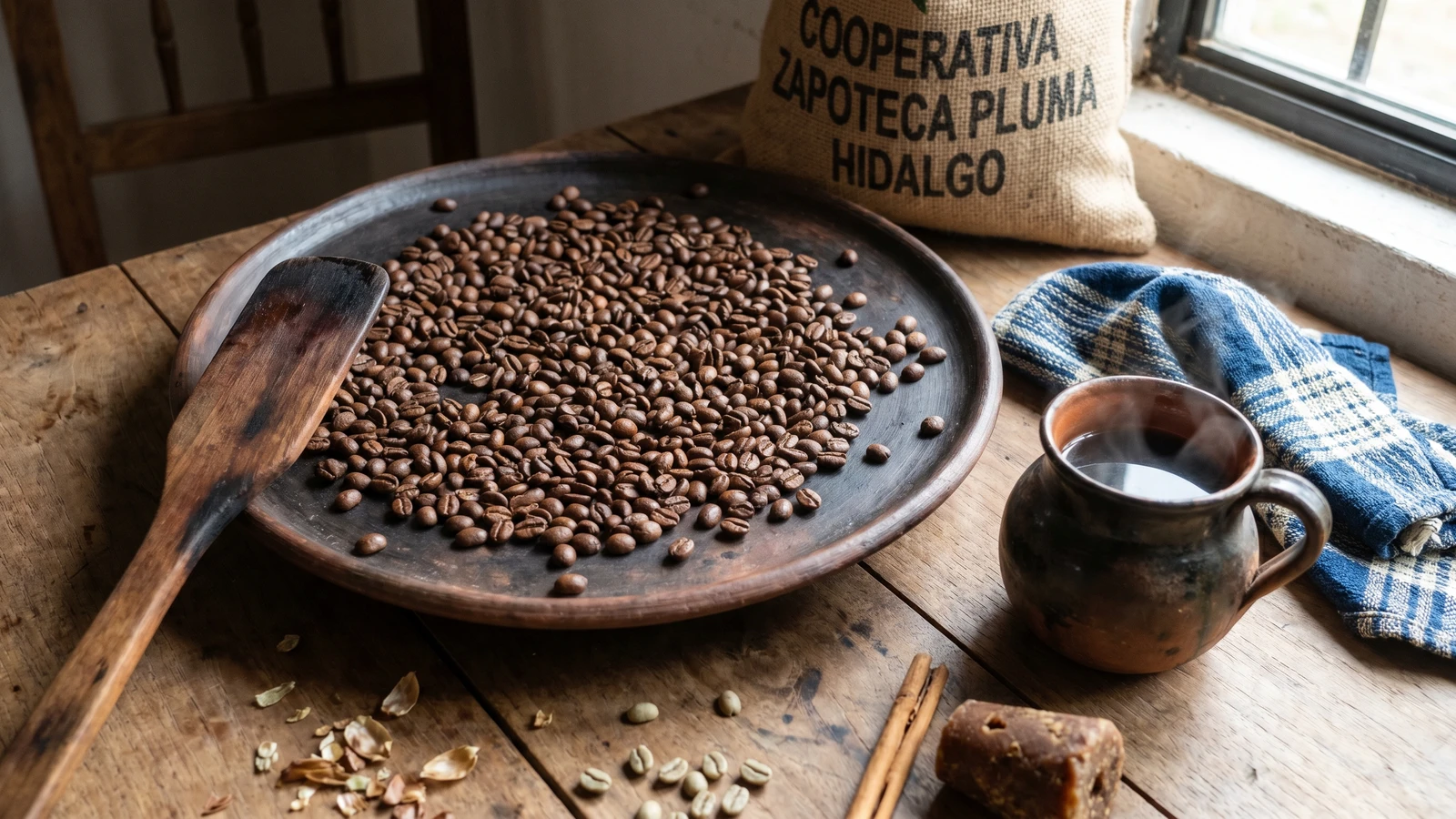
Pluma Hidalgo, the Zapotec coffee of Oaxaca's Sierra Sur, hand-roasted on a clay comal until the sugars caramelize and the bean smells of chocolate and citrus. Single-origin, single-method, single-state.
Pluma Hidalgo is a town in the Sierra Sur of Oaxaca, two hours up a switchback road from Pochutla, sitting at around 1,300 meters on the Pacific-facing slope. The bean takes its name from the town. The coffee is grown almost entirely by Zapotec families on small plots of one or two hectares, shaded under banana and guarumbo trees, picked by hand, depulped at the beneficio behind the house. This is not industrial coffee. This is mountain coffee from a region that has been growing it since the late 1800s.
The bean is a typica varietal, dense and slow to develop because of the altitude, with a flavor profile the cuppers describe as chocolate, citrus, and clean caramel. The Zapotec growers have always roasted it on a comal de barro over a wood fire, in small batches, by hand, paddling the beans constantly so the heat from the clay caramelizes the sugars without burning them. A comal does what a drum roaster does, slower and softer, and the cup it produces tastes like the place the bean came from. That is what Pluma is supposed to taste like.
My mother did not know Oaxacan coffee. She drank Cordoba coffee from Veracruz, dark and sweet, made in the olla with piloncillo. The first time I tasted properly roasted Pluma was in San Agustin Loxicha, in the kitchen of a Zapotec woman named Dona Maria, who roasted a kilo every Sunday on a clay comal that had been her grandmother's. She let me paddle the beans for the last five minutes. She told me to pull them when they smelled like chocolate, not when they looked dark. I have roasted Pluma the same way ever since. Esto no es comida de un solo Mexico, and Pluma is not coffee from a single Mexico either. It belongs to Oaxaca, to the Sierra Sur, to the Zapotec families who have kept it alive.
Coffee arrived in Oaxaca in the late 19th century during the Porfiriato, when European immigrants and large landowners established fincas in the Sierra Sur and the Mixteca; the Pluma Hidalgo region was developed primarily by German and French planters who recognized the altitude and volcanic soil as ideal for typica and bourbon varietals. Following the Mexican Revolution and the agrarian reforms of the 1920s and 1930s, the large fincas were broken up and redistributed to the Zapotec communities who had worked them, transforming Pluma from a colonial plantation crop into a smallholder cooperative tradition. Today the Denominacion de Origen Cafe Pluma protects the name, restricting it to coffee grown in the municipality of Pluma Hidalgo and surrounding Sierra Sur communities, in the same way Tequila and Mezcal are geographically protected.
Quantity
1 pound (450 grams)
Quantity
for brewing
Quantity
for serving
Quantity
1 stick, for serving
| Ingredient | Quantity |
|---|---|
| green Pluma Hidalgo coffee beans, unroasted | 1 pound (450 grams) |
| filtered water | for brewing |
| piloncillo (optional) | for serving |
| Mexican canela (Ceylon cinnamon) (optional) | 1 stick, for serving |
Spread the green Pluma beans on a wide tray. Pick out any that are broken, discolored, or shriveled. The Zapotec growers in the Sierra Sur do this by hand at the beneficio before the beans leave the mountain, but a second pass at home is the difference between an even roast and a bitter cup. One bad bean turns a whole batch.
Set a clay comal over a low flame and let it warm slowly for ten minutes. A clay comal cracks if you rush it. The heat needs to crawl into the clay until the whole surface is even. You should be able to hold your hand four inches above it and count to five before the heat pushes you back. That is the temperature you want. A cast iron comal works if you have no clay, but the clay holds the heat softer and the bean caramelizes instead of scorching.
Pour the green beans onto the comal in a single layer. Work in batches if you have to. The beans should not pile up on each other. Begin moving them immediately with a wooden spoon or a flat wooden paddle, the way the women in San Agustin Loxicha move them, in long sweeping arcs across the surface. The motion never stops. From this moment until the roast is done, the beans are always moving.
For the first eight to ten minutes, the beans turn from pale jade to yellow to the color of dried straw. The kitchen will smell grassy, then like baking bread. Keep moving them. The Pluma bean is dense, grown high, and it takes its time. No me vengas con atajos. If you raise the heat to speed it up, the outside scorches and the inside stays raw.
Around minute twelve to fifteen, you will hear a sharp pop, then another, then a run of pops like distant popcorn. This is first crack. The beans are releasing their internal moisture and the sugars are beginning to caramelize. The color will deepen to cinnamon brown. The smell shifts from bread to something nuttier, sweeter, with the chocolate edge that Pluma is known for. Keep moving them.
About two to three minutes after first crack ends, the beans should be a uniform medium brown, the color of a ripe cacao pod. There will be a faint sheen on the surface as the oils begin to come out. This is where you stop for Pluma. The bean has chocolate, citrus, and a clean caramel sweetness, and a darker roast burns those notes off. Asi se hace y punto. If you want a darker cup, drink something else.
Slide the beans immediately onto a wide metal tray or a second cool comal. Spread them in a single layer and fan them, with a clean dish towel, with a piece of cardboard, with whatever you have. Heat keeps roasting the bean even after it leaves the fire. The faster the beans drop below 100 degrees Fahrenheit, the more of the flavor you keep. The chaff, the papery skin, will lift off as you fan. Let it blow away.
Pour the cooled beans into a glass jar or a paper bag with the top loosely folded. Do not seal them airtight yet. Roasted coffee releases carbon dioxide for the first 12 to 24 hours, and a sealed jar will pop. Let the beans rest at room temperature, in a dark cupboard, for at least 12 hours before grinding. The flavor opens up overnight. The cup you brew on day three is better than the cup you brew on day one.
Grind only what you will brew that morning. For an olla de cafe de olla, grind coarse, almost like raw sugar, and simmer with piloncillo and a stick of canela. For a French press, grind medium-coarse and steep four minutes. For a Chemex, grind medium-fine. Pluma takes any method, but it will tell you the truth about your water. Use filtered water. Heavy chlorine kills the chocolate notes the bean spent six months growing on the mountain. Saber cocinar es saber vivir, and that includes knowing when to leave a good thing alone.
1 serving (about 240g)
Culinary guides, cultural storytelling, and the editorial depth that makes cooking meaningful.
Discover Culinary ExplorerChef Lupita
Ciudad de México's highland market agua fresca, fresh alfalfa blended with pineapple and lime until bright green, strained clean, and poured cold from the vitrolero.

Chef Lupita
Aguascalientes' Lenten agua fresca, jewel-red from cooked beet and full of apple, banana, orange, lettuce, and ground peanuts, served cold when Holy Week meets the Feria de San Marcos.

Chef Lupita
Sonora and Sinaloa's creamy malted barley water, built on toasted cebada perla, Mexican canela, vanilla from Papantla, and evaporated milk. Pink-beige, rich, and served cold over heavy ice in a heavy glass tumbler. Liquid cookie comfort the northwest way.

Chef Lupita
Yucatán's everyday tonic of boiled chaya leaves blended with lima agria, sugar, and ice. The bright green jarra that sits on every Peninsula table from Mérida to Valladolid.