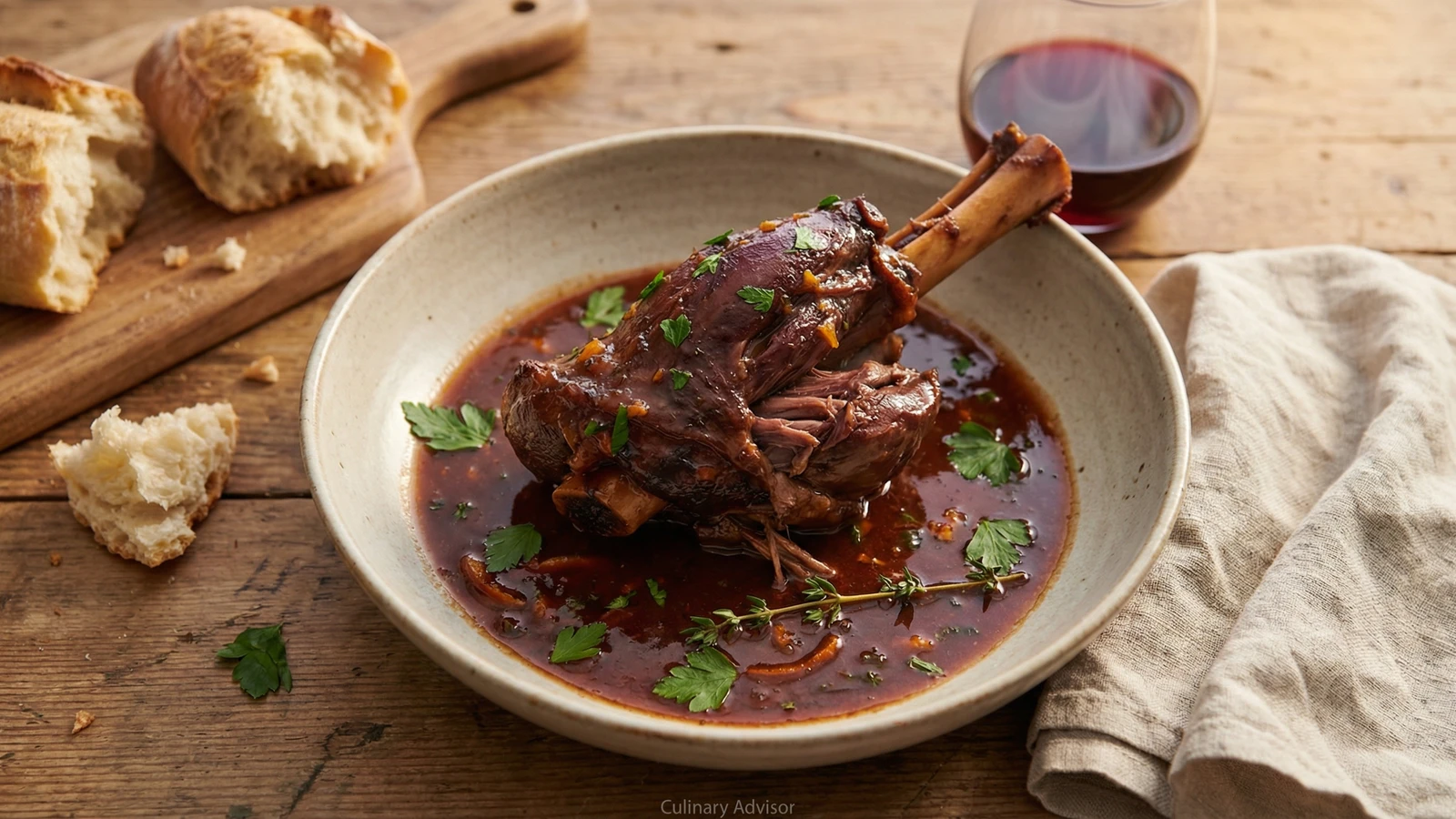
Lamb shanks surrendered to red wine and aromatics until the meat falls from the bone, yielding a sauce so rich and glossy it makes the case for slow cooking better than any words could.
Main Dishes
Mediterranean
Dinner Party
Special Occasion
Make Ahead
30 min
Active Time
3 hr cook•3 hr 30 min total
Yield4 servings
Start with the lamb. Find a butcher who knows the farm, who can tell you how the animals were raised. Lamb shanks are a humble cut, full of collagen and connective tissue that most people do not know what to do with. But give them time in a bath of good red wine and they become something extraordinary.
This is not a dish you rush. The oven does the work while you read, nap, or simply wait. Three hours of patient heat transforms tough sinew into silk. The meat does not just fall off the bone; it practically apologizes for staying attached as long as it did.
I learned to braise in the south of France, watching women who had done this their whole lives. They used whatever wine was open, whatever vegetables were in the garden, whatever herbs grew by the door. The principle was always the same: start with something honest and get out of the way. The lamb already knows what it wants to become. Your job is to let it.
The technique, the tradition, and the story behind every dish.
•Large Dutch oven (6-quart minimum) with tight-fitting lid
•Fine-mesh strainer
•Heavy tongs for turning the shanks
Instructions
1
Season the lamb
Remove the lamb shanks from the refrigerator an hour before cooking. Cold meat does not brown properly. Season generously with salt and pepper on all sides. The salt will begin to draw moisture to the surface, which helps create that deep crust.
Do not rush this step. Meat at room temperature browns evenly; cold meat steams.
2
Brown the shanks
Heat the olive oil in a large Dutch oven over medium-high heat until it shimmers but does not smoke. Working in batches if needed, brown the shanks on all sides, turning every three to four minutes. You want deep mahogany color, not pale gold. This takes twelve to fifteen minutes total. Transfer the browned shanks to a plate.
Crowding the pot creates steam instead of sear. Brown two shanks at a time if your pot is not wide enough.
3
Build the aromatic base
Pour off all but two tablespoons of fat from the pot. Add the onion, carrots, and celery. Cook over medium heat, stirring occasionally, until the vegetables soften and take on some color, about eight minutes. Add the smashed garlic and cook until fragrant, one minute more. Clear a space in the center and add the tomato paste, letting it toast against the hot pot for a minute before stirring it into the vegetables.
4
Deglaze with wine
Pour in the entire bottle of wine. Yes, the whole bottle. Bring to a boil and let it reduce by half, scraping up all the dark bits stuck to the bottom of the pot. These fond carry tremendous flavor. This reduction takes about ten minutes. The kitchen will smell like a French farmhouse.
5
Braise low and slow
Preheat your oven to 325°F. Return the lamb shanks to the pot, nestling them into the vegetables. Add the stock, thyme, rosemary, bay leaves, and orange zest. The liquid should come about two-thirds up the sides of the shanks. Bring to a gentle simmer on the stovetop.
If you do not have lamb stock, chicken works beautifully. Water works too. The wine does most of the heavy lifting.
6
Cover and cook
Cover the pot with a tight-fitting lid and transfer to the oven. Braise for two and a half to three hours, turning the shanks once halfway through. The meat is done when it pulls away from the bone with the gentlest tug and the connective tissue has melted into silk. Start checking at two hours. Every oven runs differently.
7
Rest and reduce the sauce
Transfer the lamb shanks to a warm platter and tent loosely with foil. Strain the braising liquid through a fine-mesh sieve into a clean saucepan, pressing gently on the vegetables to extract their flavor before discarding them. Skim the fat from the surface. Bring the liquid to a simmer and reduce until it coats the back of a spoon, about ten to fifteen minutes. Taste and adjust the seasoning.
8
Serve
Place each lamb shank in a shallow bowl or on a warm plate. Spoon the reduced sauce generously over and around the meat. Scatter fresh parsley over the top. Serve with something to catch the sauce: creamy polenta, mashed potatoes, or crusty bread torn at the table.
Chef Tips
•Buy your lamb from a farmer or butcher who can tell you where it came from. Pasture-raised lamb has flavor that feedlot lamb simply cannot match.
•Use a wine you would actually drink. Cooking concentrates both virtues and flaws. A Côtes du Rhône or Syrah works beautifully here.
•This dish improves overnight. Make it a day ahead, refrigerate, and reheat gently. The fat solidifies on top and lifts off easily, leaving a cleaner sauce.
•Save the bones for stock. Roasted lamb bones make the most beautiful broth for risotto or soup.
•In late winter when citrus is at its peak, that strip of orange zest becomes essential. It lifts the richness without announcing itself.
Advance Preparation
•Lamb shanks can be braised up to three days ahead. Cool in the braising liquid, refrigerate, then reheat gently in a 300°F oven until warmed through, about 45 minutes.
•The sauce can be reduced and refrigerated separately. The fat cap on top preserves freshness.
•Bring refrigerated shanks to room temperature for 30 minutes before reheating to ensure even warming.
Frequently Asked Questions
Nutrition Information
1 serving (about 365g)
Calories
700 calories
Total Fat
42 g
Saturated Fat
15 g
Trans Fat
0 g
Unsaturated Fat
24 g
Cholesterol
190 mg
Sodium
1300 mg
Total Carbohydrates
14 g
Dietary Fiber
2 g
Sugars
4 g
Protein
57 g
Where cooking meets culture.
Culinary guides, cultural storytelling, and the editorial depth that makes cooking meaningful.