
Chef Juliana
Ambrosia Baiana
You think curdled milk means you ruined dessert. Good. Tonight you'll do it on purpose, with lemon, yolks, cravo, and sugar, until the pot turns into golden gruminhos.
A cooking platform built around craft, culture, and the stories behind what we eat.
Created by
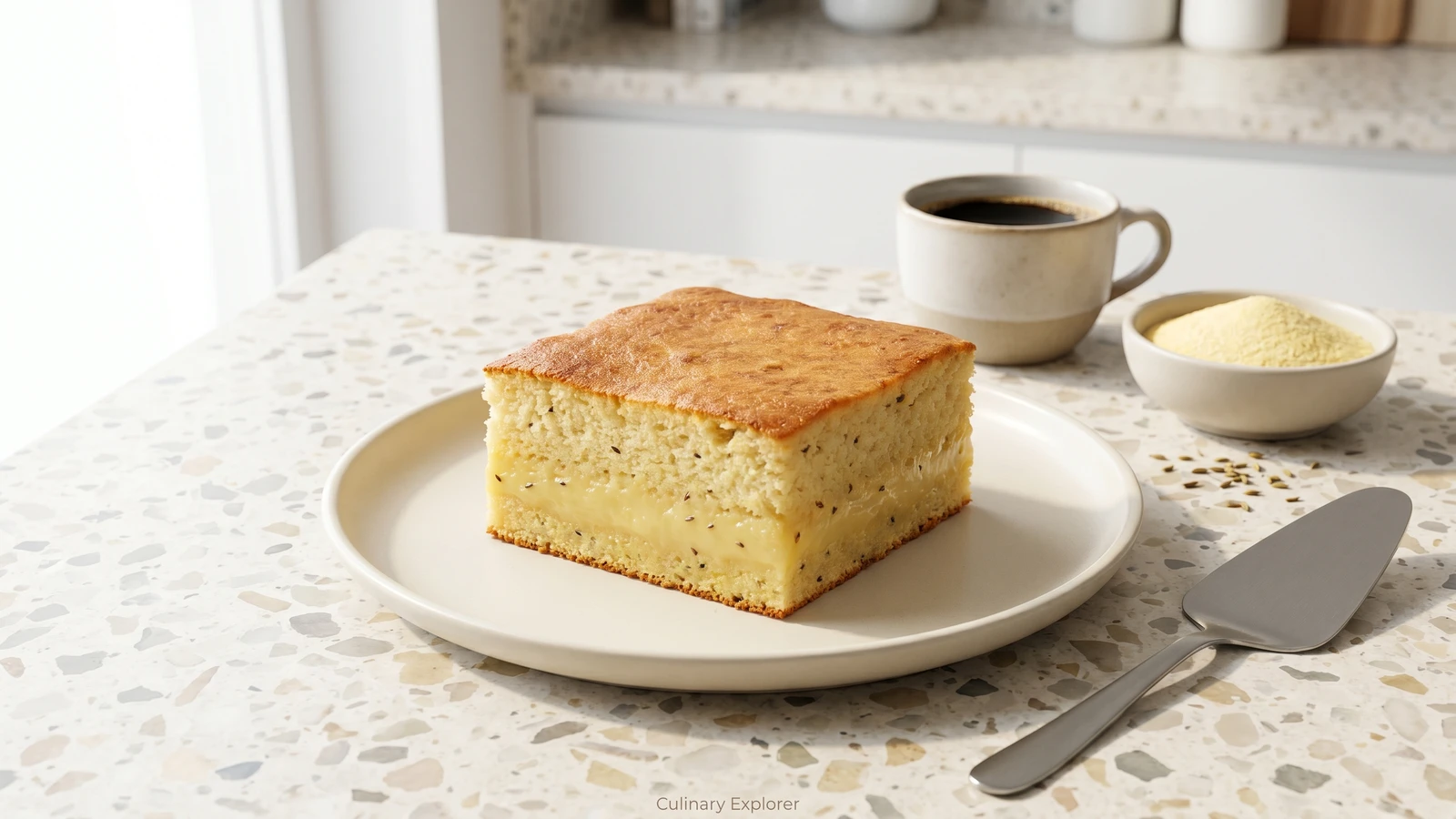
You think a creamy cake needs a mixer and courage. It doesn't. A thin blender batter, real erva-doce, and patience in the oven give you cake on top, cream underneath.
You know that quiet 'isso não é pra mim' voice, the one that sees a cake with a creamy middle and invents a whole failure before the oven is even on. I know her. I was a grown woman writing every little step in a cheap caderno because I didn't trust myself not to forget. So anota aí: this isn't a gift, it isn't bakery magic, and it isn't for people born with a wooden spoon in the hand. Cozinhar não é dom, é um aprendizado.
On the everyday Brazilian table, the pê-efe does the steady work: rice, beans, a piece of meat or egg, something green. Then coffee appears, someone cuts cake, and the table keeps being itself a little longer. That's why I don't treat bolo de fubá as decorative nostalgia. It's cornmeal, milk, eggs, butter, a little cheese, and erva-doce, comida de verdade after comida de verdade.
The method is kinder than it looks. Blend the base until smooth, stir the baking powder and seeds by hand, pour what looks like too much liquid into the pan, and leave it alone. The thin batter is the whole point: as it bakes, the heavier creamy part settles, the top sets into cake, and the erva-doce perfumes the kitchen like festa junina without asking for a costume.
When it comes out, don't cut it hot to prove a point. Let it cool so the creamy layer can set. Recipes que funcionam don't ask you to believe; they give you checkpoints. Here they are.
Fubá, fine cornmeal, has been baked into Brazilian home cakes since colonial kitchens adapted European cake formulas to corn already central to Indigenous agriculture. The creamy version is a later home-kitchen variation, spread through handwritten notebooks, newspaper columns, and blender recipes in the twentieth century, with grated cheese helping the thin batter settle into a custardy layer. Erva-doce became especially tied to bolo de fubá in festa junina season, when corn foods mark the June harvest cycle from the Southeast to much of the country.
Quantity
as needed
for greasing the pan
Quantity
1 tablespoon
for dusting the pan
Quantity
4 cups
Quantity
3 large
Quantity
1 1/2 cups
Quantity
3 tablespoons
melted and cooled
Quantity
1 cup
Quantity
1/2 cup
Quantity
1/2 cup
finely grated from a piece
Quantity
1/2 teaspoon
Quantity
1 tablespoon
Quantity
1 teaspoon
lightly crushed
| Ingredient | Quantity |
|---|---|
| butterfor greasing the pan | as needed |
| fine yellow cornmeal (fubá mimoso)for dusting the pan | 1 tablespoon |
| whole milk | 4 cups |
| eggs | 3 large |
| sugar | 1 1/2 cups |
| unsalted buttermelted and cooled | 3 tablespoons |
| fine yellow cornmeal (fubá mimoso) | 1 cup |
| all-purpose flour | 1/2 cup |
| queijo meia-cura or Parmesanfinely grated from a piece | 1/2 cup |
| fine salt | 1/2 teaspoon |
| baking powder | 1 tablespoon |
| erva-doce (fennel seeds)lightly crushed | 1 teaspoon |
Heat the oven to 180°C (350°F). Butter a 33 x 23 cm (9 x 13 inch) baking pan and dust it with 1 tablespoon fubá, tapping out the extra. Do this before the batter because the batter is thin and the baking powder starts working once wet; a waiting pan means you pour and bake without letting the lift spend itself on the counter.
Rub the erva-doce between your palms or press it once or twice with the back of a spoon, just until you smell that sweet anise perfume. Don't grind it to dust. Light crushing wakes the oils; pulverizing it makes bitter little specks and steals the gentle smell a gente wants in the cake.
Put the milk, eggs, sugar, melted butter, grated cheese, salt, 1 cup fubá, and flour in the blender. Blend until smooth, about 45 seconds, then stop. The batter should pour like thin cream. Don't add more flour to make it look like ordinary cake batter; that loose texture is what lets the cake split into a tender top and creamy bottom.
Pour the blended batter into a large bowl. Add the baking powder and crushed erva-doce, then whisk gently for 8 to 10 strokes, just until the baking powder disappears and the seeds float through the batter. Once baking powder is wet it starts doing its job, so don't beat and beat. Too much mixing knocks out the lift and makes the top tight.
Pour the batter into the prepared pan and slide it onto the center rack. Bake for 50 to 60 minutes, until the top is deep golden, the edges pull slightly from the pan, and the center jiggles softly like firm custard instead of sloshing like liquid. Don't use the dry-toothpick test here; this cake is supposed to have a creamy layer, and a clean toothpick would mean you baked the poor thing past joy.
Let the cake cool in the pan for at least 2 hours before cutting. It will puff in the oven and settle as it cools. That's not failure, that's the creamy layer finding its place. Cut into squares when the pan is cool to the touch; the knife should come out with creamy streaks, not raw batter. Serve at room temperature or chilled, preferably with coffee.
1 serving (about 125g)
Culinary guides, cultural storytelling, and the editorial depth that makes cooking meaningful.
Discover Culinary ExplorerChef Juliana
You think curdled milk means you ruined dessert. Good. Tonight you'll do it on purpose, with lemon, yolks, cravo, and sugar, until the pot turns into golden gruminhos.

Chef Juliana
You are not ruining the milk. You're curdling it on purpose, slowly, until sugar, eggs, cinnamon, and patience turn cheap ingredients into dessert.

Chef Juliana
You think curdled milk means failure. Not here. Milk, yolks, sugar, and lemon cook into golden curds in amber whey, a Minas sweet where the ponto teaches the whole recipe.

Chef Juliana
You already trust rice for dinner. Trust it for dessert: cook it gently with milk, coconut, and canela until each grain turns soft, creamy, and impossible to blame on lack of talent.