
Chef Jeong-sun
Dongdongju (동동주, Floating-Rice Wine)
A cloudy Korean rice wine brewed with sweet rice, nuruk, and water, strained just enough to drink while pale grains bob on top, the celebration cup that asks for patience more than equipment.
A cooking platform built around craft, culture, and the stories behind what we eat.
Created by
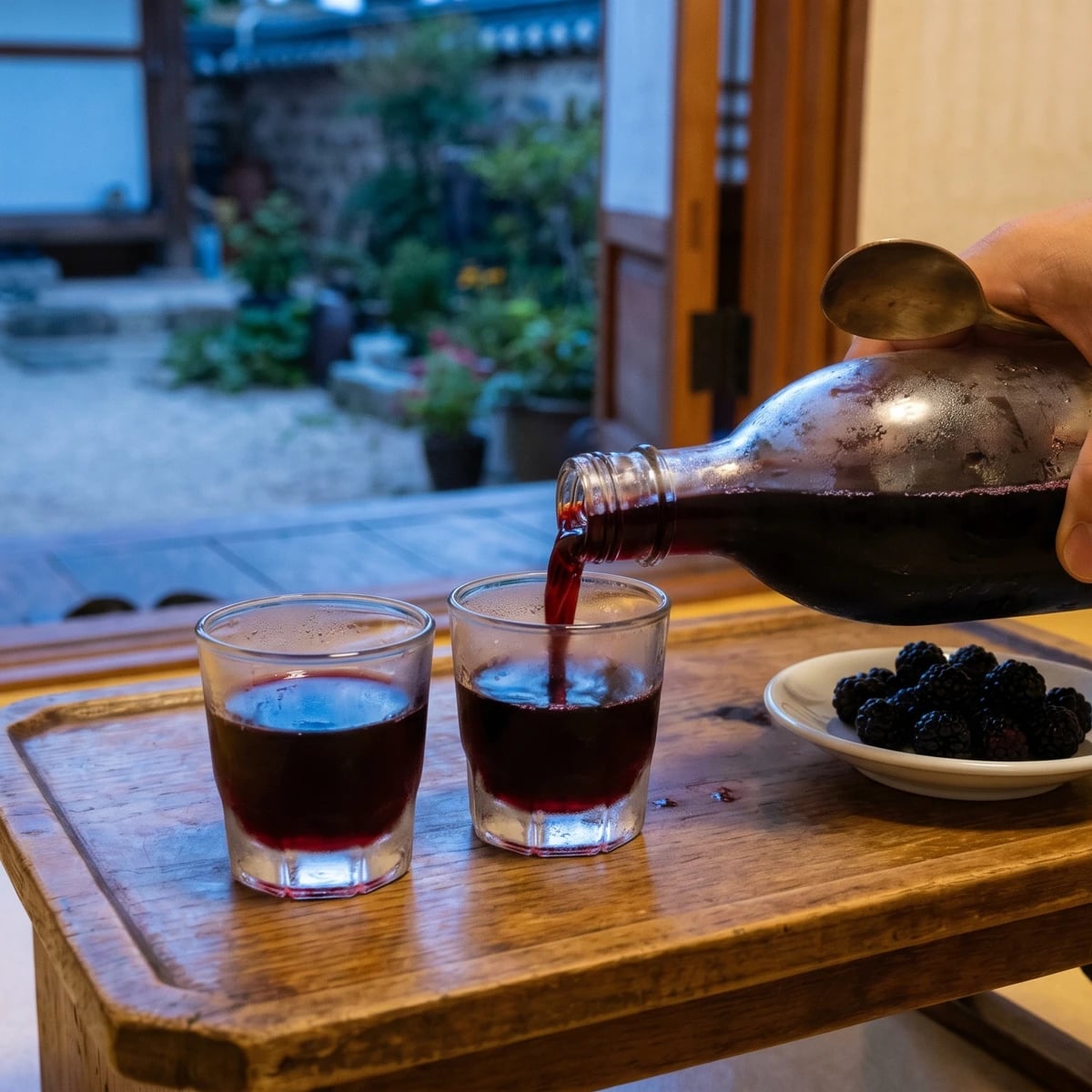
Summer bokbunja steeped with sugar and strong damgeum soju until the berries give up their deep tart color, a make-ahead Korean fruit wine for small cold cups and a slow table.
Bokbunja comes to the market for a short summer, usually late June into July, and then it vanishes unless someone froze it properly. The berries from Gochang are small, dark, and tart, not the soft perfume people expect from dessert raspberries. Cook the month you're standing in: make this with fresh berries when they stain your fingers, and use unsweetened frozen bokbunja the rest of the year rather than pretending pale supermarket fruit can do the same work.
Bokbunja-ju is often called black raspberry wine in English, but the home jar I trust is an infusion, not a closed-jar wild ferment. Fruit, sugar, and strong damgeum soju (infusion soju) are enough. The technique lives or dies by three plain things: a clean dry jar, a spirit strong enough to protect the fruit, and patience after straining. Weak table soju makes a sweet drink quickly and a risky one slowly. Use the strong one.
Notebook 38 says 1 kilogram fruit, 450 grams sugar, 1.8 liters of 30 percent soju. That ratio keeps the berry tart and deep, with sweetness underneath instead of pasted on top. Tonight you'll sort, dry, layer, pour, and put the jar away. After that, the work is waiting and turning the jar once in a while, which sounds easy until you have to leave it alone.
Bokbunja is the fruit of Rubus coreanus, and Korean materia medica such as Heo Jun's Dongui Bogam (1613) treated the dried berry as medicine before it became a popular country wine. Modern bokbunja-ju is tied especially to Gochang County in Jeonbuk, the old North Jeolla region, where organized cultivation and local wineries made the black raspberry a regional marker in the late twentieth century. The name carries an old folk joke about vigor, from bok (to overturn) and bunja (chamber pot), a story that tells how medicinal reputation and table pleasure became tangled together.
Quantity
1 kg
ripe and unsweetened, or use unsweetened frozen bokbunja
Quantity
450 g
Quantity
1.8 liters
30 percent ABV preferred
Quantity
up to 6 tablespoons
| Ingredient | Quantity |
|---|---|
| fresh bokbunja (Korean black raspberries)ripe and unsweetened, or use unsweetened frozen bokbunja | 1 kg |
| white sugar | 450 g |
| damgeum soju (Korean infusion soju)30 percent ABV preferred | 1.8 liters |
| cooled 1:1 simple syrup (optional) | up to 6 tablespoons |
Wash a 3-liter glass jar, lid, funnel, and spoon in hot soapy water. Rinse well, then sanitize with boiling water or a dishwasher hot cycle and let everything air-dry completely. A dry jar matters because extra water lowers the alcohol strength, and wet corners invite mold.
Pick through the bokbunja and discard any berry with mold, a sour fermented smell, or leaking flesh. If the fresh berries are dusty, rinse them quickly in cold water, drain, and spread them on towels until the surface is dry, about 1 hour. Do not soak them. Frozen unsweetened bokbunja can go into the jar frozen and unrinsed.
Put one third of the berries in the jar, scatter over one third of the sugar, and repeat until both are used. Press lightly with a sanitized spoon just to crack some berries, not to mash the seeds. Let the jar stand 1 hour, until the sugar begins drawing out dark juice. This starts extraction without turning the finished drink cloudy and bitter.
Pour in the 30 percent damgeum soju until the fruit is covered. If the berries are not submerged by at least 2 cm, add more soju, not water. Seal the jar and write down the date. Weak table soju is for drinking with supper; it is not for holding fruit at room temperature for months.
Keep the jar in a cool, dark place, ideally 15 to 20 C. Turn the jar gently once a day for the first 7 days, until the sugar dissolves and the floating fruit stays wet. If fruit dries above the liquid, push it down with a sanitized spoon or add a little more soju. If you see fuzzy mold or smell rot, discard the batch.
After 90 days, strain the liquid through a fine sieve lined with clean cotton or several layers of cheesecloth. Let it drip, then press the fruit lightly. Do not wring it hard, or the seeds give bitterness and the wine turns muddy. The liquid should be deep garnet, with the berries faded and spent.
Bottle the strained bokbunja-ju in clean glass bottles and rest it in a cool, dark place for 30 days. Taste it cold. If it is too sharp, add simple syrup 1 tablespoon per 750 ml bottle, wait a day, then taste again. Stop at 3 tablespoons per 750 ml. The berry should speak first, and sugar should answer from behind.
Chill the bottle well and pour 50 to 60 ml into small cups. For a lighter glass, mix 1 part bokbunja-ju with 2 parts cold sparkling water. Serve it after dinner or beside grilled meat, and keep the bottle cold once opened.
1 serving (about 85g)
Culinary guides, cultural storytelling, and the editorial depth that makes cooking meaningful.
Discover Culinary Explorer
Chef Jeong-sun
A cloudy Korean rice wine brewed with sweet rice, nuruk, and water, strained just enough to drink while pale grains bob on top, the celebration cup that asks for patience more than equipment.

Chef Jeong-sun
A measured home version of Myeoncheon's spring rice wine, made from steamed glutinous rice, nuruk, and edible azalea petals cleaned one by one, then strained clear for a table that waited.

Chef Jeong-sun
A late-autumn Korean rice wine made from hard-steamed glutinous rice, nuruk, chrysanthemum, goji, and rehmannia, fermented slowly until the cup turns pale gold and gently medicinal.

Chef Jeong-sun
A pear-blossom-season rice wine so thick it takes a spoon, fermented from steamed rice flour and rice nuruk until it turns sweet, faintly tart, and soft enough to thin with cold water.