
Chef Klaus
Bayerische Rinderrouladen mit Biersoße
Bavarian beef rolls with mustard, bacon, onion, and pickle, braised low in dark beer until the meat yields and the sauce tastes made, not bought.
A cooking platform built around craft, culture, and the stories behind what we eat.
Created by
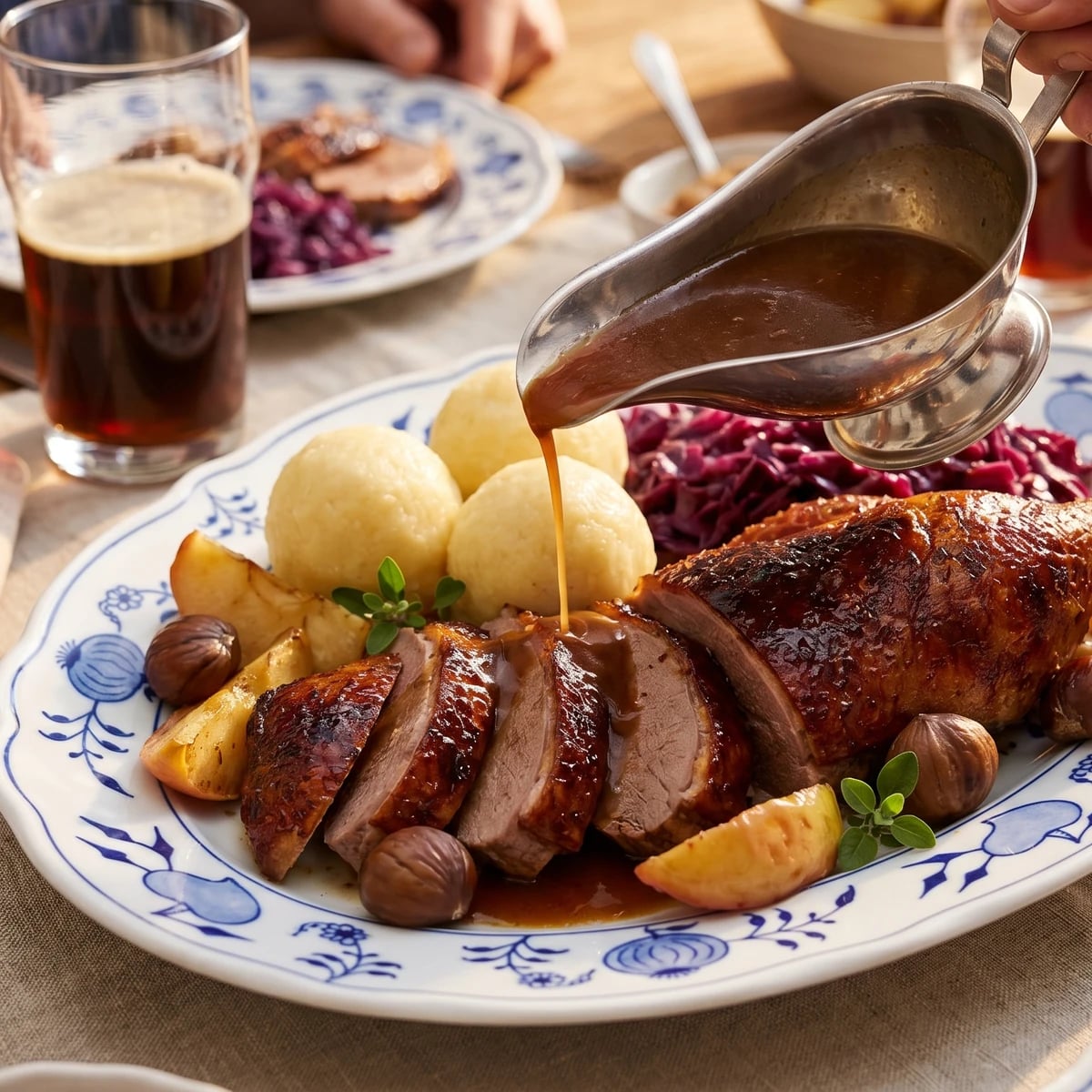
The Bavarian St. Martin goose is won in the first slow hour: render the fat gently, spoon it off, then let the skin go crisp and mahogany at the end.
Bayerische Martinsgans belongs to 11 November, St. Martin's Day, when the year turns properly cold and the fattened goose has done its work in the yard. In Bavaria I want apple, onion, chestnut, and Beifuß, mugwort, inside the bird, with Kartoffelknödel, potato dumplings, and Blaukraut, red cabbage, beside it. Im Norden anders, im Süden anders: further north you'll find prunes, plainer stuffing, or kale at the table, and in Austria the plate walks close beside the Bavarian one. German food has no single national goose. Das ist kein Bierzelt.
The goose is a fat bird, and that is a gift if you don't panic. Start it low, breast down at first, because the slow climb melts the thick fat under the skin before the meat tightens and dries. Blast it from the beginning and the skin shrinks over trapped fat, the breast goes woolly, and you spend supper apologising. Runter mit der Temperatur. Let the fat run, spoon it off, keep it, then finish hotter so the skin lacquers and crackles under the knife.
The gravy is made from the pan, neck, wing tips, vegetables, and browned drippings. Nicht aus dem Glas. The spooned-off goose fat goes into a jar for potatoes another day, and the carcass becomes stock after supper. Weggeworfen wird nichts. This is feast food, yes, but the method is plain: dry the skin, render the fat, rest the bird, taste the gravy. Erst verstehen, dann kochen.
Martinsgans is tied to St. Martin of Tours, whose feast day falls on 11 November, the old marker for the end of the agricultural year and the beginning of the slaughter season before the Advent fast. In many German-speaking regions, rents and dues were historically paid around Martinmas, often in geese, which helped put the bird on the feast table. Bavaria and Austria kept the custom especially strongly, while northern and eastern versions changed the accompaniments according to the local winter larder.
Quantity
1, about 4.5kg to 5kg
neck, wing tips, and giblets reserved
Quantity
2 tablespoons
Quantity
1 teaspoon
freshly ground
Quantity
2 teaspoons
Quantity
4
cored and cut into wedges
Quantity
2
quartered
Quantity
200g
Quantity
1
quartered
Quantity
500ml
Quantity
1
chopped
Quantity
1 small wedge or 2 stalks
chopped
Quantity
1
chopped and well rinsed
Quantity
1 tablespoon
Quantity
150ml
Quantity
1 teaspoon
Quantity
to taste
| Ingredient | Quantity |
|---|---|
| whole gooseneck, wing tips, and giblets reserved | 1, about 4.5kg to 5kg |
| fine salt | 2 tablespoons |
| black pepperfreshly ground | 1 teaspoon |
| dried Beifuß (mugwort) or marjoram | 2 teaspoons |
| tart applescored and cut into wedges | 4 |
| onionsquartered | 2 |
| cooked peeled chestnuts | 200g |
| small orange (optional)quartered | 1 |
| water or light poultry stock | 500ml |
| carrotchopped | 1 |
| celery root wedge or celery stalkschopped | 1 small wedge or 2 stalks |
| leekchopped and well rinsed | 1 |
| tomato paste | 1 tablespoon |
| dry white wine or dark beer | 150ml |
| redcurrant jelly or apple jelly (optional) | 1 teaspoon |
| salt and black pepper | to taste |
Pat the goose dry inside and out, then pull out loose lumps of fat from the cavity and keep them for rendering. Salt the skin and cavity, set the bird uncovered in the refrigerator overnight if you have the time, or at least one hour at cool room temperature before roasting. Dry skin browns; wet skin stews itself before it ever has a chance to crisp.
Mix the apple wedges, onions, chestnuts, Beifuß, pepper, and orange if using, then fill the cavity loosely. Loose filling lets heat move through the bird; packed stuffing slows the roast and keeps the centre cold too long. Tie the legs together and tuck the wing tips under, or cut the wing tips off and put them in the roasting pan for the gravy.
Heat the oven to 150C. Set the goose breast side down on a rack in a deep roasting pan with 500ml water or light stock underneath, then roast for 1 hour. Breast down protects the leanest meat while the first fat renders from the back and thighs; the water keeps the early drippings from burning before there is enough fat in the pan.
Turn the goose breast side up, carefully, and spoon off the clear fat from the pan into a heatproof bowl. Roast another 1 hour 30 minutes to 2 hours at 160C, spooning off fat every 30 minutes. This is the discipline of the dish: fat left in the pan fries the drippings black, but fat saved in a jar gives you the best roast potatoes of the month.
While the goose roasts, brown the neck, wing tips, carrot, celery, and leek in a saucepan with 1 tablespoon of the reserved goose fat until the vegetables take colour. Stir in the tomato paste and cook it dark for a minute, because raw tomato paste tastes flat in gravy. Pour in the wine or beer, scrape the pot clean, add 500ml water or stock, and simmer gently until the goose rests.
When the thickest part of the thigh reads 80C and the juices run clear, raise the oven to 220C for 15 to 20 minutes, watching closely. The fat has already rendered, so now the high heat can crisp the skin instead of trapping a greasy layer underneath. If the breast browns too fast, shield it loosely with foil and let the legs finish.
Move the goose to a board and rest it 20 to 30 minutes before carving. Resting isn't politeness; it lets the juices settle back into the meat instead of running across the board. Pour the roasting pan juices into a jug, spoon off the fat, then add the dark juices to the saucepan gravy.
Strain the gravy, press the vegetables hard, and simmer until it coats a spoon lightly. Taste with salt, pepper, and a small spoon of redcurrant or apple jelly if the sauce needs a quiet fruit note against the fat. Carve the goose, spoon a little gravy beside it, and serve with Kartoffelknödel, potato dumplings, and Blaukraut, red cabbage. Schön ist, was schmeckt.
1 serving (about 340g)
Culinary guides, cultural storytelling, and the editorial depth that makes cooking meaningful.
Discover Culinary Explorer
Chef Klaus
Bavarian beef rolls with mustard, bacon, onion, and pickle, braised low in dark beer until the meat yields and the sauce tastes made, not bought.

Chef Klaus
A Bavarian Advent and Wirtshaus roast lives by dry skin, low heat, and patience: render the duck fat slowly, then finish hot for skin that cracks under the knife.

Chef Klaus
A Bavarian Sunday pork roast lives or dies by its Schwarte, the crackling skin: slow heat renders the fat, then cold salt water tightens the hot rind into crisp bubbles.

Chef Klaus
A Bavarian Sunday roast lives or dies by the Schwarte, the rind: soften it first in stock, then turn it up and crisp it hard at the end.