
Chef Lupita
Agua de Betabel Aguascalentense de Cuaresma
Aguascalientes' Lenten agua fresca, jewel-red from cooked beet and full of apple, banana, orange, lettuce, and ground peanuts, served cold when Holy Week meets the Feria de San Marcos.
A cooking platform built around craft, culture, and the stories behind what we eat.
Created by
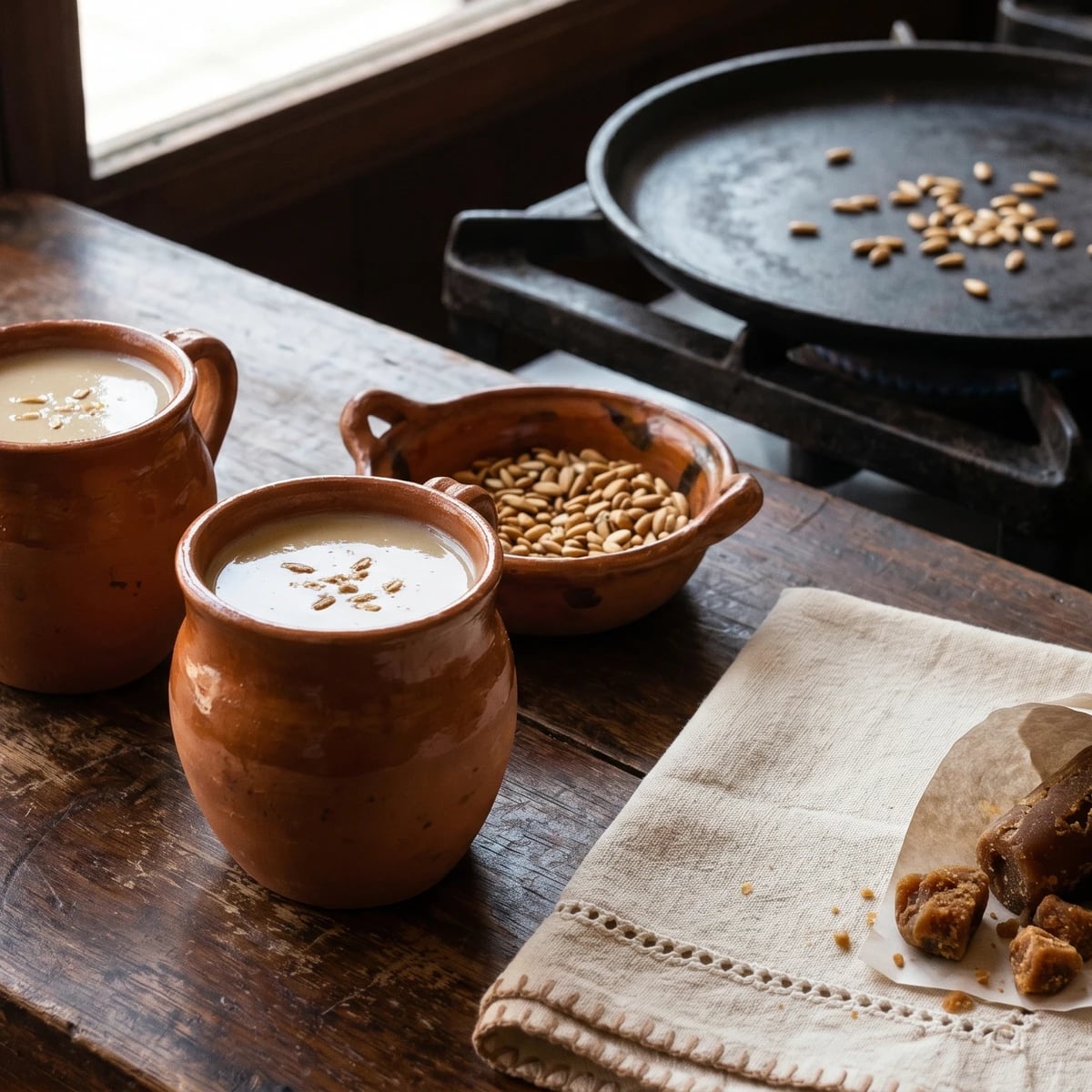
San Luis Potosí's market atole built from toasted semilla de teja, nixtamal masa, piloncillo, and cinnamon, the creamy hot drink sold by the ladle in the Mercado República.
San Luis Potosí, especially the capital and its old market corridors, owns this atole de teja. In the Mercado República, where the morning starts with tamales, gorditas, and clay cups warming between people's hands, the seed gives the drink its identity. Not chocolate. Not rice. Semilla de teja, the local name for sunflower seed, toasted until it smells nutty and then ground into a thick, pale paste.
The technique belongs to women who understand economy. A handful of seed, a little masa from nixtamal, piloncillo, canela, water, and milk if the house has it. That becomes breakfast, supper, comfort, and strength. Mexican cooking has always known how to turn seeds into food with body. Ask the women at the market. They know which seeds are fresh because they smell them before they buy.
Do not burn the seed. That is the first rule. Toast it gently on the comal until it turns golden in spots and releases its oil. Then grind it smooth enough that the atole drinks like cream, not like sand. A blender is fine here. No me vengas con atajos that skip the toasting. The toasting is the flavor.
This is a 32-state cuisine. San Luis Potosí is not borrowing someone else's atole. This is potosino, market-born, practical, and serious in the way humble food is serious when it has fed people for generations. Saber cocinar es saber vivir.
Seed-thickened drinks in central and northern Mexico descend from pre-Columbian preparations that combined ground maize, native seeds, water, and sweeteners before dairy entered the kitchen after the Spanish conquest. In San Luis Potosí, atole de teja became associated with the capital's market culture, especially the Mercado República, where vendors still sell thick hot atoles alongside tamales and gorditas. The use of sunflower seed, called semilla de teja locally, reflects the region's dry-land cooking: seeds store well, give body, and add protein when meat is not part of the morning meal.
Quantity
1 cup
picked over for shells or dark pieces
Quantity
1/2 cup
or 1/3 cup masa harina mixed with 1/3 cup warm water
Quantity
3 cups
divided
Quantity
3 cups
Quantity
1 cone, about 4 ounces
chopped
Quantity
1
Quantity
1/4 teaspoon
Quantity
1 teaspoon
| Ingredient | Quantity |
|---|---|
| raw hulled sunflower seeds (semilla de teja)picked over for shells or dark pieces | 1 cup |
| fresh nixtamal masaor 1/3 cup masa harina mixed with 1/3 cup warm water | 1/2 cup |
| waterdivided | 3 cups |
| whole milk | 3 cups |
| piloncillochopped | 1 cone, about 4 ounces |
| Mexican cinnamon stick | 1 |
| fine sea salt | 1/4 teaspoon |
| Mexican vanilla extract (optional) | 1 teaspoon |
Heat a dry comal or heavy skillet over medium-low heat. Add the sunflower seeds in one even layer and toast, stirring often, for 5 to 7 minutes. They should turn golden in spots and smell like warm nuts, not bitter oil. If they brown too fast, lower the heat. Burned seed will make the whole pot harsh.
In a heavy saucepan, combine 2 cups water, the chopped piloncillo, cinnamon stick, and salt. Bring to a gentle simmer and stir until the piloncillo dissolves, about 5 minutes. The liquid should taste sweet but not flat. The salt is small, but it wakes up the seed.
Put the toasted seeds in a blender with the fresh masa and the remaining 1 cup water. Blend for 2 full minutes, longer than you think. Stop and scrape the sides if needed. You want a pale, thick, smooth paste. If you leave it gritty, the atole will tell on you in the cup.
Pour the seed and masa paste through a fine-mesh strainer into the saucepan with the piloncillo water, pressing with a spoon to extract as much liquid as possible. This is not fussy work. It is practical work. The strainer keeps the drink creamy instead of sandy.
Set the saucepan over medium-low heat and whisk constantly for 8 to 10 minutes. The masa will thicken the drink gradually. Do not walk away. Atole catches on the bottom when the cook gets careless. It is ready when it coats the back of a spoon and moves like light cream.
Lower the heat and stir in the whole milk. Cook 5 to 7 minutes more, whisking often, until the atole is smooth, creamy, and hot all the way through. Do not boil it hard after adding the milk. A rough boil dulls the clean seed flavor and can make the texture grainy.
Remove the cinnamon stick. Stir in the vanilla if using, then taste for sweetness. Ladle into clay jarritos or thick ceramic mugs. Serve immediately, or keep warm over the lowest heat with a splash of water nearby to loosen it if it thickens. Atole should be drinkable, not pudding.
1 serving (about 240g)
Culinary guides, cultural storytelling, and the editorial depth that makes cooking meaningful.
Discover Culinary Explorer
Chef Lupita
Aguascalientes' Lenten agua fresca, jewel-red from cooked beet and full of apple, banana, orange, lettuce, and ground peanuts, served cold when Holy Week meets the Feria de San Marcos.

Chef Lupita
Querétaro's Sierra Gorda refresher made from July garambullo berries, cold water, and just enough sugar, a deep purple drink that tastes of cactus fruit, limestone soil, and market patience.

Chef Lupita
San Luis Potosí's Altiplano drink for May, pale palmito de yuca blended with cold water and cane sugar, served icy in clay jarritos when the semidesert heat stops pretending.

Chef Lupita
Guanajuato's late-summer agua fresca, made when the Bajío nopaleras are heavy with tuna roja, balanced with lime and piloncillo, and strained with restraint.