Culinary Explorer

A cooking platform built around craft, culture, and the stories behind what we eat.
Discover Culinary Explorer
Anpan (あんぱん)

Anpan (あんぱん)

Created by

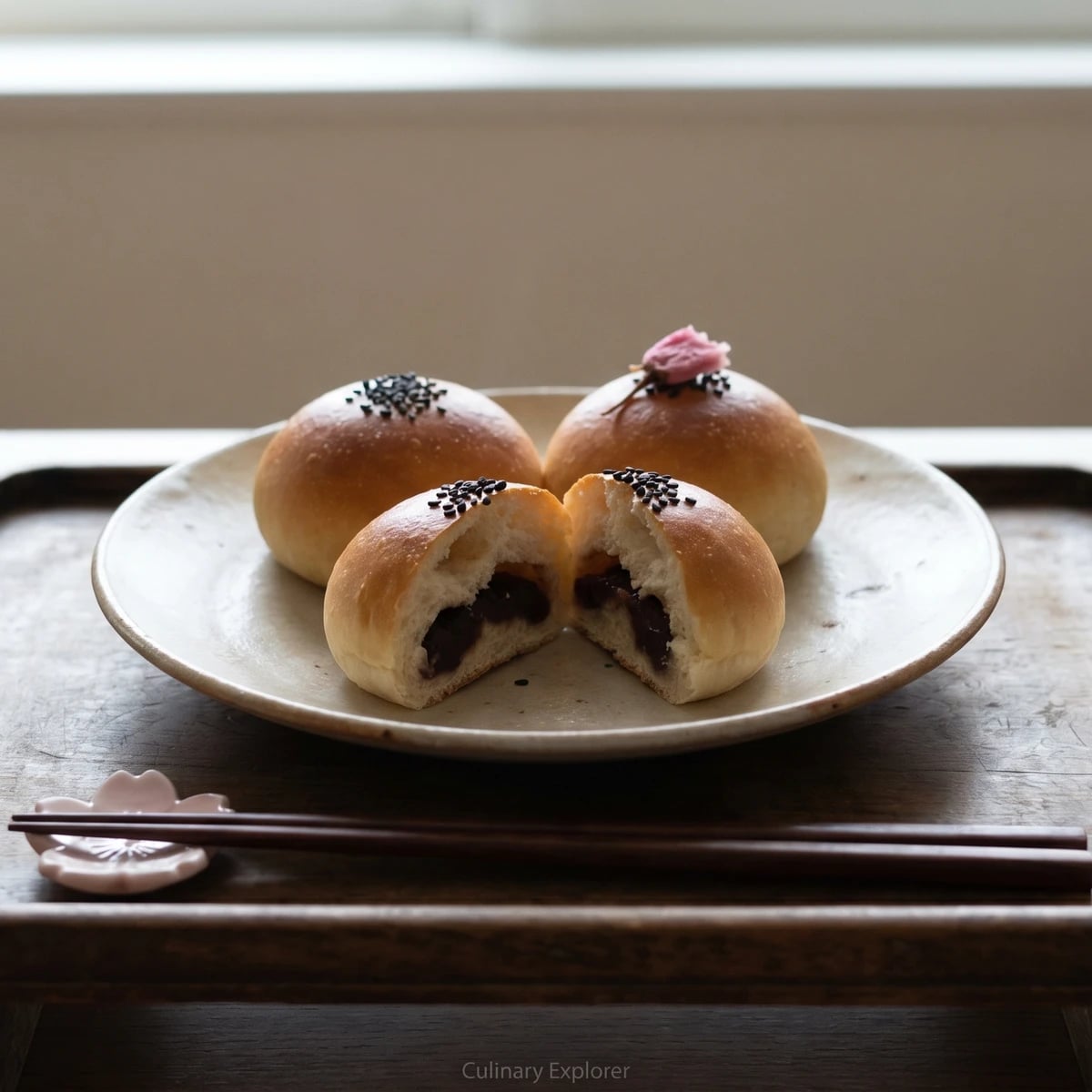
Anpan is not a pastry trick. It is soft bread, sweet azuki, and a careful seal, so the bean paste stays centered while the bun rises round and tender.

Breads
Japanese
Comfort Food
Picnic
Make Ahead
45 min
Active Time
15 min cook3 hr 15 min total
Yield8 buns

Anpan looks like a bakery secret because the filling disappears inside the dough. Don't be fooled. The whole bun turns on two plain things: a soft, patient dough and anko, sweet azuki paste, that is firm enough to wrap without leaking.

The old Ginza version rose on sakadane, a rice and koji ferment often called sake yeast. At home, I give you a small sake-kōji preferment for aroma, then a little baker's yeast for steadiness. That is a sensible stand-in, not a costume. It keeps the bun tender and faintly fragrant without asking you to nurse a ferment for days like a monk with a thermometer.

The one detail to watch is the seal. Flatten the dough thicker in the center and thinner at the edge, set the anko in the middle, then gather and pinch until no seam shows. If the edge is thick, you get a heavy knot underneath. If the seal is weak, the paste escapes in the oven. Keep the filling modest, leave the bun room to rise, and the result is honmono in spirit: bread made to meet tea, not to shout over it.

Anpan was created in 1874 by Kimura Yasubei of Ginza Kimuraya in Tokyo, using a sakadane starter made from rice, kōji, and water rather than the brewer's yeast used in Western bread. In 1875, Kimuraya presented a sakura-topped version to Emperor Meiji, helping make anpan a symbol of early Meiji Japan's adoption of bread on Japanese terms. It is widely remembered as the first kashi-pan, or sweet Japanese bread.

The technique, the tradition, and the story behind every dish.

Discover Culinary Explorer

Ingredients

cooked Japanese short-grain rice

Quantity

40g

lukewarm water

Quantity

40g

sake

Quantity

1 tablespoon

rice kōji or shio kōji

Quantity

1 teaspoon

bread flour

Quantity

250g

sugar

Quantity

25g

fine sea salt

Quantity

4g

instant yeast

Quantity

3g

whole milk

Quantity

90g

lukewarm

large egg

Quantity

1

beaten and divided

unsalted butter

Quantity

30g

softened

tsubuan or koshian (sweet azuki paste)

Quantity

320g

chilled and divided into 8 balls

black sesame seeds (optional)

Quantity

1 teaspoon

salt-pickled sakura blossoms (optional)

Quantity

8

soaked for 10 minutes and dried

Equipment Needed

  • Kitchen scale
  • Mixing bowl
  • Bench scraper
  • Rolling pin
  • Baking sheet lined with parchment
  • Pastry brush

Instructions

  1. 1

    Make the preferment

    Mash the cooked rice, lukewarm water, sake, and kōji together until milky and loose. Cover and let it stand 30 minutes. This won't behave like a true sakadane in such a short time, but the rice and kōji bring the soft aroma that belongs to anpan, while the baker's yeast will carry the rise.

  2. 2

    Mix the dough

    In a bowl, combine the bread flour, sugar, salt, and instant yeast. Add the preferment, milk, and about half the beaten egg, saving the rest for glazing. Mix until no dry flour remains. The dough should feel soft and a little tacky, because a tight dough bakes into a dry bun.

  3. 3

    Knead in butter

    Knead for 6 to 8 minutes, then work in the softened butter a little at a time. At first it will slip about and look wrong. Keep folding and pressing until the dough turns smooth and elastic. Butter goes in after the gluten begins to form, because fat coats flour and would slow that structure if added too early.

  4. 4

    First rise

    Shape the dough into a ball, cover, and let it rise until about doubled, 60 to 75 minutes in a warm room. Press it gently with a floured finger. If the dent slowly fills halfway, it's ready. If it springs back hard, give it more time.

  5. 5

    Prepare the anko

    Divide the chilled anko into 8 balls of about 40g each. Cold paste is easier to wrap and holds its shape while the dough gathers around it. If your anko is loose or glossy-wet, chill it uncovered for a short time so it firms rather than smearing.

  6. 6

    Divide and rest

    Turn the dough out and divide it into 8 equal pieces. Shape each into a small ball, cover, and rest 10 minutes. This pause relaxes the dough so it rolls out without fighting you, which matters more than strength here.

  7. 7

    Fill the buns

    Flatten one dough ball into a round about 10cm wide, keeping the center slightly thicker than the edge. Set one anko ball in the middle. Gather the edge up around the paste and pinch firmly until sealed. Turn seam-side down and cup the bun with your hand to round it. Thin edges make a clean underside; a thick edge leaves a lump.

  8. 8

    Proof and top

    Set the buns seam-side down on a lined tray, leaving space between them. Cover and proof 35 to 45 minutes, until puffy and light. Brush gently with the reserved beaten egg. Top each with black sesame, or press one soaked and dried sakura blossom into the center. The topping marks the bun without crowding it.

  9. 9

    Bake and cool

    Bake at 190°C for 13 to 15 minutes, until the tops are evenly golden and the sides feel set. Cool on a rack for at least 15 minutes before eating. Hot anko burns the tongue with unnecessary confidence, and the crumb finishes settling as it cools.

Chef Tips

  • Use anko that tastes cleanly of azuki, not only sugar. Tsubuan keeps some bean texture; koshian is smooth. Both are proper, so choose the one you want to meet under the bread.
  • A true sakadane takes days and care. For a home kitchen, the rice-kōji preferment gives the right direction of flavor while instant yeast gives reliable lift. Don't call it the same thing, and don't be ashamed of it.
  • Keep each filling ball smaller than you think. A bun stuffed past reason may look generous before baking, then split open. Restraint makes the better anpan.

Advance Preparation

  • The anko can be divided into balls a day ahead and kept covered in the refrigerator.
  • The dough can complete its first rise slowly overnight in the refrigerator. Let it sit at room temperature for 30 minutes before dividing.
  • Baked anpan keeps one day at room temperature, wrapped once fully cool. For longer keeping, freeze the buns and warm them gently after thawing.

Frequently Asked Questions

Nutrition Information

1 serving (about 60g)

Calories
305 calories
Total Fat
5 g
Saturated Fat
2 g
Trans Fat
0 g
Unsaturated Fat
3 g
Cholesterol
40 mg
Sodium
260 mg
Total Carbohydrates
51 g
Dietary Fiber
3 g
Sugars
20 g
Protein
8 g

Note: Chef personas and recipes are created with AI assistance. Cook with care: follow safe food-handling practices, check doneness with a thermometer when needed, and adapt for allergies and your kitchen.

Where cooking meets culture.

Culinary guides, cultural storytelling, and the editorial depth that makes cooking meaningful.

Discover Culinary Explorer

More from Kashi-pan: Japanese Filled Sweet Buns

Browse the full collection