Culinary Explorer

A cooking platform built around craft, culture, and the stories behind what we eat.
Discover Culinary Explorer
Zimtsterne

Zimtsterne

Created by

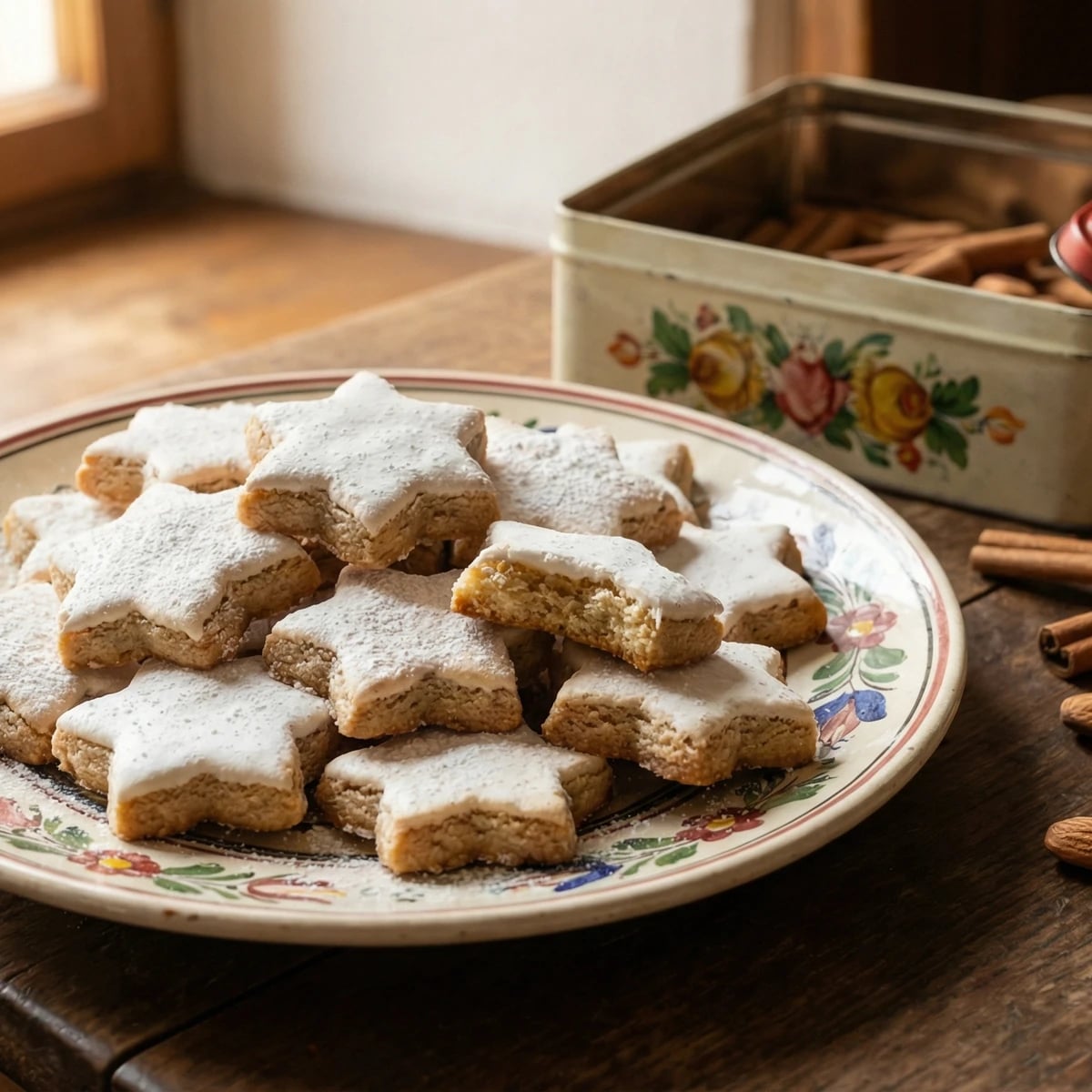
Flourless cinnamon-almond stars with a snow-white meringue cap, baked low and slow until the edges barely blush gold. The cookie tin that makes an Austrian Christmas smell right.

Pastries & Cookies
Austrian
Christmas
Holiday
Make Ahead
45 min
Active Time
12 min cook2 hr total
YieldAbout 40 cookies

Gretel always said that Christmas baking in Austria wasn't one afternoon, it was a season. You started in late November, filled tin after tin, and by Advent the whole house smelled like cinnamon, almonds, and Vanillezucker. Zimtsterne were always first. They needed time to rest in the tin before they reached their best, so you made them early and let them wait.

I remember standing on my stool in my grandmother Eva's kitchen in Kent, pressing a star cutter into the dough while Gretel spread the white icing across the top with a palette knife, steady and quick, the way someone does when they've done it a thousand times. The trick, she told me, was patience with the icing and patience with the oven. Low heat. White tops. Golden edges. If the meringue turned brown you'd pushed too hard.

Zimtsterne are a flour-free cookie, which makes them one of the oldest recipes in the Alpine baking tradition. Ground almonds do all the structural work. The egg white meringue binds the dough and becomes the glossy cap on top. Cinnamon runs through everything. When you bite into one, the outside gives a gentle snap and the inside is soft and dense, almost like marzipan that someone taught to hold its shape. They're not crisp cookies. They're not soft cookies. They're something entirely their own.

The technique asks for a bit of care but no real difficulty. You whip the meringue, set some aside for icing, fold almonds and cinnamon into the rest, chill, roll, ice, cut, dry, bake. Every step has a reason. Once you understand why the dough needs to chill and why the icing needs to dry before the oven, the whole process makes sense and the cookies come out right.

Zimtsterne are documented in German-language cookbooks as far back as the 16th century, making them one of the oldest surviving Christmas cookie recipes in the Alpine tradition. Their origins are tied to the medieval spice trade through Venice and the Habsburg trade routes that brought cinnamon, then an extravagant luxury, to Austrian and South German kitchens. The almond-based, flourless construction suggests a connection to earlier Arabic and Mediterranean confections that entered European baking through these same routes. By the 18th century, Zimtsterne were firmly established as a Christmas staple across Austria, Bavaria, and Switzerland, baked in enormous batches and stored in painted tins through the Advent season.

The technique, the tradition, and the story behind every dish.

Discover Culinary Explorer

Ingredients

egg whites

Quantity

3 large

at room temperature

powdered sugar (Staubzucker)

Quantity

250g

sifted

fresh lemon juice

Quantity

1 tablespoon

ground almonds (unblanched)

Quantity

350g

ground Ceylon cinnamon

Quantity

1 tablespoon

fine salt

Quantity

pinch

unwaxed lemon

Quantity

zest of 1

Kirschwasser (cherry brandy) (optional)

Quantity

1 teaspoon

powdered sugar

Quantity

for rolling

Equipment Needed

  • Stand mixer or hand mixer with whisk attachment
  • Star-shaped cookie cutter (5cm)
  • Rolling pin
  • Small offset spatula or palette knife
  • Baking sheets lined with parchment

Instructions

  1. 1

    Whip the egg whites and sugar

    Beat the egg whites in a spotlessly clean bowl with a pinch of salt until they hold soft peaks. Add the sifted powdered sugar a few tablespoons at a time, beating continuously until the meringue is thick, glossy, and holds stiff peaks when you lift the whisk. This takes a good five minutes with a hand mixer, a bit less with a stand mixer. The meringue should look like wet white satin. Add the lemon juice in the final thirty seconds of beating. It stabilizes the whites and keeps the icing from yellowing.

    Any trace of fat in your bowl will sabotage the egg whites. Wipe the bowl and whisk with a cut lemon half before you start. The acid cuts through any invisible grease.
  2. 2

    Reserve the icing

    Scoop out about a third of the meringue, roughly 4 to 5 heaped tablespoons, and set it aside in a small bowl. Cover it tightly with cling film pressed directly against the surface so it doesn't crust over. This reserved portion is your Glasur, the icing that goes on top of each star. Don't skip this step and don't be stingy with the amount you set aside. Without enough icing, your Zimtsterne lose their whole identity.

  3. 3

    Build the dough

    Into the remaining meringue, fold the ground almonds, cinnamon, lemon zest, and the Kirschwasser if using. Work it together with a spatula or your hands until you have a soft, slightly sticky dough. It should hold together when pressed but feel damp and fragile. Don't knead it the way you'd knead bread dough. There's no gluten here, only almond and egg white holding things together. Treat it gently. Wrap the dough in cling film and refrigerate for at least forty-five minutes.

    The chill is not optional. Warm almond dough sticks to everything and tears when you cut it. Cold dough holds its shape and releases cleanly from the cutter. If your kitchen is warm, chill it a full hour.
  4. 4

    Roll and ice the dough

    Dust your work surface generously with powdered sugar, not flour. Flour would compromise the gluten-free nature of these cookies, and besides, powdered sugar tastes better. Roll the chilled dough out to about seven millimeters thick. It should feel firm under the rolling pin but not crack at the edges. If it cracks, it's too cold. Let it sit for two minutes and try again. Using a small offset spatula or the back of a spoon, spread the reserved meringue icing in a thin, even layer across the entire surface of the rolled dough. You want it white and opaque but not thick. About two millimeters is right.

  5. 5

    Cut the stars

    Dip a star-shaped cookie cutter (about 5cm) in hot water before each cut and shake off the excess. The hot water keeps the sticky meringue from clinging to the metal and dragging when you press down. Cut the stars as close together as you can. Transfer each one carefully to a lined baking sheet using a thin spatula. Gather the scraps, re-roll, chill for ten minutes if the dough has gone soft, ice again, and cut more stars. You'll get two or three rounds from the scraps before the dough gets tired.

    Keep a mug of hot water next to your cutting board and dip the cutter between every single star. It sounds fussy. It isn't. It's the difference between clean white-topped stars and a ragged mess.
  6. 6

    Dry the icing

    Let the cut stars sit uncovered at room temperature for at least thirty minutes before baking. The surface of the meringue icing needs to form a dry skin. Touch it gently with your fingertip. If it feels tacky, give it more time. If it feels papery and set, you're ready. This drying step is what gives Zimtsterne their signature look: a matte white top that stays pristine while the edges of the cookie puff and brown around it.

  7. 7

    Bake the Zimtsterne

    Preheat your oven to 140°C (280°F). This is lower than you'd expect for cookies and that's the point. Zimtsterne need gentle heat. The icing must stay white. If your oven runs hot and the tops start yellowing, you've lost the visual contrast that makes these cookies what they are. Bake for 10 to 12 minutes. The meringue top should remain pale white while the edges of the cookie turn just barely golden. The cookies will feel soft when they come out. Don't panic. They firm up as they cool. If you bake them until they feel firm in the oven, they'll be dry as chalk by the time they reach the tin.

    Every oven is different. Bake a test batch of three or four stars first. If the icing yellows, drop the temperature by ten degrees. If the cookies are still raw-tasting after twelve minutes, raise it by five.
  8. 8

    Cool and store

    Let the cookies cool completely on the baking sheet before moving them. They're fragile while warm. Once cool, the outside should be gently crisp and the inside should be soft, moist, and chewy with almond and cinnamon. Store them in an airtight tin with a sheet of baking parchment between each layer. Zimtsterne actually improve after two or three days in the tin as the flavors deepen and the texture settles. They'll keep for three weeks stored properly, which is good, because you're going to want them around for the whole Advent season.

Chef Tips

  • Buy whole almonds and grind them yourself in a food processor if you can. Pre-ground almonds lose their oils quickly and the flavor goes flat. Pulse in short bursts. If you process too long, you'll end up with almond butter instead of almond meal.
  • Use Ceylon cinnamon, not cassia. They're different spices sold under the same name. Ceylon is lighter, more complex, with floral and citrus notes. Cassia is the harsh, one-dimensional cinnamon you find in most supermarkets. For a cookie where cinnamon is the defining flavor, this difference matters enormously. Look for Ceylon at spice shops or online.
  • If the dough sticks to your rolling pin, dust the pin with powdered sugar and lay a sheet of baking parchment over the dough before rolling. Peel it back and ice the surface once it's flat.
  • Zimtsterne are perfect make-ahead Christmas gifts. Stack them in a pretty tin with parchment between layers. They travel well and they're naturally gluten-free, which means they're the one cookie on the Christmas plate that almost everyone can eat.

Advance Preparation

  • The dough can be made a day ahead, wrapped tightly, and refrigerated. Let it sit at room temperature for ten minutes before rolling so it doesn't crack.
  • Baked Zimtsterne improve with age. Make them at least two to three days before you plan to serve them. Stored in an airtight tin, they keep beautifully for up to three weeks.
  • The meringue icing cannot be made ahead. It must be freshly whipped and used while still glossy, or it dries out and won't spread.

Frequently Asked Questions

Nutrition Information

1 serving (about 18g)

Calories
80 calories
Total Fat
4 g
Saturated Fat
0 g
Trans Fat
0 g
Unsaturated Fat
4 g
Cholesterol
0 mg
Sodium
9 mg
Total Carbohydrates
9 g
Dietary Fiber
1 g
Sugars
8 g
Protein
2 g

Note: Chef personas and recipes are created with AI assistance. Cook with care: follow safe food-handling practices, check doneness with a thermometer when needed, and adapt for allergies and your kitchen.

Where cooking meets culture.

Culinary guides, cultural storytelling, and the editorial depth that makes cooking meaningful.

Discover Culinary Explorer

More from Weihnachtsbäckerei (Austrian Christmas Cookies)

Browse the full collection