Culinary Explorer

A cooking platform built around craft, culture, and the stories behind what we eat.
Discover Culinary Explorer
Pink Noodle Soup (Yen Ta Fo)

Pink Noodle Soup (Yen Ta Fo)

Created by

Fermented red bean curd turns the broth pink and funky. Fish sauce balances the salt. Sugar tames the ferment. The four pillars hold, even when the flavor base is Chinese. That's the system at work.

Soups & Stews
Thai
Weeknight
Comfort Food
30 min
Active Time
20 min cook50 min total
Yield2 servings

Yen ta fo is a lesson in how Thai cooking absorbs and transforms. The flavor base of this dish is tao hu yi daeng (เต้าหู้ยี้แดง), fermented red bean curd, a Chinese ingredient that arrived in Bangkok with Teochew and Hokkien migrants generations ago. In Chinese cooking, it's a condiment. In Thai hands, it became a broth, stained electric pink and governed by the same four pillars that run through every bowl and plate on the street.

Ajarn always said: Thai cuisine doesn't reject outside influence. It absorbs it and makes it follow the rules. Yen ta fo is proof. The tao hu yi daeng provides umami and that signature funk. Fish sauce (nam pla) adds salinity. Sugar rounds the fermented edge. Vinegar or lime brings the sour. Chili is on the table, always. The system holds.

This isn't a kreung tam dish. There's no pounded paste at the foundation. But the principle is the same: you build a concentrated flavor base before anything else touches the broth. The tao hu yi daeng gets fried in garlic oil until it blooms, darkens a shade, and releases its full fermented depth into the fat. That fried paste IS the dish. Without it, you have noodle soup. With it, you have yen ta fo. The base is everything, whether you pound it in a mortar or fry it in a pan.

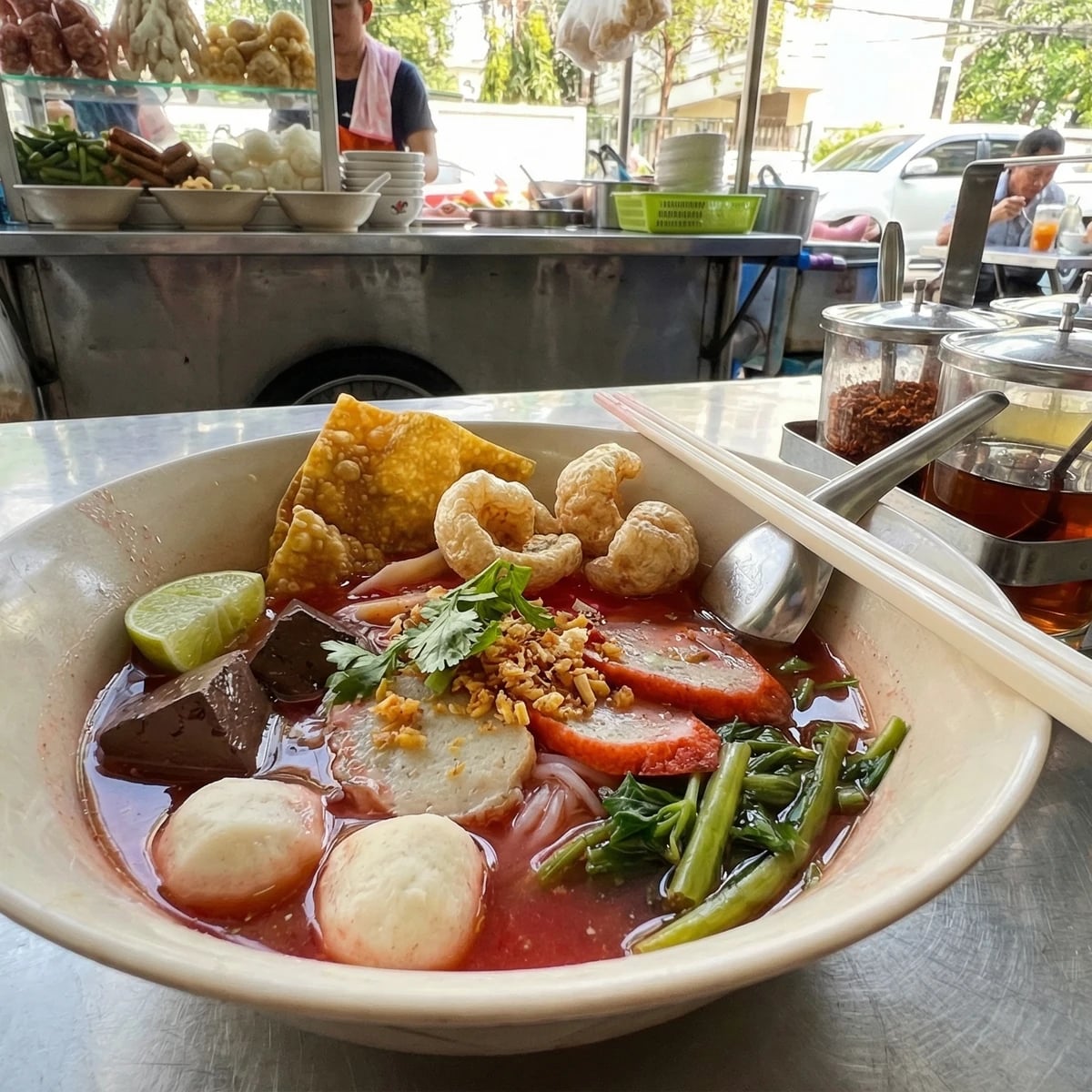
Every yen ta fo vendor I've watched in Bangkok has her own ratio of tao hu yi to stock. Some go heavy, almost opaque pink. Others keep it light, a blush. The toppings vary by stall: fish balls, morning glory, fried wontons, blood tofu, squid, crispy pork rinds. But the sauce is the identity. You can swap every topping. Change the sauce, and it's not yen ta fo anymore. Principles, not recipes.

Yen ta fo (เย็นตาโฟ) traces its name to Hokkien Chinese dialect, likely a phonetic adaptation that stuck as the dish became a Bangkok noodle stall staple in the mid-20th century. The fermented red bean curd (tao hu yi daeng) that defines the dish is a Chinese preservation technique repurposed as a Thai soup base, one of the clearest examples of Sino-Thai culinary adaptation in the street food canon. Unlike most Chinese-origin Thai noodle dishes such as bamee or kuay tiew, yen ta fo has no close equivalent in mainland Chinese cooking, making it a uniquely Thai creation built on an imported ingredient.

The technique, the tradition, and the story behind every dish.

Discover Culinary Explorer

Ingredients

rice noodles, sen yai or sen lek

Quantity

200g

blanched according to package

pork stock or light chicken stock

Quantity

4 cups

fermented red bean curd (tao hu yi daeng)

Quantity

3 tablespoons

fermented bean curd liquid

Quantity

1 tablespoon

from the jar

fish sauce (nam pla)

Quantity

2 tablespoons

granulated sugar

Quantity

1 tablespoon

white vinegar

Quantity

1 tablespoon

garlic

Quantity

3 cloves

minced

vegetable oil

Quantity

2 tablespoons

fish balls (luk chin pla)

Quantity

8

fried fish cake (thot man pla)

Quantity

4 pieces

sliced into strips

morning glory (pak bung)

Quantity

100g

cut into 3-inch pieces

fried wontons (kiao thot)

Quantity

8

blood tofu (lueat mu) (optional)

Quantity

50g

cubed

crispy pork rinds (kaep mu)

Quantity

30g

bean sprouts (thua ngok)

Quantity

50g

fried garlic (kratiem jiew)

Quantity

2 tablespoons

fresh cilantro leaves (pak chi)

Quantity

for garnish

lime

Quantity

1

quartered

dried chili flakes (prik pon)

Quantity

for serving

fish sauce with chilies (nam pla prik)

Quantity

for serving

Equipment Needed

  • Medium saucepan for broth
  • Separate pot for blanching noodles
  • Spider strainer or noodle basket for blanching
  • Deep noodle bowls (melamine or ceramic)

Instructions

  1. 1

    Fry the sauce base

    Heat the vegetable oil in a saucepan over medium heat. Add the minced garlic and fry until it just starts to turn golden, about 30 seconds. Add the fermented red bean curd and its liquid immediately. Mash and stir it into the oil with a spoon. Fry the paste for a full minute, pressing it against the pan. The color will darken a shade from bright red to a deeper crimson. The smell will shift from sharp and raw to roasted and complex. That's the Maillard reaction working on the fermented proteins. This step is the entire dish. Rush it and your broth will taste flat and one-dimensional.

    Buy tao hu yi daeng in jars at any Asian grocery store. The cubes sit in red brine. You want both the cubes and the liquid. The brine carries flavor. Different brands vary in saltiness, so taste your paste before you season the broth. Adjust the fish sauce accordingly.
  2. 2

    Build the broth

    Pour the stock into the saucepan with the fried bean curd paste. Stir to dissolve everything. The broth will turn pink immediately. Bring it to a gentle boil, then reduce to a simmer. Add the fish sauce, sugar, and white vinegar. Stir once. Taste. The balance should be: savory and funky first, salty second, a touch of sweet to soften the fermented edge, sour barely there in the background. If the funk is too aggressive, add a pinch more sugar. If it tastes flat, more fish sauce. The vinegar keeps things bright without competing with the tao hu yi.

    The broth should be a clear, vibrant pink. Not pale, not opaque. If it looks watery, you didn't use enough tao hu yi. If it looks like paint, you went too far. The right color is somewhere between rose milk and a Bangkok sunset.
  3. 3

    Cook the toppings in the broth

    Add the fish balls and blood tofu cubes to the simmering broth. Cook for 3 minutes until the fish balls are heated through and the blood tofu is firm but tender. Add the morning glory stems first (they take longer), then the leaves, and cook for 60 seconds. The morning glory should be bright green and still have bite. Overcooked pak bung turns army green and slimy. Pull it off the heat the moment the leaves wilt.

    Blood tofu (lueat mu) is cubes of solidified pig's blood. It sounds intense, but it's mild, creamy, and rich in iron. It's completely traditional. If it's not for you, skip it. The dish still works. But know that you're leaving out a component that every Bangkok yen ta fo vendor would include.
  4. 4

    Blanch the noodles

    While the toppings cook, blanch your rice noodles in a separate pot of boiling water. Sen yai (wide) takes about 30 seconds if fresh, a minute if dried. Sen lek (thin) cooks even faster. The noodles should be soft but still have some chew. Drain and divide between two bowls immediately. Don't let them sit or they'll clump into a sticky mass.

  5. 5

    Assemble and serve

    Ladle the hot pink broth over the noodles. Arrange the fish balls, blood tofu, morning glory, and sliced fish cake on top. Nestle the fried wontons and crispy pork rinds to one side so they stay crunchy above the broth line. Scatter bean sprouts over the surface. Top with fried garlic and a few cilantro leaves. Serve with lime wedges, dried chili flakes (prik pon), fish sauce with chilies (nam pla prik), sugar, and white vinegar on the side. The condiment caddy is not optional. Every noodle dish in Thailand comes with one. The cook sets the baseline. The eater finishes the seasoning. That's the contract.

    Fried wontons and kaep mu go ON TOP of the broth, not submerged. The textural contrast between crispy and soupy is half the point of this dish. The second they hit the liquid, they're gone. Place them at the last moment.

Chef Tips

  • Yen ta fo is a Chinese-Thai dish, and the Chinese migration heritage is right there in the name and the ingredient list. But what makes it Thai is the seasoning logic. Fish sauce for salt (not soy sauce). Nam pla prik on the table (not chili oil). Fresh lime on the side. A Chinese noodle vendor wouldn't season this way. A Thai one would, and does, every single day.
  • The toppings are customizable, and every vendor has her own lineup. Fish balls and morning glory are non-negotiable. Beyond that, you'll see fried wontons, blood tofu, squid, red fish cake, crispy pork rinds, or cubes of fried tofu. The toppings are variables. The pink broth is the constant. Don't overthink the toppings. Get the sauce right.
  • Fermented red bean curd comes in jars with a red brine. Don't confuse it with white fermented bean curd (tao hu yi khao), which is a completely different product used for different dishes. You want the red one. The label will usually show red cubes in red liquid. The brand doesn't matter much, but taste it before cooking. Some are saltier than others, and you'll need to adjust your fish sauce accordingly.
  • The condiment caddy (krueng prung, เครื่องปรุง) for noodle dishes in Thailand always includes four things: nam pla prik (fish sauce with sliced chilies), prik pon (dried chili flakes), sugar, and white vinegar (sometimes with pickled chilies). This is not a suggestion. It's the system. The cook provides the base seasoning. The eater finishes the dish at the table. That back-and-forth is built into Thai noodle culture.

Advance Preparation

  • The yen ta fo sauce base (fried tao hu yi daeng with garlic) can be made a day ahead and refrigerated. Reheat it with stock when ready to serve.
  • Fried wontons and crispy pork rinds should be prepared fresh or bought day-of. They lose crunch overnight. Store in an airtight container at room temperature if making a few hours ahead.
  • Fish balls, blood tofu, and fried fish cake can be bought pre-made from any Thai or Chinese grocery. They're pantry items, not something you make from scratch for this dish.
  • Morning glory wilts quickly after cutting. Prep it no more than 30 minutes before cooking. Keep in cold water until ready.

Frequently Asked Questions

Nutrition Information

1 serving (about 900g)

Calories
940 calories
Total Fat
35 g
Saturated Fat
7 g
Trans Fat
0 g
Unsaturated Fat
28 g
Cholesterol
70 mg
Sodium
3700 mg
Total Carbohydrates
115 g
Dietary Fiber
2 g
Sugars
7 g
Protein
36 g

Note: Chef personas and recipes are created with AI assistance. Cook with care: follow safe food-handling practices, check doneness with a thermometer when needed, and adapt for allergies and your kitchen.

Where cooking meets culture.

Culinary guides, cultural storytelling, and the editorial depth that makes cooking meaningful.

Discover Culinary Explorer

More from Thai Street Food Masters

Browse the full collection