
Chef Fai
Isan Beef Larb (Larb Nua)
No sugar. That's the rule. Isan larb strips Thai cuisine down to three pillars: nam pla for salt, manao for sour, prik for heat, bound by the smoky crunch of freshly pounded khao khua. The absence defines the dish.
A cooking platform built around craft, culture, and the stories behind what we eat.
Created by
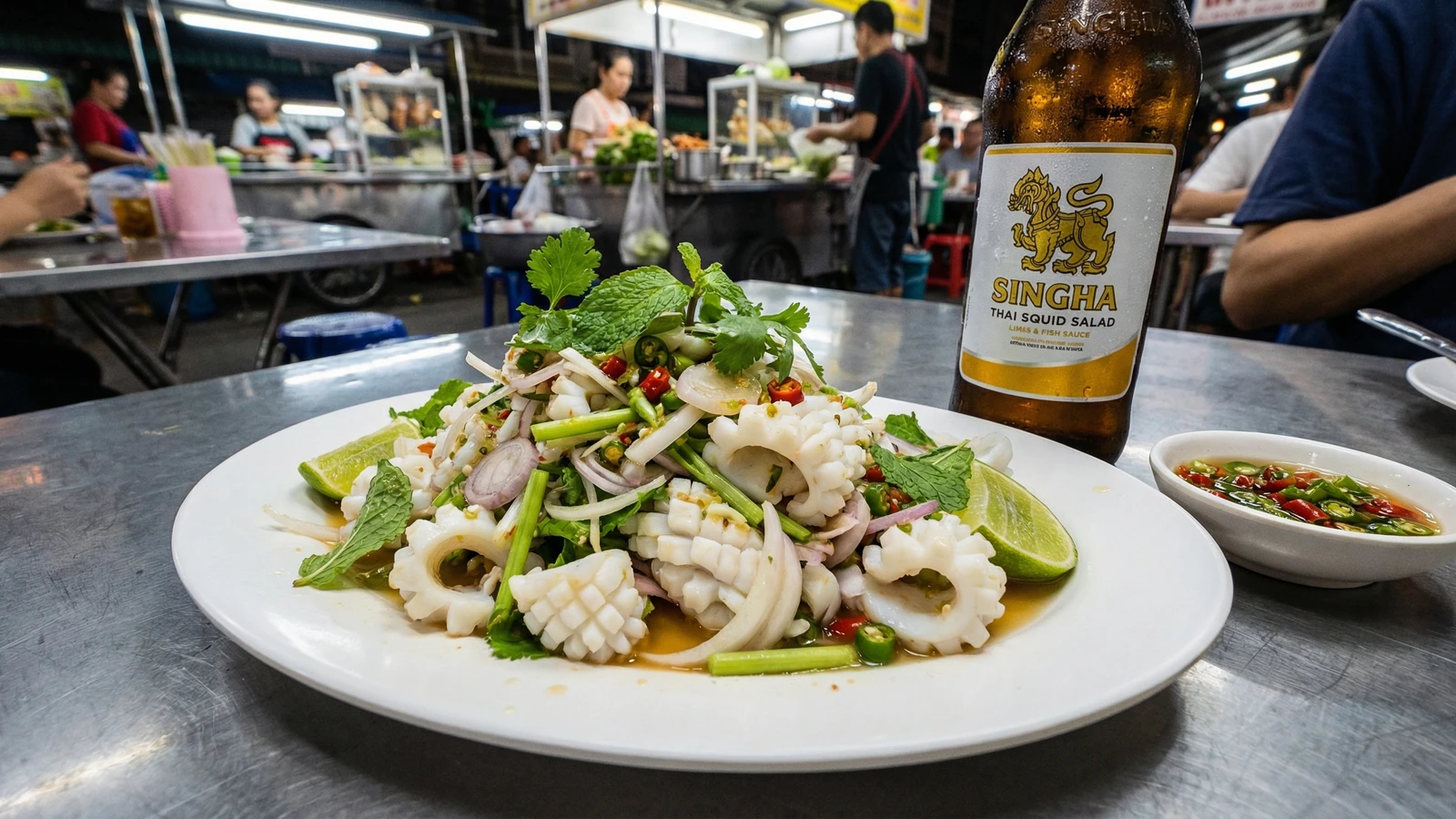
The yam dressing is the four pillars made portable: nam pla for salt, manao for sour, nam tan pip for sweet, prik for fire. Dress the squid while it's still warm. The heat opens the dressing. That's the science.
Yam is the purest expression of the four pillars. No paste. No wok. No coconut cream. Just the dressing: fish sauce, lime juice, palm sugar, chili. That's the entire system in a spoon. Ajarn always said if you can nail a yam dressing, you understand Thai flavor balance better than most trained cooks. He's right.
Here's what governs every yam: sour leads. Lime is the dominant note, aggressive and bright. Fish sauce follows, providing salinity and the fermented depth that makes Thai food taste like Thai food and not Vietnamese or Chinese food with similar ingredients. Palm sugar rounds the edges, just enough to keep the lime from being shrill. Chili brings heat. The ratio shifts by the protein, by the cook, by the day. But sour always leads. That's the law.
Squid is the most forgiving protein you can dress. It blanches in under a minute. It curls beautifully when scored. And here's the principle that separates a great yam from a mediocre one: dress the squid while it's still warm. Warm protein absorbs dressing. Cold protein sits in it. The heat opens the surface, pulls the lime and fish sauce into the flesh. By the time it reaches room temperature, the squid tastes like the dressing instead of being coated by it. This isn't a trick. It's science. Ajarn taught me this the first time I made yam in his kitchen, and I've never dressed cold protein since.
The herbs in a yam are not garnish. Mint, cilantro, Chinese celery, raw shallots: these are structural ingredients, as essential as the dressing itself. They provide bitterness, freshness, and crunch that complete the dish. Pile them on. If the herbs feel like an afterthought, you used too few.
Yam (ยำ) is one of Central Thailand's oldest culinary categories, a family of dressed salads governed by a lime-fish sauce-sugar-chili formula that predates restaurant culture. Yam pla muek became a staple of Bangkok's seafood stalls and open-air restaurants (ร้านอาหารตามสั่ง) in the latter half of the 20th century, as fresh squid became widely available through the expansion of Thailand's Gulf fishing industry. The scoring technique, cutting a crosshatch into the squid body before blanching, is borrowed from Chinese-Thai cooking traditions and causes the flesh to curl into textured tubes that grip the dressing.
Quantity
300g
cleaned, body scored in crosshatch pattern and cut into bite-sized pieces, tentacles separated
Quantity
3 tablespoons (about 3 limes)
Quantity
2 tablespoons
Quantity
1 tablespoon
shaved or softened
Quantity
5
sliced thin
Quantity
3
sliced thin
Quantity
2 stalks
cut into 1-inch pieces, leaves reserved
Quantity
1/4
sliced thin
Quantity
1 small handful
Quantity
1 small handful
Quantity
1 stalk
tender part only, sliced paper-thin
Quantity
for serving
| Ingredient | Quantity |
|---|---|
| squid (pla muek)cleaned, body scored in crosshatch pattern and cut into bite-sized pieces, tentacles separated | 300g |
| lime juice (nam manao) | 3 tablespoons (about 3 limes) |
| fish sauce (nam pla) | 2 tablespoons |
| palm sugar (nam tan pip)shaved or softened | 1 tablespoon |
| bird's eye chilies (prik khi nu)sliced thin | 5 |
| shallots (hom daeng)sliced thin | 3 |
| Chinese celery (khuen chai)cut into 1-inch pieces, leaves reserved | 2 stalks |
| white onionsliced thin | 1/4 |
| fresh mint leaves (bai saranae) | 1 small handful |
| fresh cilantro leaves and stems (phak chi) | 1 small handful |
| lemongrass (takhrai)tender part only, sliced paper-thin | 1 stalk |
| lime wedges (optional) | for serving |
Lay each squid body flat on the cutting board, inner side up. Score a crosshatch pattern with your knife, cutting about halfway through the flesh. The cuts should be about 5mm apart. Don't cut all the way through. Then cut the scored body into pieces roughly two fingers wide. Leave the tentacles whole or halve them if large. The scoring is the whole move here. When the squid hits boiling water, each piece curls into a tight tube with ridged edges that grip the dressing. Without scoring, you get flat, slippery sheets that the lime slides right off.
In a bowl large enough to hold everything, combine the lime juice, fish sauce, and palm sugar. Stir until the sugar dissolves completely. Add the sliced chilies. Taste. Sour should hit first, then salty, then a gentle sweetness rounding the back, then heat building. If the lime is too sharp, add a pinch more sugar. If it tastes flat, more fish sauce. This is the four pillars in a spoon. Get it right before the squid goes in. You can't fix the dressing once it's on the protein.
Bring a pot of water to a hard boil. No salt. Drop the squid pieces and tentacles in. Watch them. The moment the scored pieces curl up and turn white, about 30 to 45 seconds, pull them out with a slotted spoon or spider. Do not wait a second longer. Squid goes from tender to rubber in the time it takes you to look at your phone. Drain briefly on a plate. Do not rinse with cold water. You want the squid warm.
Immediately add the warm squid to the bowl of dressing. Toss it through. The residual heat from the squid does the real work here. Warm protein absorbs dressing. Cold protein repels it. You'll see the lime juice and fish sauce getting pulled into the scored ridges. This is the technique that separates a proper yam from a dressed salad. Let it sit for one minute in the dressing, tossing once or twice.
Add the sliced shallots, white onion, Chinese celery pieces and leaves, lemongrass, mint, and cilantro. Toss everything together with your hands or two spoons. The herbs should be distributed throughout, not sitting on top. Taste one piece of squid with a bit of everything. Adjust: more lime if it needs brightness, more fish sauce if the salt is shy, another chili if you want more heat. Transfer to a plate. Serve at room temperature with lime wedges on the side. Do not refrigerate this. Cold kills the dressing.
1 serving (about 270g)
Culinary guides, cultural storytelling, and the editorial depth that makes cooking meaningful.
Discover Culinary ExplorerChef Fai
No sugar. That's the rule. Isan larb strips Thai cuisine down to three pillars: nam pla for salt, manao for sour, prik for heat, bound by the smoky crunch of freshly pounded khao khua. The absence defines the dish.

Chef Fai
No sugar. That's the line between Isan and Central Thai larb. Grilled catfish flaked while warm, dressed with nam pla, manao, khao khua, prik pon, and a storm of fresh herbs. The plateau on a plate.

Chef Fai
No sugar. That's the rule. Isan larb strips Thai cuisine down to three pillars: nam pla for salt, manao for sour, prik for heat, with khao khua tying it together in a way nothing else can.

Chef Fai
Duck brings gamey depth to the Isan larb formula. No sugar. Lime, fish sauce, khao khua, prik pon, and a wall of fresh herbs. This is the celebration table standard, and the governing rule is restraint.