
Chef Fai
Isan Beef Larb (Larb Nua)
No sugar. That's the rule. Isan larb strips Thai cuisine down to three pillars: nam pla for salt, manao for sour, prik for heat, bound by the smoky crunch of freshly pounded khao khua. The absence defines the dish.
A cooking platform built around craft, culture, and the stories behind what we eat.
Created by
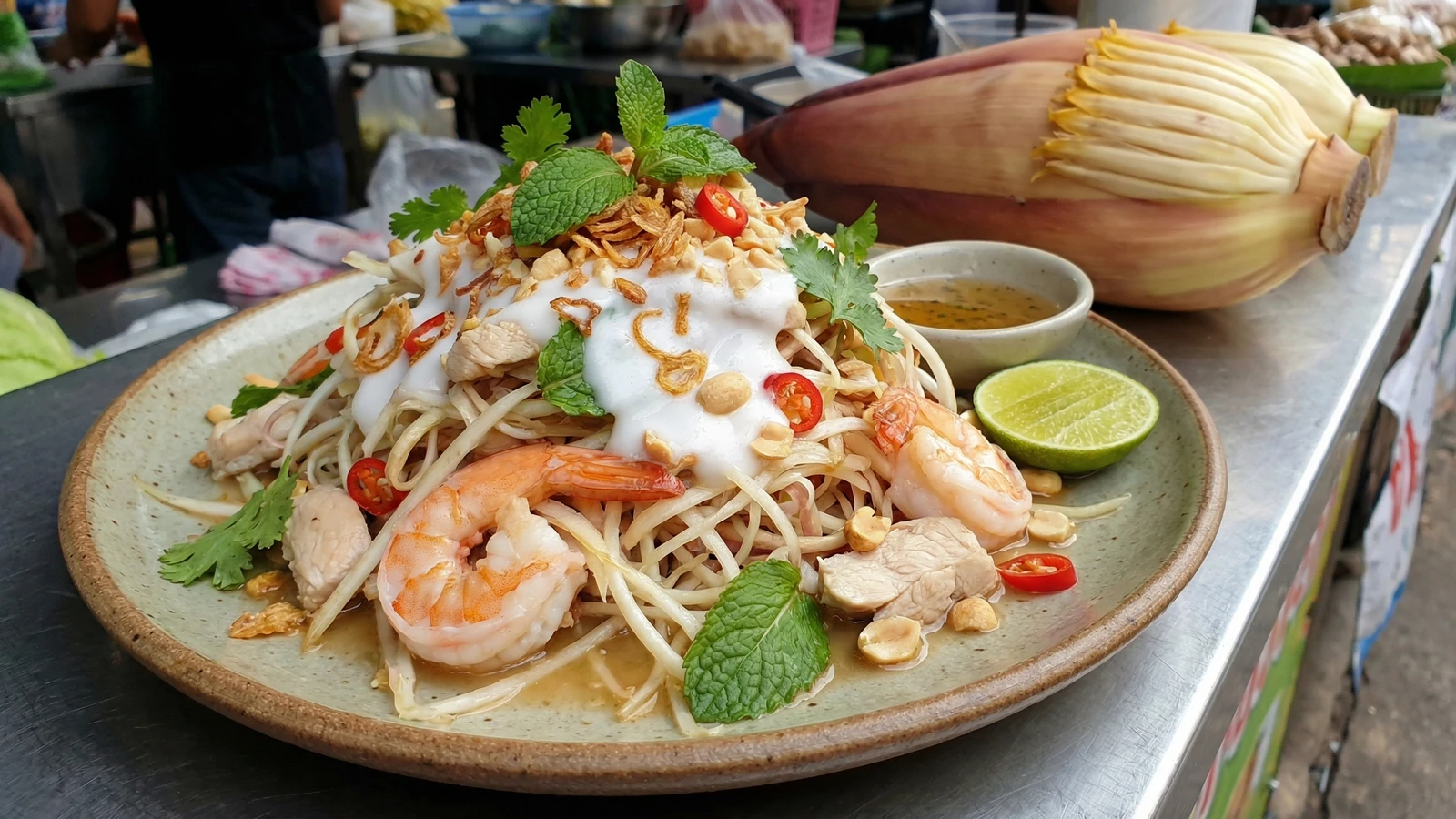
Central Thai yam dressed with thick coconut cream, not thin. Banana blossom soaked in acid water to hold its color, then dressed with the four pillars and crowned with shrimp, chicken, and a handful of herbs that do real work.
The yam dressing is the four pillars made portable. Fish sauce for salt. Palm sugar for sweet. Lime for sour. Chili for spice. That ratio governs every Central Thai yam, and yam hua plee is no exception. What makes this one different is the coconut cream. It's cooked down thick, almost like a sauce, and spooned over the top. Not poured thin. Not mixed into a runny dressing. Thick. That richness is what turns shredded banana blossom into something that stops conversation at a dinner table.
Here's the science you need to understand before you touch the blossom. Banana blossom oxidizes fast. The moment you slice it, the cut surfaces start turning brown. Same chemistry as a cut apple: polyphenol oxidase reacting with oxygen. The fix is acid. Squeeze lime juice into a bowl of cold water and drop the shredded blossom in immediately. The citric acid denatures the enzyme. No browning. This isn't a trick. It's chemistry your grandmother knew without needing the vocabulary.
Ajarn always said the kreung tam is everything, but the yam family is where you learn that the principles extend beyond the mortar. There's no paste here. The dressing itself carries the four pillars. You mix nam pla (fish sauce), nam tan pip (palm sugar), nam manao (lime juice), and prik khi nu (bird's eye chili) in a bowl, taste it, adjust it, and that dressing goes onto everything warm. Dress while the protein is still warm. The heat opens the dressing, lets the fish sauce and lime penetrate the chicken and shrimp. Serve at room temperature. Never from the fridge. Cold kills the aromatics.
I teach this dish at Fai Thai workshops because it forces you to respect the vegetable. Banana blossom has a delicate, slightly astringent flavor and a crisp texture that disappears if you overcook it or drown it in dressing. The blossom does the heavy lifting. The coconut cream, the shrimp, the chicken, the herbs: they're supporting cast. If you understand that, you understand yam.
Yam hua plee is a Central Thai home-cooking staple that predates the restaurant era, rooted in the practical reality that banana plants (Musa spp.) grow in nearly every Thai household garden and temple compound. The blossom, or hua plee (หัวปลี), was historically valued as a postpartum food for nursing mothers due to its believed galactagogue properties. Coconut cream-dressed yam like this one and yam thua phoo (winged bean salad) form a distinct subcategory within the Central Thai yam tradition, where the richness of coconut replaces the sharper, leaner dressing of seafood-based yam.
Quantity
1 large, about 300g
shredded
Quantity
juice of 2 limes
Quantity
200g
Quantity
200g
Quantity
250ml
thick first press only
Quantity
3 tablespoons
Quantity
3 tablespoons (about 3 limes)
Quantity
1 tablespoon
shaved
Quantity
5
sliced thin
Quantity
3
sliced thin
Quantity
1/4 cup
Quantity
1/4 cup
Quantity
2 tablespoons
Quantity
2 tablespoons
lightly crushed
| Ingredient | Quantity |
|---|---|
| banana blossom (hua plee)shredded | 1 large, about 300g |
| lime juice for soaking | juice of 2 limes |
| chicken breast | 200g |
| medium shrimp, shell on | 200g |
| coconut cream (hua kathi)thick first press only | 250ml |
| fish sauce (nam pla) | 3 tablespoons |
| lime juice (nam manao) | 3 tablespoons (about 3 limes) |
| palm sugar (nam tan pip)shaved | 1 tablespoon |
| bird's eye chilies (prik khi nu)sliced thin | 5 |
| shallots (hom daeng)sliced thin | 3 |
| fresh mint leaves (bai saranae) | 1/4 cup |
| fresh cilantro leaves and stems (phak chi) | 1/4 cup |
| fried shallots (hom jiew) | 2 tablespoons |
| roasted unsalted peanutslightly crushed | 2 tablespoons |
Fill a large bowl with cold water and squeeze in the juice of two limes. Pull away the dark outer petals of the banana blossom until you reach the pale, tightly packed inner layers. Halve the blossom lengthwise. Remove the small finger-like florets from between each layer (they're fibrous and bitter). Slice the pale inner layers as thin as you can manage, crosswise, into fine shreds. Drop each handful into the lime water immediately. Don't wait. The oxidation starts in seconds. The acid stops the browning enzyme cold. Let the shreds soak for at least 15 minutes. When you're ready to use them, drain and squeeze dry. They should be pale, crisp, and clean-tasting.
Bring a pot of water to a gentle simmer. Poach the chicken breast whole until just cooked through, about 12 minutes. Remove and let it rest for five minutes, then shred it along the grain into thin strips. In the same water, poach the shrimp with shells on until they curl and turn pink, about 2 minutes. Peel and halve lengthwise. Keep the proteins warm. You'll dress them while they still carry heat. The warmth opens the dressing, lets the fish sauce and lime juice penetrate the protein fibers. Cold protein repels dressing. Warm protein absorbs it. That's the rule for every yam with cooked protein.
Pour the coconut cream into a small saucepan over medium heat. Stir constantly as it comes to a simmer. Let it cook for 5 to 7 minutes until it reduces by about a third and thickens visibly. You'll see the fat start to separate at the edges, tiny pools of oil breaking from the cream. That's the signal. It should coat the back of a spoon and hold its shape when drizzled. Take it off the heat and let it cool to warm. This is not a thin pour. This is a thick, rich crown that sits on top of the salad. If your coconut cream is watery, you bought the wrong brand. Look for one with at least 60% coconut extract.
In a bowl, combine the fish sauce, lime juice, shaved palm sugar, and sliced chilies. Stir until the palm sugar dissolves completely. Taste it. The balance should hit sour first, then salty, then a gentle sweetness that rounds the edges, then heat building at the back. That's the yam dressing formula: the four pillars in liquid form. Adjust now. More lime if it's flat. More fish sauce if it needs depth. A pinch more sugar if the lime bites too hard. Ajarn always said: add sour last, add sour slowly. The lime changes everything the moment it goes in, and you can't pull it back.
Drain the banana blossom shreds and squeeze them firmly in a clean towel. They must be dry or they'll water down the dressing. Toss the shreds in a large bowl with the warm shredded chicken and shrimp. Pour the dressing over and toss with your hands, gently, working the dressing into the blossom strands. Add the sliced raw shallots, mint, and cilantro. Toss once more. Mound onto a serving plate. Spoon the thick coconut cream over the top. It should sit on the salad, not sink into it. Scatter the crushed peanuts and fried shallots over the coconut cream. Serve immediately at room temperature. This is a dish that waits for no one. The blossom starts to wilt, the herbs lose their punch, the coconut cream sets. Eat it now.
1 serving (about 220g)
Culinary guides, cultural storytelling, and the editorial depth that makes cooking meaningful.
Discover Culinary ExplorerChef Fai
No sugar. That's the rule. Isan larb strips Thai cuisine down to three pillars: nam pla for salt, manao for sour, prik for heat, bound by the smoky crunch of freshly pounded khao khua. The absence defines the dish.

Chef Fai
No sugar. That's the line between Isan and Central Thai larb. Grilled catfish flaked while warm, dressed with nam pla, manao, khao khua, prik pon, and a storm of fresh herbs. The plateau on a plate.

Chef Fai
No sugar. That's the rule. Isan larb strips Thai cuisine down to three pillars: nam pla for salt, manao for sour, prik for heat, with khao khua tying it together in a way nothing else can.

Chef Fai
Duck brings gamey depth to the Isan larb formula. No sugar. Lime, fish sauce, khao khua, prik pon, and a wall of fresh herbs. This is the celebration table standard, and the governing rule is restraint.