
Chef Joost
Aardappelschotel met Gehakt
A plain name for a quietly clever dish: fresh mince, sweet fried onion, nutmeg, and mashed potato baked until the top goes golden and the table goes silent.
A cooking platform built around craft, culture, and the stories behind what we eat.
Created by
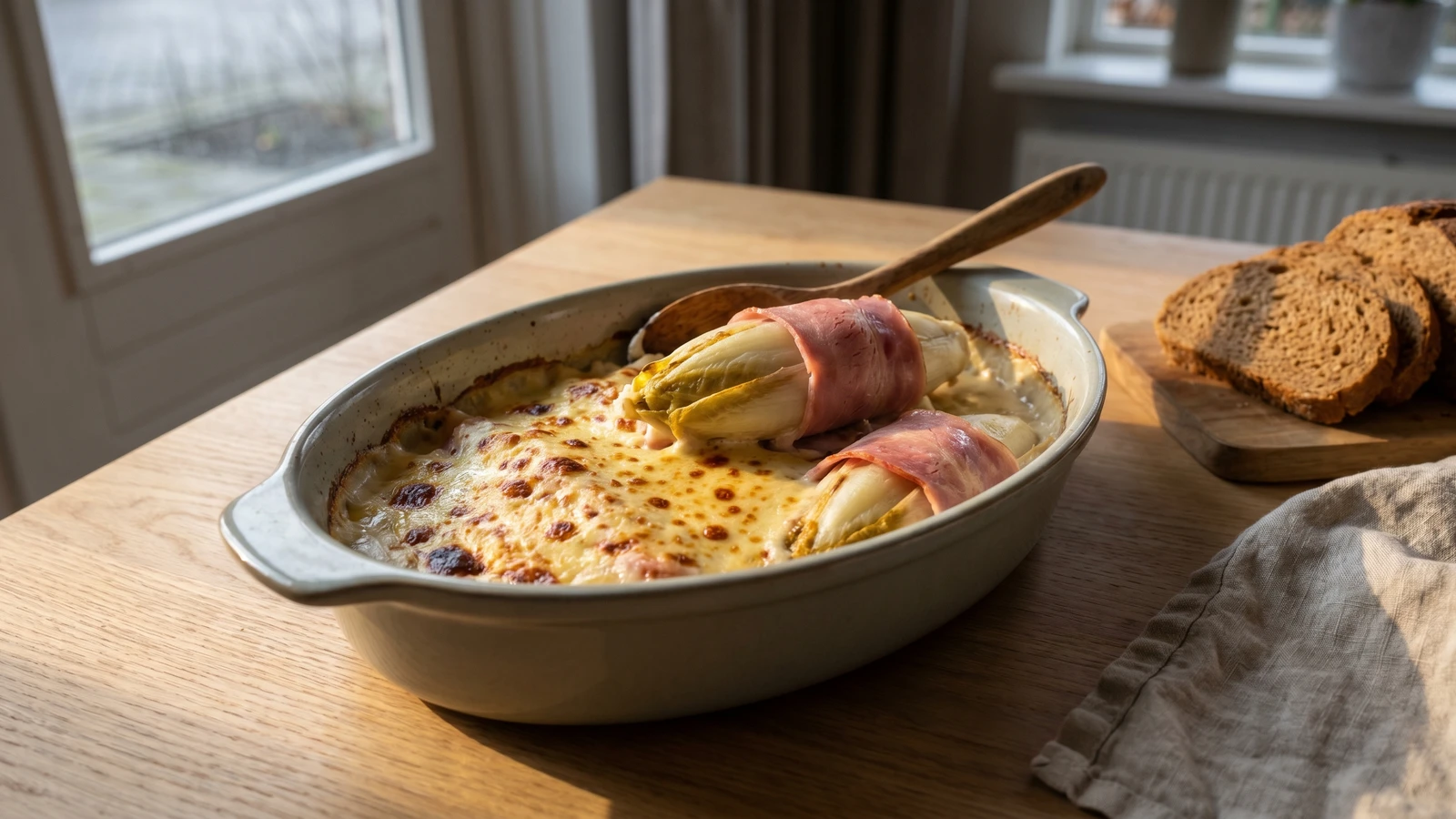
Bitter white leaves, salty ham, and a Gouda sauce browned at the edges: the Low Countries winter bake that proves plain food can keep a very sharp secret.
In my grandmother's second notebook, the recipe for witlof met ham en kaas occupies six lines, which is how you know it was trusted. She did not explain the sauce. She did underline one sentence twice: goed laten uitlekken, let it drain well. There are whole philosophies shorter than that, and less useful.
The name already tells you the trick. Witlof means white leaf, the pale shoot of chicory forced in darkness until it grows tight, tender, and pleasantly bitter. But let me tell you a secret: bitterness is not a flaw here. It is the spine of the dish. Wrapped in ham and covered with cheese sauce, the witlof keeps the dairy from going soft and sleepy.
History and cookery, they cannot be separated, especially when a Belgian vegetable walks into a Dutch oven dish and behaves as if it has always lived there. Witlof belongs to winter, when the fields look empty but the cellar can still grow something white and alive. Cook it gently, drain it as if the casserole depends on it, because it does, then let the Gouda brown on top. Hou het altijd simpel, always keep it simple: bitter leaf, salty ham, good cheese, and a dish brought straight to the table.
Witlof, called witloof in Belgian Dutch, means white leaf, and the modern vegetable was developed near Brussels in the nineteenth century by forcing chicory roots in darkness. The popular origin story credits Jan Lammers of Schaerbeek after the Belgian Revolution of 1830, while commercial cultivation was refined by Franciscus Bresiers at the Brussels Botanic Garden in the 1850s. The ham-and-cheese bake became a standard Low Countries winter household dish in the twentieth century, when Belgian endive, cooked ham, dairy sauce, and grated cheese met in the practical oven dishes of Dutch and Flemish home kitchens.
Quantity
8 small heads, about 1.1kg
trimmed, or 4 large heads halved lengthwise
Quantity
15g
Quantity
120ml
Quantity
1 tablespoon
Quantity
1/2 teaspoon
plus more to taste
Quantity
8 thin slices, about 200g
Quantity
40g
plus extra for the baking dish
Quantity
40g
Quantity
500ml
warmed
Quantity
180g
grated and divided
Quantity
1 teaspoon
Quantity
1 small pinch
grated
Quantity
to taste
| Ingredient | Quantity |
|---|---|
| Belgian endive (witlof)trimmed, or 4 large heads halved lengthwise | 8 small heads, about 1.1kg |
| butter for braising | 15g |
| water | 120ml |
| lemon juice | 1 tablespoon |
| fine saltplus more to taste | 1/2 teaspoon |
| cooked ham | 8 thin slices, about 200g |
| unsalted butter for sauceplus extra for the baking dish | 40g |
| plain flour | 40g |
| whole milkwarmed | 500ml |
| aged Gouda or belegen kaasgrated and divided | 180g |
| Dutch mustard or Dijon mustard | 1 teaspoon |
| fresh nutmeggrated | 1 small pinch |
| freshly ground black or white pepper | to taste |
Trim the browned bases from the witlof and pull away any tired outer leaves. If using large heads, halve them lengthwise through the root so they hold together. Melt the 15g butter in a wide lidded pan, lay in the witlof, add the water, lemon juice, and salt, then cover and cook over medium-low heat for 12 to 15 minutes, turning once. A knife should slip in with slight resistance. Tender is the aim, not collapse.
Lift the witlof into a colander, then lay it on a clean kitchen towel, cut side down if halved. Leave it for 15 minutes, then press gently with the towel to draw out more water. This is the recipe's honest work: a wet witlof thins the sauce and turns a gratin into a puddle with ambition.
While the witlof drains, melt the 40g butter in a saucepan over medium heat. Whisk in the flour and cook for 2 minutes until the mixture looks pale and sandy. Add the warm milk a little at a time, whisking smooth after each addition, then simmer for 4 to 5 minutes until the sauce coats a spoon. Take it off the heat and stir in the mustard, nutmeg, 130g of the grated Gouda, and pepper. Taste before adding salt; the ham and cheese have already brought plenty to the meeting.
Heat the oven to 200C, or 180C fan. Butter a baking dish large enough to hold the rolls snugly in one layer. Pat the drained witlof dry, wrap each head or half-head in a slice of ham, and lay the rolls seam-side down in the dish. Spoon the cheese sauce over the top, leaving a few ends just visible, then scatter over the remaining 50g Gouda.
Bake for 25 to 30 minutes, until the sauce is bubbling at the edges and the top is freckled gold. Let the dish stand for 10 minutes before serving. The rest is not politeness; it lets the sauce gather itself around the bitter leaves instead of running across the plate. Serve with boiled potatoes or a plain mash to catch the sauce.
1 serving (about 450g)
Culinary guides, cultural storytelling, and the editorial depth that makes cooking meaningful.
Discover Culinary ExplorerChef Joost
A plain name for a quietly clever dish: fresh mince, sweet fried onion, nutmeg, and mashed potato baked until the top goes golden and the table goes silent.

Chef Joost
Ajam Besengek is the golden chicken stew of the Indo-Dutch table: coconut milk, turmeric, and candlenut cooked down until the sauce clings to the meat like memory.

Chef Joost
The old Dutch spelling says ajam, the city says Batavia, and the pot says exactly what the rijsttafel always was: memory, trade, and dinner in one dish.

Chef Joost
The name means simply fried chicken, but the Dutch spelling carries a whole Indies kitchen: turmeric, coriander, garlic, and a golden crust that remembers the boemboe.