
Chef Elsa
Apfelkren
Freshly grated horseradish folded with tart apple and lemon, the cold, sharp sauce that belongs beside every plate of Tafelspitz in Vienna and has done for as long as anyone can remember.
A cooking platform built around craft, culture, and the stories behind what we eat.
Created by
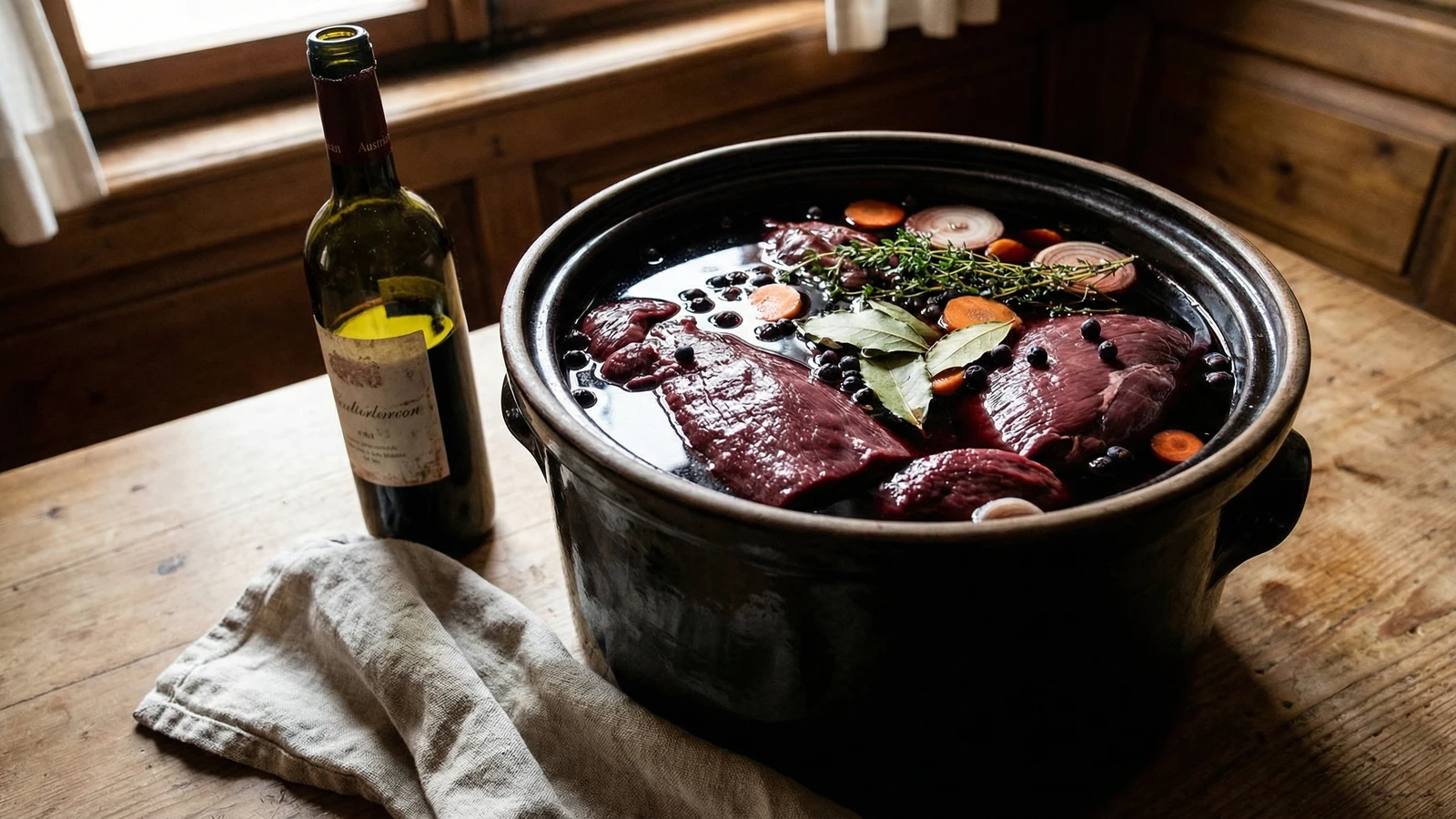
A wine-dark Austrian marinade of juniper, allspice, and bay leaves that tenderizes venison and wild boar over days of patient waiting, then becomes the foundation for the richest game sauce you'll ever make.
Every autumn in Salzburg, the Grunmarkt shifts. The summer stone fruit disappears and suddenly there's game everywhere. Whole haunches of Reh (roe deer) hanging in the butcher stalls, wild boar from the Salzkammergut, hares from the Alpine foothills. The air gets colder, the food gets darker, and the smell of Wildbeize drifting out of restaurant kitchens is as much a signal of the season as the first frost on the Untersberg.
Wildbeize is not a recipe in the way most people think of recipes. It's a preparation, a commitment. You combine red wine, vinegar, root vegetables, and a handful of spices that smell like the Austrian woods (juniper, allspice, bay, cloves) and you simmer them into something greater than the sum of their parts. Then you wait. Two days for a tender loin. Three or four for a tough shoulder. The acid and the wine work slowly, softening the dense fibers of wild meat, mellowing the strong gamey flavor that puts some people off, and leaving behind something deeply savory and perfumed.
Gretel always said that the Beize is where the sauce begins. She was right. Once the meat comes out, you strain that liquid and reduce it, and it becomes the most beautiful dark, glossy, juniper-scented sauce. Nothing from a packet or a cube comes close. This is good Austrian home cooking at its most elemental: simple ingredients, proper technique, and time doing most of the work for you.
Beizen, the practice of marinating game in an acidic wine mixture, has been central to Austrian and Central European hunting cuisine since at least the medieval period, when wild game was a primary protein source in the Alpine regions. The technique served a practical purpose before refrigeration: the acid in wine and vinegar inhibited bacterial growth and extended the usable life of a kill. Austrian regional variations reflect local wine production. Styria and Burgenland favor their own robust reds, while in Salzburg and Upper Austria, where wine is scarcer, older recipes sometimes substitute beer or even buttermilk. The classic Wildbeize as we know it today, built on red wine with juniper and allspice, was codified in Austrian cookery books by the 18th century and remains the standard preparation in Gasthaus kitchens during game season.
Quantity
500ml
Quantity
250ml
Quantity
250ml
Quantity
1 large
peeled and roughly sliced
Quantity
1 medium
halved and sliced
Quantity
1
roughly chopped
Quantity
1 small
peeled and sliced
Quantity
6
lightly crushed
Quantity
6
Quantity
8
Quantity
3
Quantity
3
Quantity
1 small
Quantity
4 sprigs
Quantity
3 sprigs
Quantity
1 strip (about 5cm)
pith removed
Quantity
1 teaspoon
Quantity
1 tablespoon
| Ingredient | Quantity |
|---|---|
| dry red wine (Blaufränkisch or Zweigelt) | 500ml |
| red wine vinegar | 250ml |
| cold water | 250ml |
| carrotpeeled and roughly sliced | 1 large |
| onionhalved and sliced | 1 medium |
| celery stalkroughly chopped | 1 |
| parsnippeeled and sliced | 1 small |
| juniper berrieslightly crushed | 6 |
| whole allspice berries | 6 |
| whole black peppercorns | 8 |
| bay leaves | 3 |
| whole cloves | 3 |
| cinnamon stick | 1 small |
| fresh thyme | 4 sprigs |
| fresh parsley | 3 sprigs |
| lemon zestpith removed | 1 strip (about 5cm) |
| salt | 1 teaspoon |
| granulated sugar | 1 tablespoon |
Crush the juniper berries lightly with the flat side of a heavy knife. You don't want powder. You want them cracked open so their resinous, piney fragrance releases slowly into the liquid over days. Do the same with the allspice and peppercorns, just a firm press to split them. Leave the cloves, cinnamon, and bay leaves whole.
Put the sliced carrot, onion, celery, and parsnip into a heavy-bottomed pot with no fat. Set it over medium heat and let the vegetables dry-toast for three to four minutes, stirring once or twice. You're not trying to brown them deeply, just coax a little sweetness out. The onion should be translucent at the edges, the carrot starting to soften.
Add the wine, vinegar, and water to the pot. Drop in the crushed juniper, allspice, peppercorns, cloves, cinnamon stick, bay leaves, thyme, parsley, lemon zest, salt, and sugar. Stir once to dissolve the sugar. Bring the liquid to a gentle simmer and let it cook, uncovered, for twenty minutes. The kitchen will smell like a Styrian hunting lodge in November. That sharp, aromatic, wine-dark smell is exactly right.
Remove the pot from the heat and let the Beize cool to room temperature. This is not optional. If you pour warm marinade over raw game, you start cooking the surface of the meat before the acid and aromatics have a chance to penetrate. Patience here means tenderness later. Let it sit until it's truly cool, at least an hour.
Place your game meat in a deep, non-reactive container: glass, ceramic, or food-safe plastic. Never aluminum, which reacts with the acid and gives the meat a metallic taste. Pour the cooled Beize over the meat, vegetables and all. The liquid should cover the meat completely. If it doesn't, turn the meat twice a day. Cover tightly and refrigerate for two to four days. Venison loin needs two days. A wild boar shoulder or a whole hare benefits from three or four. The meat will darken, and the texture will soften as the wine and vinegar slowly break down the tough connective fibers.
When you're ready to cook, remove the meat and pat it completely dry with paper towels. Strain the marinade through a fine sieve and keep the liquid. Discard the spent vegetables and spices. The strained Beize is the foundation for your sauce: reduce it by half in a saucepan, then use it to deglaze your roasting pan or braise your game. It becomes the best gravy you've ever made, rich with wine and juniper and all those days of slow, patient work.
1 serving (about 175g)
Culinary guides, cultural storytelling, and the editorial depth that makes cooking meaningful.
Discover Culinary ExplorerChef Elsa
Freshly grated horseradish folded with tart apple and lemon, the cold, sharp sauce that belongs beside every plate of Tafelspitz in Vienna and has done for as long as anyone can remember.

Chef Elsa
The clear, caraway-scented pan jus you pour over Schweinsbraten and Knödel, built from nothing but good pork drippings, honest stock, and the patience to let a roasting pan tell you everything it knows.

Chef Elsa
A silky butter roux sauce finished with beef broth, cream, and handfuls of fresh dill, the way every Viennese grandmother serves it alongside Tafelspitz on Sunday.

Chef Elsa
Crisp cauliflower, sweet carrots, and bright peppers in a spiced sweet-sour brine with mustard seeds, the jar you open first when the Brettljause comes out and the last one you put away.