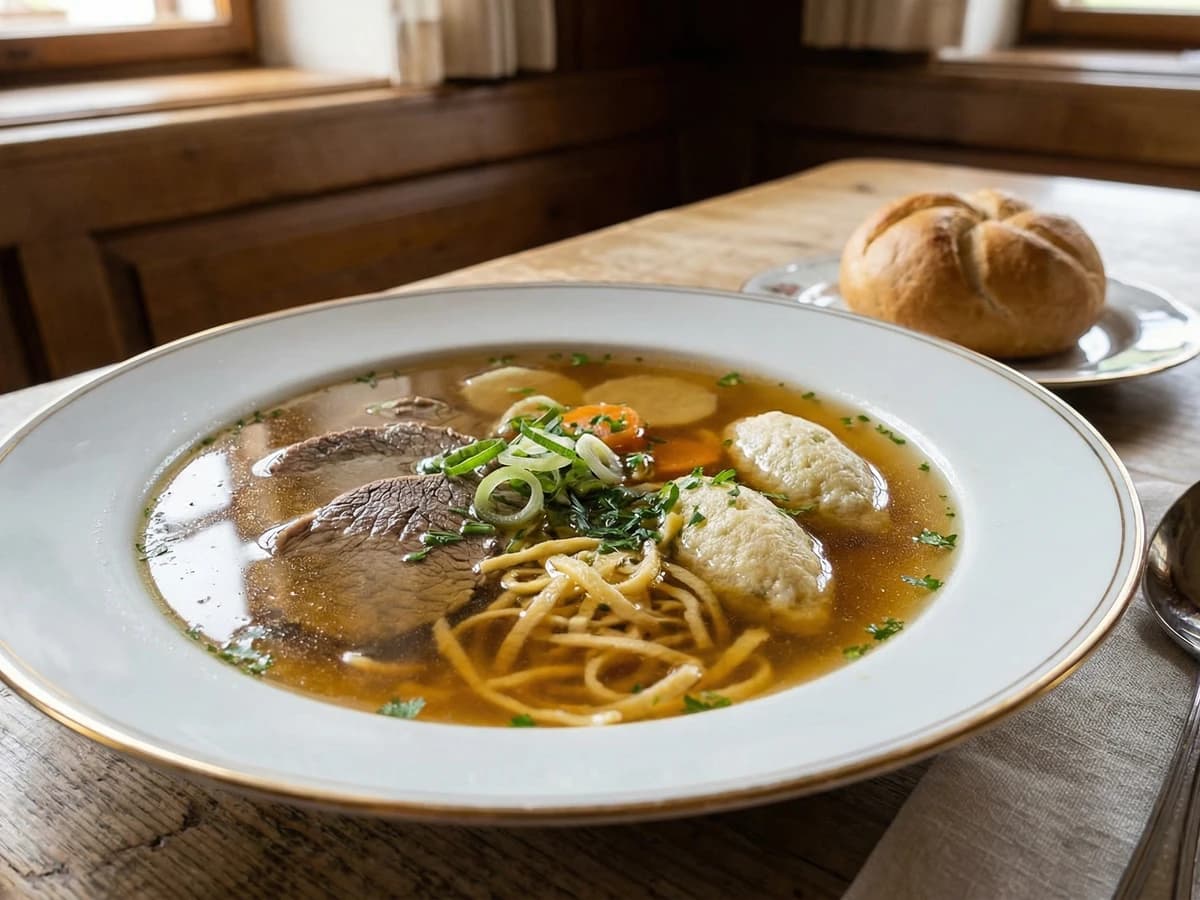
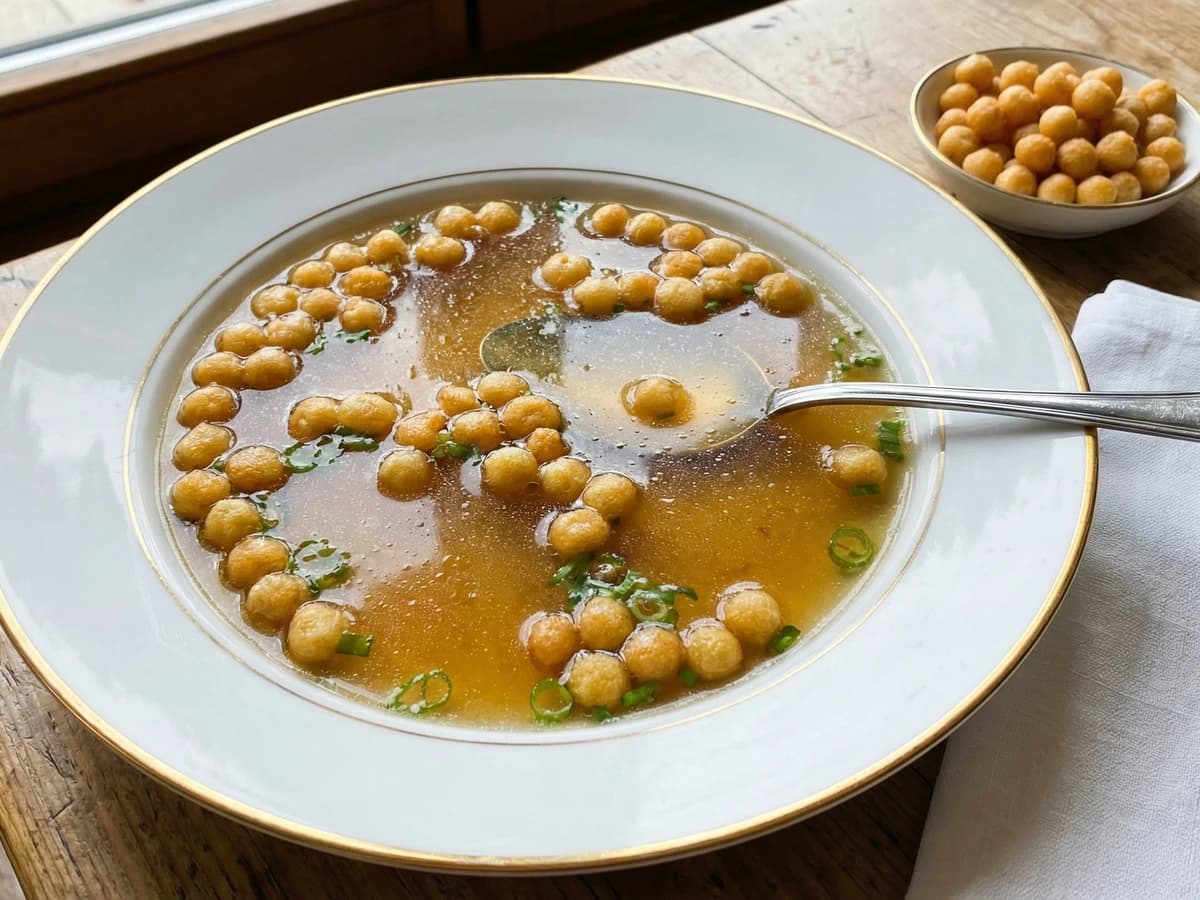
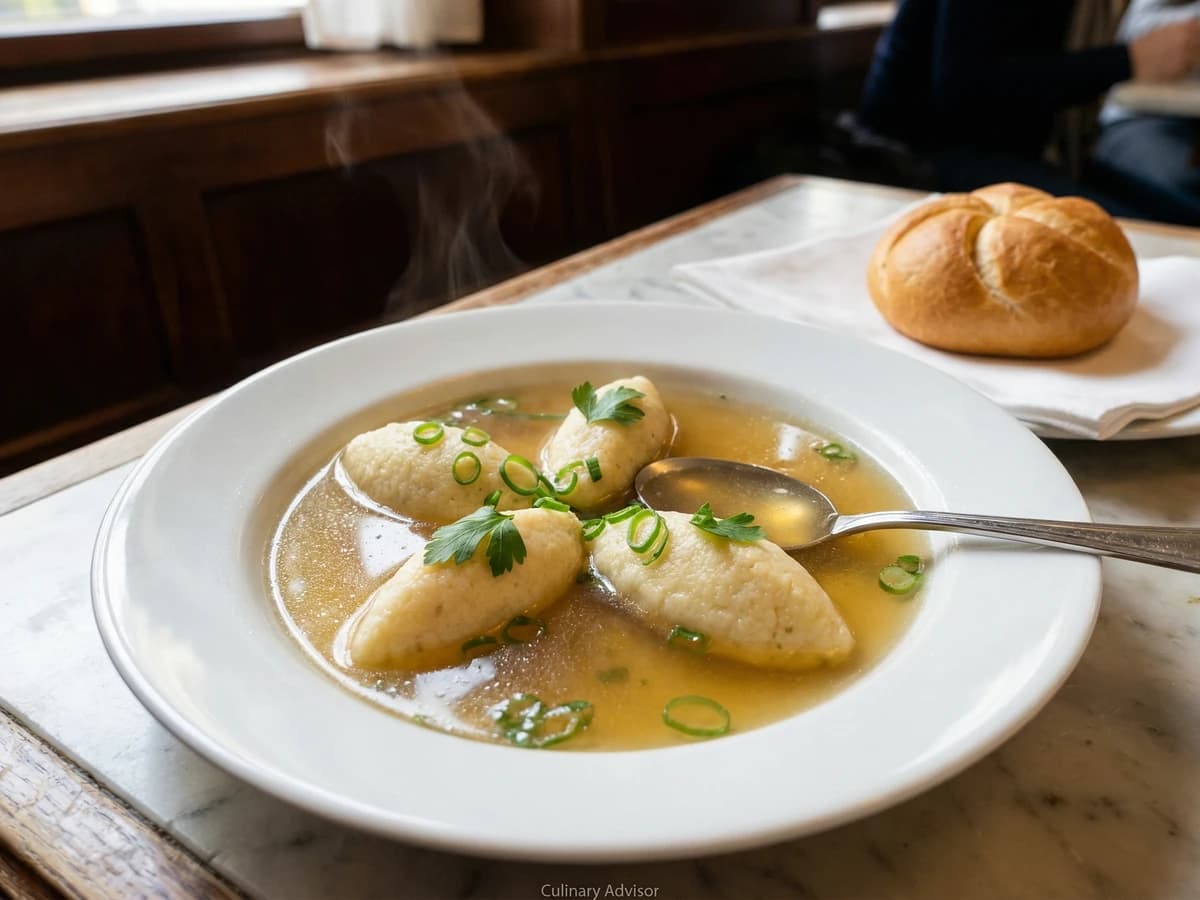
Vienna's honest tripe stew, slow-simmered with paprika, caraway, and marjoram until the Kuttelfleck turns silky and the broth turns golden. Beisl cooking at its best, served with a fresh Semmel and a streak of sharp mustard.
Soups & Stews
Austrian
Comfort Food
30 min
Active Time
2 hr 30 min cook•3 hr total
Yield4 servings
There's a smell that hits you the moment you walk into a proper Viennese Beisl. Paprika browning in hot fat, caraway seeds cracking in the heat, onions going soft and gold. It's the smell of Kuttelfleck. This is not the dish tourists order. This is the dish the regulars eat, the ones who've been sitting at the same Stammtisch for twenty years and would notice if the cook changed a single thing.
I first tasted Kuttelfleck during my training at GAFA in Vienna. There was a Beisl near the Judenplatz, the kind with handwritten menus and tablecloths that had seen better decades, and their Kuttelfleck was extraordinary. Tripe cut into short strips, simmered until it went from rubbery to silky, swimming in a paprika broth that tasted like someone's grandmother had been stirring it since morning. I ordered it three times that week. The cook, an older woman who never told me her name, said the secret was patience and good lard. She wasn't wrong.
Kuttelfleck asks you to respect an ingredient most people walk past at the butcher's. Tripe is humble. It doesn't pretend to be anything other than what it is: stomach lining, honest and plain, waiting for slow heat and strong seasoning to transform it into something remarkable. The paprika comes from Hungary, carried into Viennese kitchens along with goulash and Letscho during the centuries the two nations shared an empire. The caraway is purely Austrian. Together they make a broth that tastes like Vienna's working-class history in a bowl.
Gretel always said that good cooks waste nothing. Austrian Beisl cooking was built on that principle. Kuttelfleck isn't a dish that apologizes for its ingredients. It celebrates them.
Kuttelfleck belongs to the tradition of Innereien (offal) dishes that formed the backbone of Viennese Beisl cooking from the 18th century onward. The dish reflects Hungary's deep influence on Viennese cuisine: the generous use of paprika arrived through the Habsburg empire's long union with Hungary, while caraway and marjoram are signatures of Austrian seasoning. Beisl, Vienna's traditional taverns, served Kuttelfleck as an affordable, filling meal for workers and tradesmen. The name itself comes from Kutteln (tripe) and Fleck (an old German word for piece or patch), referring to the cut strips of stomach lining.
The technique, the tradition, and the story behind every dish.
•Mortar and pestle or flat knife (for crushing caraway)
Instructions
1
Prepare and pre-cook the tripe
Rinse the honeycomb tripe under cold running water. Place it in a large pot with enough cold water to cover by five centimeters. Add a tablespoon of vinegar, the bay leaves, and the peppercorns. Bring to a simmer over medium heat and cook gently for ninety minutes to two hours. The tripe is ready when you can push a fork through it without resistance. Don't rush this. Tough tripe will ruin the finished dish, and there is no shortcut for what time and gentle heat accomplish here.
Some butchers sell tripe already pre-boiled. If yours does, taste a small piece. If it's tender enough to chew comfortably, you can skip this step and go straight to cutting. You'll save yourself ninety minutes.
2
Cut the tripe into strips
Drain the cooked tripe and let it cool until you can handle it. Cut it into strips about five centimeters long and one centimeter wide. The size matters. Too large and the pieces won't absorb the paprika broth properly. Too small and you lose the satisfying chew that makes Kuttelfleck what it is. Set the strips aside.
3
Build the Einbrenn
Melt the lard in a heavy pot over medium heat. Lard is the traditional fat here and it makes a difference. Butter works if you must, but Schmalz gives you a depth and richness that butter can't quite reach. Add the diced onions and cook them slowly, stirring often, until they turn soft and deeply golden. This takes a good ten to twelve minutes. Don't rush it by turning up the heat. Browned onions taste completely different from burned onions, and the line between them is about thirty seconds of inattention.
If you can find good pork lard from a butcher rather than the hydrogenated blocks at the supermarket, use it. The flavor is clean and round, not heavy.
4
Add garlic and paprika
Add the minced garlic and stir for thirty seconds, just until fragrant. Pull the pot off the heat before you add the paprika. This is important. Paprika burns in seconds and burned paprika tastes acrid and bitter. It will destroy the whole pot. Off the heat, stir in the two tablespoons of sweet paprika until everything is coated in that deep brick-red color. The residual warmth is enough to bloom the spice and release its flavor without scorching it.
5
Make the roux and add broth
Sprinkle in the flour and stir it through the paprika-onion mixture. Return the pot to medium-low heat and cook for one minute, stirring constantly. This is your Einbrenn, the Viennese roux that gives the stew its body. Pour in the beef broth gradually, stirring as you go to prevent lumps. Add the crushed caraway seeds and dried marjoram. The caraway is what makes this taste Austrian rather than Hungarian. Without it, you've made a different dish entirely.
6
Simmer the Kuttelfleck
Add the tripe strips to the broth. Stir in the tablespoon of vinegar. Bring everything to a gentle simmer, then turn the heat down until the surface barely trembles. Cover and let it cook for forty-five minutes to an hour. The tripe will absorb the paprika broth and go from pale and plain to golden-red and full of flavor. Stir occasionally to make sure nothing sticks to the bottom. The stew should be thick enough to coat the tripe strips generously, but still loose enough to pool in a bowl. If it thickens too much, add a splash of broth.
7
Season and serve
Taste the stew. Season with salt and pepper. The vinegar should be present as a bright note in the background, not sharp enough to make you wince. If it needs more acidity, add half a teaspoon at a time. Ladle the Kuttelfleck into warm bowls. Scatter the chopped parsley over the top. Serve with a fresh Semmel for tearing and dunking into the broth, and a good streak of sharp mustard on the side. Kremser Senf is the Austrian standard, grainy and hot. Mahlzeit!
Chef Tips
•Buy your tripe from a butcher you trust, not wrapped in plastic at the supermarket. Good honeycomb tripe should smell clean, almost neutral. If it smells sour or sharp, it's old and no amount of cooking will fix that.
•Crush the caraway seeds lightly with the flat of a knife or in a mortar before adding them. Whole caraway seeds can be unpleasant to bite into, but you want them cracked open so they release their oils into the broth. Ground caraway goes dusty and loses its punch. Lightly crushed is the sweet spot.
•Kuttelfleck tastes better the next day. The tripe continues to absorb the paprika broth as it sits, and the flavors deepen overnight. Make it on Saturday, eat it on Sunday. This is the kind of dish that rewards you for waiting.
•The vinegar is not optional. It cuts through the richness of the lard and the paprika and keeps the whole stew in balance. Without it, the dish sits heavy. With it, every spoonful has somewhere to go.
Advance Preparation
•The tripe can be pre-boiled up to two days ahead and refrigerated in its cooking liquid. Drain and cut into strips when ready to use.
•The finished Kuttelfleck keeps for three days in the fridge and reheats beautifully. Add a splash of broth when reheating if the stew has thickened too much overnight.
•The stew also freezes well for up to two months. Thaw overnight in the fridge and reheat gently on the stove.
Frequently Asked Questions
Nutrition Information
1 serving (about 480g)
Calories
520 calories
Total Fat
22 g
Saturated Fat
8 g
Trans Fat
0 g
Unsaturated Fat
13 g
Cholesterol
310 mg
Sodium
1450 mg
Total Carbohydrates
41 g
Dietary Fiber
2 g
Sugars
6 g
Protein
39 g
Where cooking meets culture.
Culinary guides, cultural storytelling, and the editorial depth that makes cooking meaningful.