Culinary Explorer

A cooking platform built around craft, culture, and the stories behind what we eat.
Discover Culinary Explorer
Fiakergulasch

Fiakergulasch

Created by

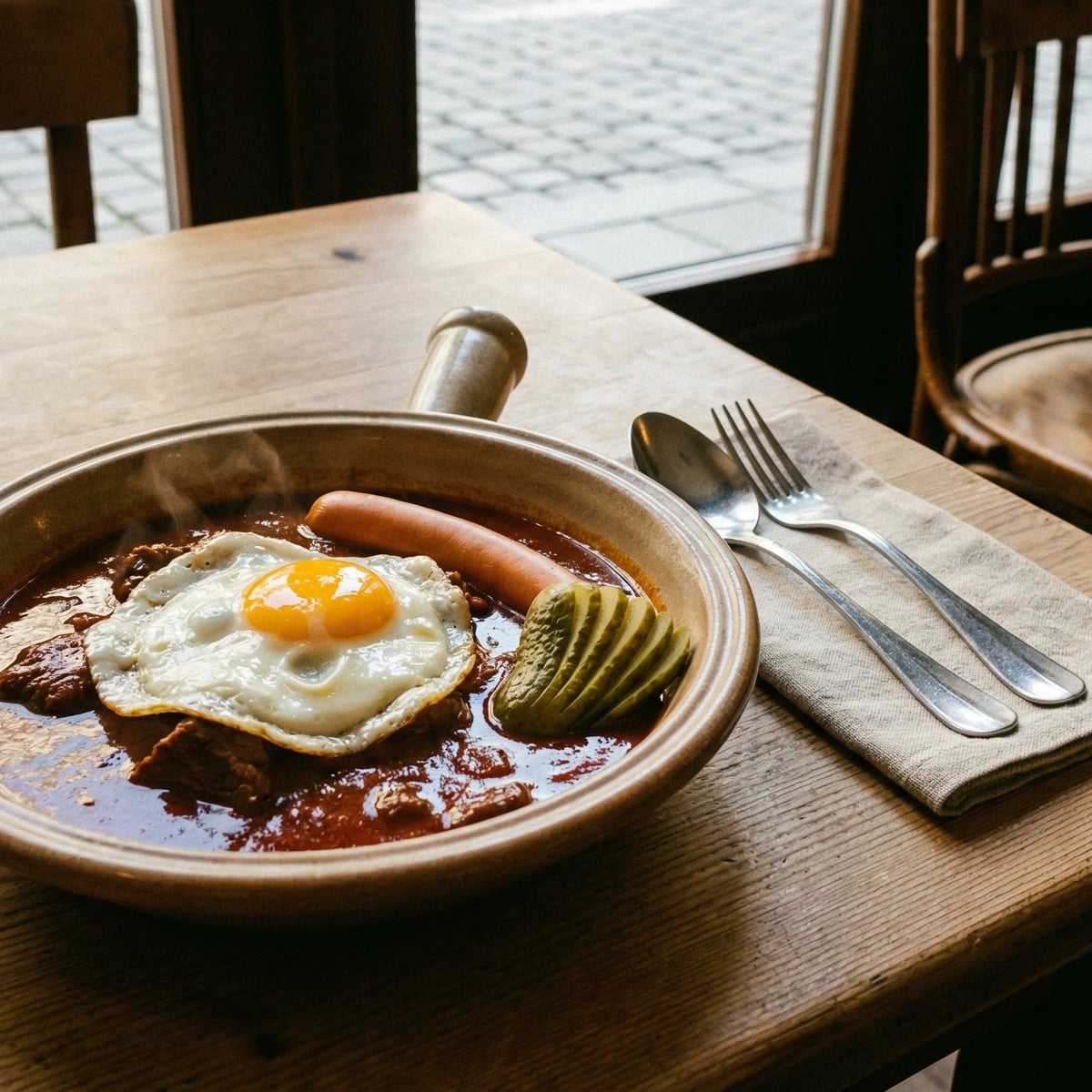
Vienna's coachman's goulash: a slow-simmered, paprika-red Saftgulasch crowned with a fried egg, a Frankfurter, and a fan-cut pickle. The heartiest plate in the city, built for people who work hard and eat well.

Soups & Stews
Austrian
Dinner Party
Special Occasion
30 min
Active Time
2 hr 30 min cook3 hr total
Yield4 servings

The first time I understood what Fiakergulasch was about, I was sitting in a Beisl in Vienna's second district on a freezing November evening during my time at GAFA. The plate arrived looking like no refined culinary school lesson I'd had that week. A wide bowl of deep red Gulasch, thick with dissolved onions, a fried egg sitting on top with the yolk trembling, a whole Frankfurter leaning off the side, and a pickle fanned out along the rim like it was there to make a point. It was glorious. It was ridiculous. It was exactly the meal I needed.

Fiakergulasch begins with Saftgulasch, which is the purest expression of what Austrian goulash actually is. Forget everything you think you know about goulash from other countries. Viennese Saftgulasch is not a thick stew with potatoes and vegetables crowding the pot. It's beef and onions. That's it. An enormous quantity of onions, cooked until they dissolve into a silky, paprika-stained sauce that clings to every piece of meat. The Hungarian influence runs deep here, three centuries of shared empire left paprika at the center of Austrian cooking, but the Viennese made it their own. They stripped the dish down to its essentials and then crowned it with garnishes that tell you everything about who used to eat it.

The Fiaker coachmen needed a meal that would keep them warm through hours on a cold box seat. It had to be rich, filling, and cheap. The egg gave it fat and protein. The Frankfurter stretched the plate. The pickle cut through the heaviness so you could finish the whole thing and still climb back onto the carriage. This isn't delicate food. It's working food, and the fact that it's now served in fine restaurants all over Vienna hasn't changed its character one bit. Make it on a cold evening when you want something that fills the house with the smell of paprika and onions, and don't hold back on any of the garnishes. They aren't decoration. They're the reason the dish has its name.

The Fiaker were the horse-drawn cab drivers who defined Viennese street life from the 17th century through the early 20th century, and their name came from the Hôtel de St Fiacre in Paris, where the first hackney carriages for hire were based. The coachmen ate at simple taverns near their stands, and the dish that carried their name reflected what they could afford and what they needed: a hearty goulash stretched with cheap but satisfying garnishes. The combination of fried egg, Frankfurter, and fan-cut gherkin on top of a Saftgulasch became codified as Fiakergulasch by the late 19th century, and it remains one of the few Viennese dishes defined entirely by its garnish rather than its base preparation.

The technique, the tradition, and the story behind every dish.

Discover Culinary Explorer

Ingredients

beef chuck or shin

Quantity

800g

cut into 3cm cubes

yellow onions

Quantity

600g

finely sliced

lard or sunflower oil

Quantity

3 tablespoons

sweet Hungarian paprika (édes)

Quantity

3 tablespoons

hot Hungarian paprika (erős) (optional)

Quantity

1 teaspoon

tomato paste

Quantity

1 tablespoon

garlic

Quantity

2 cloves

crushed

caraway seeds

Quantity

1 teaspoon

lightly crushed

dried marjoram

Quantity

1 teaspoon

bay leaf

Quantity

1

white wine vinegar

Quantity

1 tablespoon

lemon zest

Quantity

from half a lemon

beef stock or water

Quantity

500ml

salt

Quantity

to taste

Frankfurter sausages (Wiener Würstel)

Quantity

4

eggs

Quantity

4 large

butter or lard

Quantity

for frying eggs

gherkins (Salzgurken)

Quantity

4 large

fan-cut

fresh bread or Semmelknödel

Quantity

for serving

Equipment Needed

  • Heavy-bottomed pot or Dutch oven (4-liter minimum)
  • Non-stick pan for frying eggs
  • Sharp knife for fan-cutting gherkins

Instructions

  1. 1

    Cook the onions down

    Melt the lard in a heavy-bottomed pot over medium heat. Add all the sliced onions and a generous pinch of salt. Cook them slowly, stirring now and then, until they collapse completely and turn deep golden. This takes a solid twenty to twenty-five minutes. Don't rush it. The onions are not a base layer you get through quickly on the way to something else. They are the sauce. In a proper Saftgulasch, the onions dissolve into the liquid and become the body of the whole dish. If you cut this short, you'll have thin, watery gravy and no amount of simmering later will fix it.

    Gretel always said: the onions should weigh almost as much as the meat. Viennese Gulasch is an onion stew with beef in it, not the other way around. Don't reduce the quantity.
  2. 2

    Bloom the paprika

    Pull the pot off the heat. This is the most important moment in the recipe. Add the sweet paprika and the hot paprika if you're using it, and stir everything together quickly. Paprika burns in seconds on direct heat, and burnt paprika turns bitter and acrid and ruins the entire pot. Off the heat, it blooms in the residual warmth of the onions and releases that deep, sweet, brick-red flavor that defines Gulasch. You'll smell it change from powdery to fragrant in about thirty seconds. Stir in the tomato paste, garlic, caraway, and marjoram while the pot is still off the flame.

    Buy Hungarian paprika from a shop that sells it regularly and turns over their stock. Old paprika tastes like red dust. Fresh paprika smells sweet and warm the moment you open the tin. It makes all the difference.
  3. 3

    Add the beef

    Return the pot to medium heat. Add the beef cubes and stir to coat every piece in the paprika-onion mixture. You are not browning the meat. This is one of the things people get wrong about Austrian Gulasch, coming at it with French technique. You don't sear the beef first. You nestle it into the onions and let everything come together. The meat will release its juices, the onions will continue breaking down, and the paprika will stain everything that deep, honest red.

  4. 4

    Build the braising liquid

    Add the vinegar, lemon zest, and bay leaf. Pour in the stock or water. The liquid should come about two-thirds of the way up the meat, not cover it completely. You want the sauce to reduce and concentrate as the beef cooks, not stay thin and soupy. Bring everything to a gentle simmer, then reduce the heat to the lowest setting your stove will give you. Cover the pot with the lid slightly ajar.

    The vinegar and lemon zest are not optional. They provide the bright, sharp note that keeps the paprika and onion richness from becoming heavy. Without them, the whole dish sits flat.
  5. 5

    Simmer low and slow

    Let the Gulasch simmer gently for two to two and a half hours. Check it every thirty minutes. Stir the bottom to prevent sticking, and add a splash of water if the sauce reduces too far before the meat is ready. You're looking for beef that yields to a fork with no resistance and a sauce that coats the back of a spoon, thick and glossy from the dissolved onions. The color should be a deep, warm paprika red. Taste for salt and adjust. The flavor deepens as it cooks, so be patient with the seasoning.

  6. 6

    Prepare the garnishes

    When the Gulasch is nearly done, heat the Frankfurter sausages. Drop them into a pot of hot water, just below a simmer, for about five minutes. You never boil a Würstel. Boiling splits the casing and turns the texture rubbery. While the sausages warm through, cuteach gherkin lengthwise into thin slices, leaving the stem end connected so the slices fan out like a hand of cards. This is the Fächergurke, the fan pickle, and it's as much a part of the dish as the Gulasch itself.

  7. 7

    Fry the eggs

    Melt a generous knob of butter in a pan over medium heat. Crack the eggs in one at a time, giving each room. Fry them until the whites set and the edges go lacy and golden, but keep the yolks runny. A Spiegelei, a mirror egg, should have a yolk that breaks when the diner cuts into it and runs into the Gulasch sauce. That's the whole point. The yolk becomes part of the dish.

  8. 8

    Plate the Fiakergulasch

    Ladle a generous portion of the Gulasch into a wide, warm bowl or deep plate. Set a fried egg on top with the yolk facing up. Lean one Frankfurter sausage against the side. Fan a gherkin across the rim. Serve with good bread or a Semmelknödel to soak up the sauce. Every element on the plate has a job: the egg enriches, the sausage adds salt and snap, the pickle cuts through the richness. Eat it all together, the way a Fiaker coachman would have, and don't apologize for the mess on the plate. Mahlzeit!

Chef Tips

  • The single most common mistake is not using enough onions. The onion-to-meat ratio should be close to equal by weight. When you pile 600 grams of sliced onions into the pot it looks absurd. Trust it. They cook down to almost nothing and become the sauce.
  • Never add flour to thicken Saftgulasch. The sauce gets its body from the dissolved onions alone. If your sauce is thin, your onions weren't cooked down enough at the start or you added too much liquid. Simmer with the lid off for the last thirty minutes to concentrate it.
  • Fiakergulasch is better the next day. The flavors settle and deepen overnight. Make the Saftgulasch a day ahead, refrigerate it, and reheat gently. Cook the egg, warm the Würstel, and cut the pickle fresh just before serving.
  • Use lard if you can find good quality rendered lard. It's the traditional fat for Austrian goulash and gives the onion base a depth that oil can't match. If lard isn't available, sunflower oil is a better substitute than butter, which can burn during the long onion cook.

Advance Preparation

  • The Saftgulasch base can and should be made a day ahead. Refrigerate overnight and reheat gently before assembling with the garnishes. The flavor improves dramatically with a night's rest.
  • Fan-cut gherkins can be prepared an hour ahead and kept covered in the fridge.
  • The fried eggs and Frankfurter sausages must be prepared fresh, just before plating. Neither one waits.

Frequently Asked Questions

Nutrition Information

1 serving (about 480g)

Calories
830 calories
Total Fat
60 g
Saturated Fat
24 g
Trans Fat
0 g
Unsaturated Fat
34 g
Cholesterol
365 mg
Sodium
1735 mg
Total Carbohydrates
22 g
Dietary Fiber
5 g
Sugars
8 g
Protein
53 g

Note: Chef personas and recipes are created with AI assistance. Cook with care: follow safe food-handling practices, check doneness with a thermometer when needed, and adapt for allergies and your kitchen.

Where cooking meets culture.

Culinary guides, cultural storytelling, and the editorial depth that makes cooking meaningful.

Discover Culinary Explorer

More from Austrian Stews & Gulasch

Browse the full collection