A lighter, more refined veal goulash braised low and slow in a paprika and onion sauce, finished with sour cream and served with Nockerl or Semmelknödel to catch every last drop.
Soups & Stews
Austrian
Dinner Party
Comfort Food
25 min
Active Time
1 hr 45 min cook•2 hr 10 min total
Yield4 servings
The first time I understood what Gulasch could be, I was twelve, on one of those summer trips to Austria with Gretel and my grandmother Eva. We stopped at a Gasthaus somewhere between Salzburg and Bad Ischl, the kind of place with checked tablecloths and a handwritten menu. Gretel ordered Kalbsgulasch and when it arrived I remember the color: not the fiery red I expected, but this warm, burnished copper from the sour cream stirred through at the end. The sauce was thick with dissolved onions. The veal was so tender you didn't need a knife. Gretel tasted it, nodded once, and said nothing, which from her was the highest compliment.
Kalbsgulasch is the lighter, more elegant cousin of the beef Gulasch most people know. Where Rindsgulasch is sturdy and bold, a working person's dinner, this is something gentler. Veal shoulder cooked so slowly it surrenders into a sauce built almost entirely from onions and paprika. There's no flour to thicken it. You don't need any. The onions do the work themselves, melting over ninety minutes into something silky and rich.
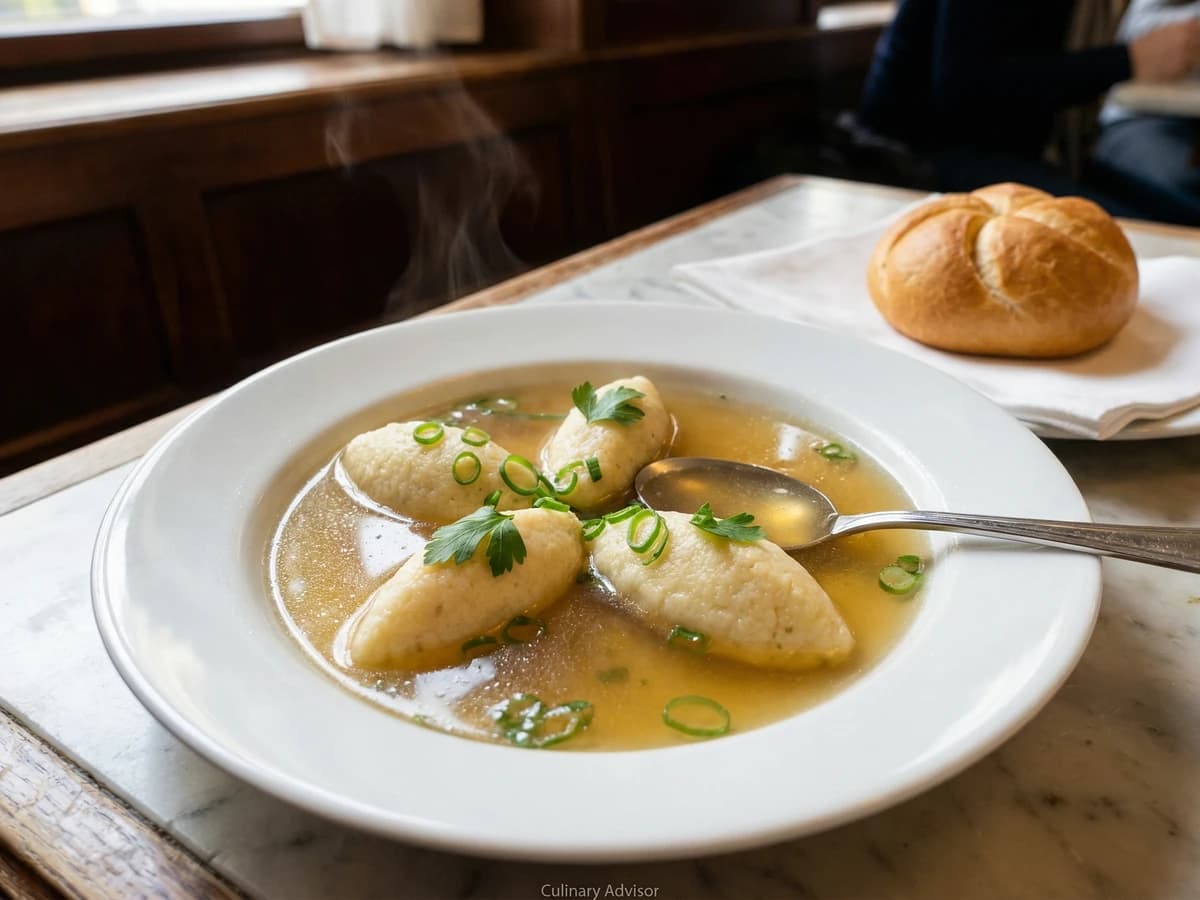
The technique is not difficult, but it asks you to trust two things: the onions will become the sauce if you give them time, and the paprika will give you all the depth you need if you bloom it off the heat instead of burning it in a hot pan. Those two principles are the whole secret. Sour cream at the end rounds everything out, turning the flavors from sharp to warm. Serve it with Nockerl, those small, soft dumplings made from nothing more than flour, egg, and a little salt, or with a proper Semmelknödel if you want something more substantial. Either way, you want something to soak up the sauce, because the sauce is the point.
Gulasch arrived in Austrian kitchens from Hungary, carried across the Habsburg empire along with paprika, which Hungarian traders first brought from Ottoman spice routes in the 16th century. The Hungarian original, gulyás, was a cowherds' stew made with beef and cooked outdoors over open fire. Viennese cooks adapted it into something more refined: the Kalbsgulasch, using veal instead of beef, adding sour cream, and finishing with lemon zest. By the 19th century, Gulasch in its many Austrian variations (Rindsgulasch, Kalbsgulasch, Saftgulasch, Fiakergulasch) had become so embedded in Viennese cuisine that most Austrians consider it their own, a fact Hungarians have opinions about to this day.
The technique, the tradition, and the story behind every dish.
•Heavy-bottomed Dutch oven or braising pot (at least 4 liters)
•Wooden spoon
•Sharp knife and cutting board for the onions
Instructions
1
Sweat the onions slowly
Melt the lard or clarified butter in a heavy-bottomed pot or Dutch oven over medium-low heat. Add all the diced onions at once. This will look like far too many onions. It isn't. The Viennese ratio for Gulasch is nearly equal parts onion to meat, and the onions are the sauce. Cook them gently, stirring now and then, for about twenty minutes. You want them soft, glassy, and just beginning to turn gold at the edges. If they brown too fast, lower the heat. Burnt onion will make the whole dish bitter and there's no coming back from that.
Gretel always said the onions are everything in a good Gulasch. If you rush this step, you'll spend two hours braising meat in mediocre sauce. Take the twenty minutes. They earn it.
2
Bloom the paprika
Pull the pot off the heat. This is important. Add the paprika and stir it through the onions immediately. Paprika burns in seconds on direct heat, and burnt paprika turns acrid and harsh. Off the heat, it toasts gently in the residual warmth and releases that deep, sweet, almost smoky fragrance that defines Gulasch. Stir in the tomato paste, crushed caraway seeds, garlic, and marjoram. Add the vinegar and lemon zest and stir again. The vinegar gives a brightness the finished sauce needs. The lemon zest is subtle but it lifts everything.
Use only sweet Hungarian paprika, the kind labeled edelsüß. Smoked paprika belongs to a different tradition entirely and will take this dish somewhere it shouldn't go. If your paprika has been sitting in the cupboard for over a year, buy a fresh tin. Stale paprika tastes like red dust.
3
Add the veal
Return the pot to medium heat. Add the veal cubes, the bay leaf, and a good pinch of salt. Stir to coat every piece in the paprika-onion mixture. You are not searing the meat here. Kalbsgulasch is different from a beef stew. You want the veal to warm through gently and begin releasing its juices into the onions. Let it cook for five minutes, stirring occasionally, until the meat has turned pale on all sides and the pot looks wet and deeply red.
4
Braise low and slow
Pour in the warm stock. It should just barely cover the meat. Bring the liquid to a gentle simmer, then reduce the heat to the lowest setting. Cover the pot with a tight-fitting lid. Let it braise for about ninety minutes. Check every half hour: the surface should show only the laziest, slowest bubbles. If it's boiling, your veal will tighten up and go dry. The sauce thickens on its own as the onions dissolve. If it looks too thick before the meat is tender, add a splash of stock. If it's too thin after the meat is done, remove the lid and let it reduce for ten minutes.
You can also braise this in the oven at 150°C (300°F) with the lid on. The heat surrounds the pot evenly and you don't have to worry about hot spots on the stovetop.
5
Test and adjust
After ninety minutes, test a piece of veal. It should yield easily when you press it with a spoon and pull apart without resistance. Veal shoulder is leaner than beef, so it won't reach that falling-apart softness, but it should be completely tender with no chew left. Remove the bay leaf. Taste the sauce. It should be rich, sweet from the onions, warm from the paprika, with a gentle tang from the vinegar. Adjust salt now.
6
Finish with sour cream
Take the pot off the heat and let it settle for two minutes. Stir in the sour cream. The sauce will turn from deep brick red to a warm, burnished copper. Don't boil it after adding the cream or it will break and go grainy. If you need to reheat, do it gently over low flame. Ladle into warm bowls, scatter parsley over the top, and serve with Nockerl or Semmelknödel to catch the sauce. Mahlzeit!
Chef Tips
•The onion-to-meat ratio looks wrong when you start. Trust it. Six hundred grams of onion for eight hundred grams of veal is the traditional Viennese proportion, and by the time the Gulasch is done, those onions have melted into the sauce completely. If you cut back, you'll have thin, watery gravy and you'll wonder what went wrong.
•Buy your paprika from a shop that turns over its stock. Good Hungarian edelsüß paprika should smell sweet and warm the moment you open the tin. If it smells like nothing, it will taste like nothing. Once opened, store it in the fridge to preserve its color and flavor.
•Let the Gulasch rest overnight. Like most braised dishes, Kalbsgulasch is better the next day. The flavors settle and deepen. Reheat gently with the lid on, adding a tablespoon of water if the sauce has thickened too much, and stir in a fresh spoonful of sour cream just before serving.
•If you can't find veal shoulder, pork shoulder works as a substitute. It's not traditional Kalbsgulasch at that point, but it's good Saftgulasch and nobody at your table will be disappointed.
Advance Preparation
•Kalbsgulasch improves overnight. Make it a day ahead, cool, and refrigerate. Reheat gently over low heat with the lid on. Stir in a fresh spoonful of sour cream just before serving.
•The onion base can be prepared up to the end of step 2 and refrigerated for up to a day. Bring it back to warmth before adding the veal and continuing.
•Nockerl or Semmelknödel can be prepared while the Gulasch braises. They take about thirty minutes and want to be served fresh.
Frequently Asked Questions
Nutrition Information
1 serving (about 475g)
Calories
510 calories
Total Fat
30 g
Saturated Fat
12 g
Trans Fat
0 g
Unsaturated Fat
17 g
Cholesterol
180 mg
Sodium
500 mg
Total Carbohydrates
19 g
Dietary Fiber
3 g
Sugars
8 g
Protein
44 g
Where cooking meets culture.
Culinary guides, cultural storytelling, and the editorial depth that makes cooking meaningful.