
Chef Elsa
Apfelkren
Freshly grated horseradish folded with tart apple and lemon, the cold, sharp sauce that belongs beside every plate of Tafelspitz in Vienna and has done for as long as anyone can remember.
A cooking platform built around craft, culture, and the stories behind what we eat.
Created by
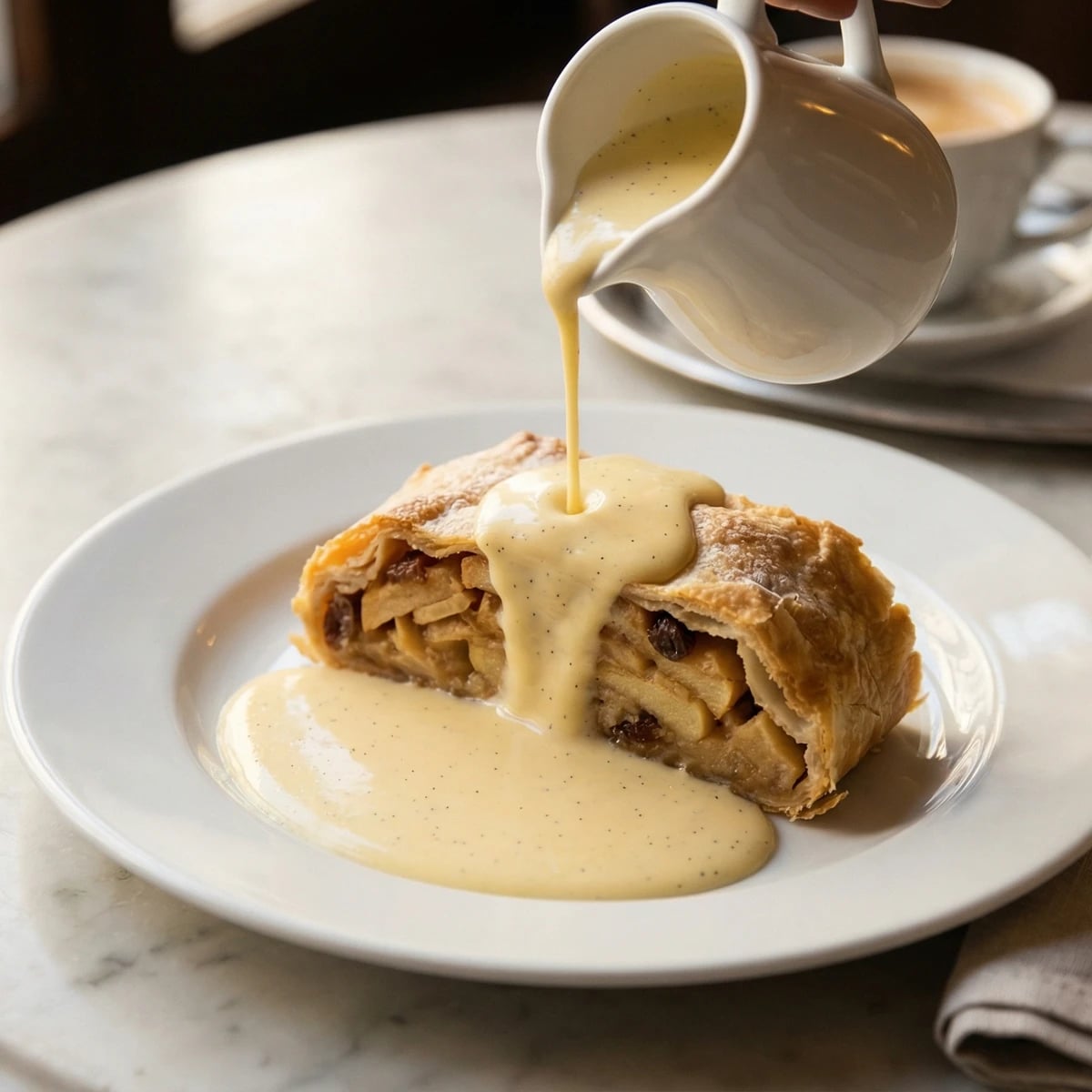
The warm vanilla custard sauce that belongs beside every Austrian Mehlspeise, made with real vanilla, good egg yolks, and the kind of patience that turns four simple ingredients into liquid gold.
In my grandmother Eva's kitchen in Kent, the smell of Vanillesauce meant Gretel was testing a recipe. You'd walk through the door and the whole house smelled of warm vanilla and hot milk, and you knew something good was coming out of the oven. The sauce was never an afterthought. It was the thing that tied the whole plate together. Gretel always said that a Mehlspeise without its sauce is only half dressed.
Warme Vanillesauce is Austria's answer to every dessert that needs something poured beside it. Not on top of it, beside it. Apfelstrudel gets a generous pool on the plate. Palatschinken get it ladled alongside. Kaiserschmarrn, Topfenknödel, Germknödel, warm Buchteln pulled apart at the table: they all want this sauce. It's the quiet constant of Austrian pastry kitchens, the recipe every cook at GAFA learns in the first week and spends the rest of their career perfecting.
The technique is not difficult, but it's unforgiving if you stop paying attention. You're cooking egg yolks with hot milk and sugar over gentle heat, stirring the whole time, coaxing the mixture to thicken without ever letting it boil. The moment it coats the back of your spoon in a smooth, creamy film, it's done. Ten seconds past that, you have sweet scrambled eggs. This is a sauce that rewards your attention and punishes your phone.
Warme Vanillesauce belongs to the broader European tradition of crème anglaise, but in Austria it developed its own identity through the Mehlspeisen culture of the 18th and 19th centuries. As Vienna's Konditoreien and Kaffeehäuser expanded their dessert repertoires, warm custard sauce became the standard companion for an enormous range of baked, boiled, and fried sweet dishes. Vanillezucker, the vanilla-scented sugar that defines Austrian baking, was already a Viennese pantry staple by the mid-1800s, and its particular rounded sweetness gives Austrian Vanillesauce a character distinct from French crème anglaise or English custard.
Quantity
4 large
Quantity
40g
Quantity
1 packet (8g)
Quantity
400ml
Quantity
1
split and scraped
Quantity
pinch
| Ingredient | Quantity |
|---|---|
| egg yolks | 4 large |
| caster sugar | 40g |
| Vanillezucker (vanilla sugar) | 1 packet (8g) |
| whole milk | 400ml |
| vanilla pod (optional)split and scraped | 1 |
| fine salt | pinch |
Pour the milk into a heavy-bottomed saucepan. If you're using a vanilla pod, split it lengthwise with a sharp knife, scrape the seeds out with the back of the blade, and add both seeds and pod to the milk. Set it over medium heat and bring it just to the point where tiny bubbles appear around the edges and the surface trembles. Do not let it boil. Pull it off the heat the moment it gets there. If you're using a vanilla pod, let the milk sit for five minutes so the seeds infuse properly. That patience pays for itself in flavor.
While the milk heats, whisk the egg yolks with the caster sugar, Vanillezucker, and salt in a heatproof bowl. Whisk until the mixture turns pale yellow and feels slightly thick when the whisk lifts. This takes about two minutes by hand. You're dissolving the sugar into the yolks and incorporating air, which helps the sauce stay smooth when the hot milk hits it.
This is the step where most people panic, and there's no need to. Ladle a small amount of the hot milk into the egg yolk mixture, whisking constantly as you pour. Then add another ladle, still whisking. You're raising the temperature of the yolks gradually so they don't seize. After two or three additions, the yolk mixture will feel warm to the touch. Now pour it all back into the saucepan with the remaining milk, whisking as you go.
Set the saucepan over low to medium-low heat. Switch from a whisk to a wooden spoon or heatproof spatula and stir continuously, making sure to reach the corners and bottom of the pan where the sauce is hottest. The sauce will look thin and milky for the first few minutes. Then you'll notice it starting to thicken, coating the spoon with a creamy film. Draw a line through the sauce on the back of the spoon with your finger. If the line holds its shape and doesn't run together, the sauce is done. This happens between 78 and 82 degrees Celsius if you're using a thermometer. If you're not, trust the spoon test. The whole process takes about five to eight minutes.
Remove the vanilla pod if you used one. Pour the sauce through a fine-mesh sieve into a warm jug or serving pitcher. The sieve catches any tiny bits of cooked egg that might have formed, giving you a sauce that's perfectly smooth. Serve it warm, not hot. Vanillesauce should flow like heavy cream when you pour it, pooling gently beside whatever Mehlspeise you've made. It's the last thing to come to the table and the first thing your guests will notice. Mahlzeit!
1 serving (about 80g)
Culinary guides, cultural storytelling, and the editorial depth that makes cooking meaningful.
Discover Culinary Explorer
Chef Elsa
Freshly grated horseradish folded with tart apple and lemon, the cold, sharp sauce that belongs beside every plate of Tafelspitz in Vienna and has done for as long as anyone can remember.

Chef Elsa
The clear, caraway-scented pan jus you pour over Schweinsbraten and Knödel, built from nothing but good pork drippings, honest stock, and the patience to let a roasting pan tell you everything it knows.

Chef Elsa
A silky butter roux sauce finished with beef broth, cream, and handfuls of fresh dill, the way every Viennese grandmother serves it alongside Tafelspitz on Sunday.

Chef Elsa
Crisp cauliflower, sweet carrots, and bright peppers in a spiced sweet-sour brine with mustard seeds, the jar you open first when the Brettljause comes out and the last one you put away.