
Chef Elsa
Apfelkren
Freshly grated horseradish folded with tart apple and lemon, the cold, sharp sauce that belongs beside every plate of Tafelspitz in Vienna and has done for as long as anyone can remember.
A cooking platform built around craft, culture, and the stories behind what we eat.
Created by
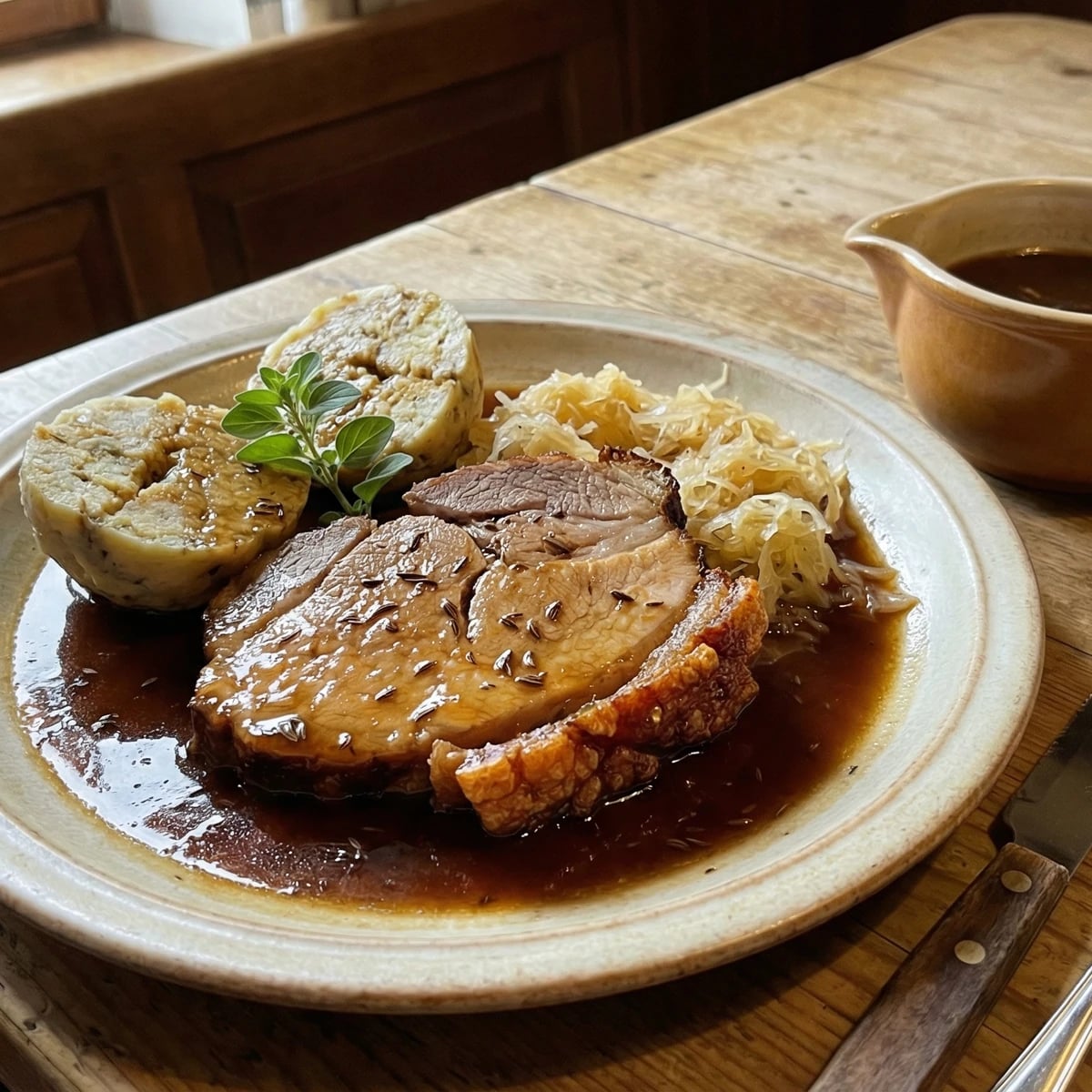
The clear, caraway-scented pan jus you pour over Schweinsbraten and Knödel, built from nothing but good pork drippings, honest stock, and the patience to let a roasting pan tell you everything it knows.
Bratensaft is the sauce Austrians don't call a sauce. It's jus. Clear, dark, deeply savory, and built entirely from what the pork leaves behind in the roasting pan. No flour. No cream. No thickener. Just the concentrated drippings of a good piece of pork, a handful of aromatics, and stock to pull it all together. When you pour it over a plate of Schweinsbraten with Knödel and Sauerkraut, it ties the whole meal into one thing.
Gretel always said the Bratensaft is how you know if the cook cared. Anybody can roast pork. The question is what you do with the pan afterward. A lazy cook throws it in the sink. A good cook puts it on the stove and turns those dark, sticky bits into liquid gold. The Bratensatz, that caramelized fond on the bottom of the pan, is flavor you've already spent hours building. Deglazing it is just claiming what's yours.
I learned to make this watching my grandmother Eva at her stove in Kent, scraping a roasting tin with a wooden spoon while Gretel stood next to her explaining why the onion needed to be cut thick, not fine. Thick pieces brown. Fine pieces burn. That stayed with me. At my restaurant in Salzburg, the Bratensaft recipe hasn't changed much from what those two women taught me. Pork drippings, caraway, garlic, onion, good stock, time. The technique is simple. What makes it extraordinary is the quality of what goes in and the patience to reduce it properly.
This is not a recipe you make on its own. You make it because you've roasted pork and the pan is sitting there full of possibility. Think of it as the final step of your Schweinsbraten, the moment the roast comes out and the pan goes onto the hob. Twenty minutes of work for a jus that turns a good Sunday lunch into one people remember.
Bratensaft belongs to the tradition of Saftl in Austrian cooking, where the natural juices of roasted meat form the foundation of the sauce rather than a separate roux-based preparation. This approach reflects the strong Bohemian and Hungarian influences on Austrian cuisine, where clear pan juices seasoned with caraway (Kümmel) became the standard accompaniment for pork across the Habsburg lands. In Austrian Gasthaus culture, the quality of the Saft served alongside Schweinsbraten remains one of the most reliable indicators of whether the kitchen takes its work seriously.
Quantity
from one Schweinsbraten (approximately 3 tablespoons)
Quantity
1 medium
cut into thick wedges
Quantity
2 cloves
lightly crushed
Quantity
1 teaspoon
Quantity
1 tablespoon
Quantity
150ml
Quantity
500ml
preferably homemade
Quantity
2
Quantity
4
Quantity
to taste
Quantity
1 teaspoon
for finishing
| Ingredient | Quantity |
|---|---|
| roasting pan drippings (rendered fat and fond) | from one Schweinsbraten (approximately 3 tablespoons) |
| onioncut into thick wedges | 1 medium |
| garliclightly crushed | 2 cloves |
| whole caraway seeds (Kümmel) | 1 teaspoon |
| tomato paste | 1 tablespoon |
| dry white wine or light Austrian beer | 150ml |
| pork or beef stockpreferably homemade | 500ml |
| bay leaves | 2 |
| whole black peppercorns | 4 |
| salt | to taste |
| cold unsalted butter (optional)for finishing | 1 teaspoon |
Once your Schweinsbraten comes out of the oven, transfer the roast to a cutting board and tent it loosely with foil. Turn your attention to the roasting pan. This is where the Bratensaft lives. You'll see rendered pork fat, dark caramelized bits stuck to the bottom, maybe some charred onion from the roast. Pour off most of the liquid fat into a heatproof bowl, but leave about two tablespoons in the pan along with all those dark sticky bits. That's your Bratensatz. Every minute of roasting built that flavor. Don't waste a speck of it.
Set the roasting pan across two burners on medium heat. Add the thick onion wedges and let them brown in the residual fat, turning once, about three minutes. Thick wedges brown. Fine pieces burn. That's a rule I learned young and it hasn't failed me yet. Add the crushed garlic and whole caraway seeds. Stir them through the fat for thirty seconds until the caraway smells warm and toasty and the garlic just starts to color. Add the tomato paste and cook it for another minute, stirring it into the drippings. The paste needs direct heat to lose its tinny raw edge and deepen into something sweet and concentrated.
Pour in the wine or beer. It will hiss and bubble up, and that's exactly what you want. Use a wooden spoon to scrape every dark bit off the bottom of the pan. Work the corners. Work the edges. Everything that's stuck there is concentrated flavor, and the liquid is dissolving it back into something you can pour. Let the wine reduce by about half, two to three minutes, until the sharp alcohol smell cooks off and what's left smells round and savoury.
Pour in the stock. Drop in the bay leaves and peppercorns. Bring everything to a steady simmer, not a rolling boil. You want lazy bubbles breaking the surface every few seconds. Let it cook for fifteen to twenty minutes, uncovered, until the liquid reduces by roughly half. The jus will darken and the flavor will concentrate. Taste it after ten minutes. If it tastes thin and watery, it needs more time. When it tastes like it could stand on its own, coating the back of a spoon in a thin, glossy layer, you're close.
Set a fine-mesh sieve over a small saucepan. Pour the jus through, pressing the onions gently with the back of a spoon to extract their liquid, then discard the solids. You should have about 300 to 350 milliliters of clear, dark, intensely flavoured jus. Taste it. Adjust the salt. If you want a touch of richness and shine, swirl in a teaspoon of cold butter off the heat. It rounds everything out without making it heavy. The jus should be thin enough to pour freely, not thick like a gravy. Austrians want Saft, not Sauce. There's a difference.
Pour the hot Bratensaft into a warm Sauciere or small jug and bring it to the table. Let people pour their own over sliced Schweinsbraten, Semmelknödel or Erdäpfelknödel, and Sauerkraut. The jus should pool around the Knödel, soaking into the bread as it sits. That first bite of Knödel saturated with Bratensaft is one of the great pleasures of Austrian cooking, and it costs you nothing but twenty minutes and a dirty roasting pan. Mahlzeit!
1 serving (about 88g)
Culinary guides, cultural storytelling, and the editorial depth that makes cooking meaningful.
Discover Culinary Explorer
Chef Elsa
Freshly grated horseradish folded with tart apple and lemon, the cold, sharp sauce that belongs beside every plate of Tafelspitz in Vienna and has done for as long as anyone can remember.

Chef Elsa
A silky butter roux sauce finished with beef broth, cream, and handfuls of fresh dill, the way every Viennese grandmother serves it alongside Tafelspitz on Sunday.

Chef Elsa
Crisp cauliflower, sweet carrots, and bright peppers in a spiced sweet-sour brine with mustard seeds, the jar you open first when the Brettljause comes out and the last one you put away.

Chef Elsa
Austria's sharp, herbal tarragon mustard, the golden-green condiment that belongs next to every sausage, every Brettljause board, and every cold cut platter you'll ever serve.