Culinary Explorer

A cooking platform built around craft, culture, and the stories behind what we eat.
Discover Culinary Explorer
Wachauer Busserl (Wachau Hazelnut Kisses)

Wachauer Busserl (Wachau Hazelnut Kisses)

Created by

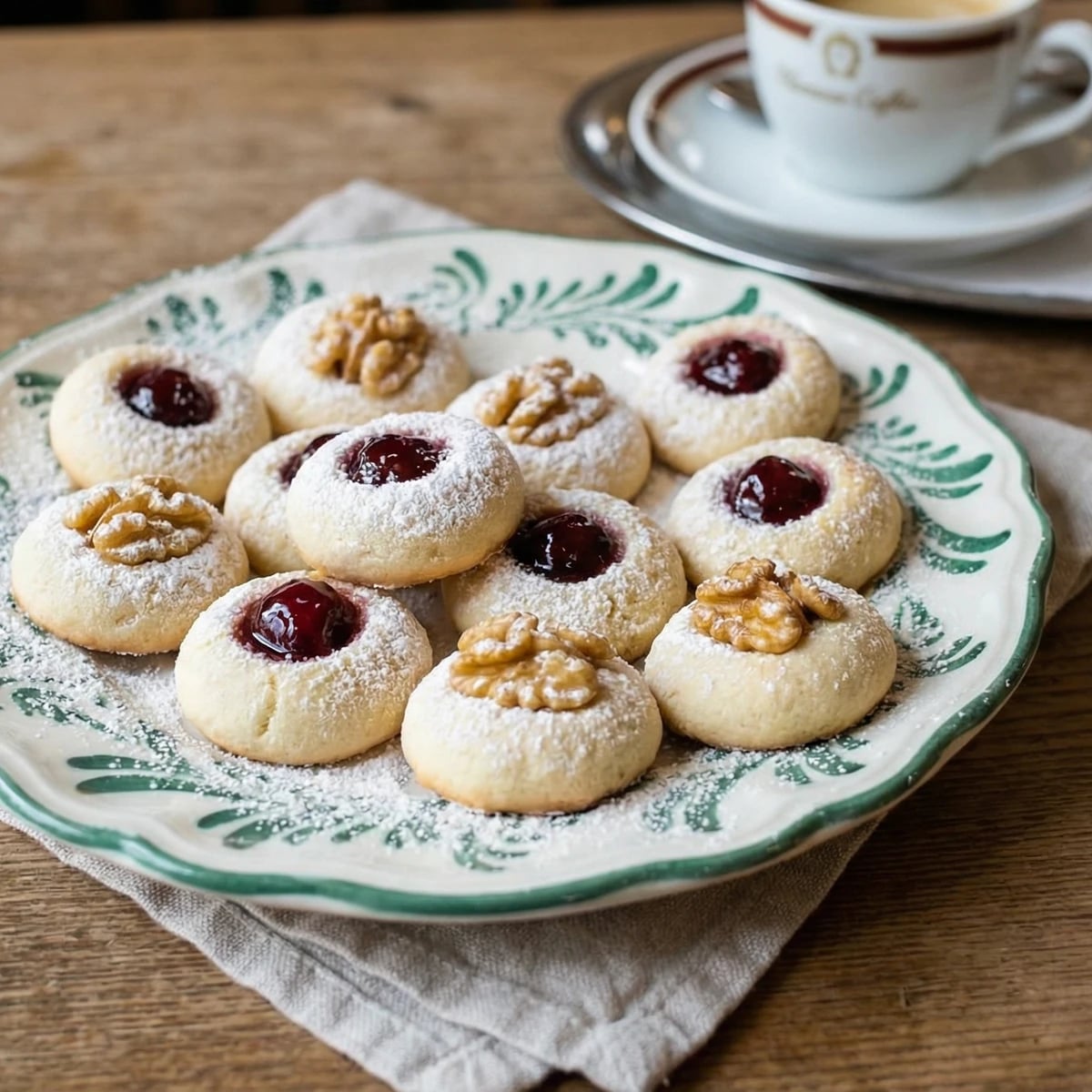
Hazelnut butter thumbprints from the Wachau valley, brightened with orange zest and filled with tart cherry jam or a walnut half. The kind of Christmas cookie that disappears before the tin is full.

Pastries & Cookies
Austrian
Christmas
Holiday
Make Ahead
30 min
Active Time
14 min cook1 hr total
Yield40 cookies

In my grandmother Eva's kitchen in Deal, the Christmas baking started in November and didn't stop until every tin was full. Gretel would arrive with her notebook and a bag of ground hazelnuts, and the two of them would spend entire afternoons at the table, rolling, pressing, filling, dusting. Wachauer Busserl were always in the first batch. Gretel said they needed time to rest in the tin, that the flavors settled and the butter softened into the nuts over a week or two. She was right. They're good the day you make them. They're better at Christmas.

Busserl means 'little kiss' in Austrian German, and these are exactly that: small, round, barely sweet hazelnut cookies with a thumbprint pressed into the center and filled with bright cherry jam or topped with a walnut half. The dough is short and sandy, more nut than flour, with a thread of orange zest running through it that you taste before you can name it. They don't look like much on the baking tray. Small pale rounds with a dip in the middle. Then you bite one and the whole thing crumbles into buttery hazelnut and that sharp hit of fruit, and you understand why Austrians guard their Weihnachtsbäckerei recipes like family secrets.

The technique is forgiving. You don't need to roll the dough thin or cut it into shapes or worry about spreading. You scoop, you roll, you press, you fill. If your thumbprint cracks at the edges, that's fine. The jam fills the cracks and everything bakes together. These are home cookies, not Konditorei showpieces, and they're better for it.

The Wachau valley, a UNESCO World Heritage stretch of the Danube between Melk and Krems in Lower Austria, is best known for its Grüner Veltliner wines and Wachau apricots, but its baking traditions run just as deep. Wachauer Busserl belong to the broader Austrian Weihnachtsbäckerei tradition, where families spend weeks before Christmas producing dozens of cookie varieties to fill decorative tins. The hazelnut-heavy recipes of the Wachau reflect the region's orchards and the Austrian preference for nut-based pastries over the butter-and-sugar cookies more common in northern European traditions.

The technique, the tradition, and the story behind every dish.

Discover Culinary Explorer

Ingredients

ground hazelnuts

Quantity

200g

plain flour

Quantity

250g

powdered sugar (Staubzucker)

Quantity

100g

vanilla sugar (Vanillezucker)

Quantity

1 packet (8g)

salt

Quantity

pinch

orange

Quantity

1

finely grated zest only

unsalted butter

Quantity

200g

cold and cubed

egg yolk

Quantity

1 large

sour cherry jam (Weichselmarmelade)

Quantity

100g

for filling

walnut halves (optional)

Quantity

20

for topping

powdered sugar

Quantity

for dusting

Equipment Needed

  • Two baking trays
  • Parchment paper
  • Fine sieve for dusting powdered sugar
  • Mixing bowl
  • Cling film

Instructions

  1. 1

    Toast the hazelnuts

    Spread the ground hazelnuts on a dry baking tray and toast them in a 160°C oven for six to eight minutes, stirring once halfway through. Watch them carefully. You want them fragrant and barely golden, not dark. Toasting deepens the flavor and removes excess moisture so the cookies stay sandy and short instead of turning dense. Let them cool completely before you use them.

    If you're grinding whole hazelnuts yourself, pulse them in short bursts. You want a coarse, sandy texture, not hazelnut butter. A tablespoon of flour from the recipe pulsed in with the nuts helps absorb the oil and keeps things dry.
  2. 2

    Make the dough

    Combine the flour, cooled toasted hazelnuts, powdered sugar, vanilla sugar, salt, and orange zest in a large bowl. Toss the cold butter cubes through the dry mixture, then work everything together with your fingertips until it looks like coarse breadcrumbs. Add the egg yolk and press the dough together until it just holds. Don't knead it. This is a short dough, closer to Mürbteig than anything elastic. The less you handle it, the more tender the cookies will be.

    Cold butter is not a suggestion. If the butter softens, the dough gets greasy and the cookies spread instead of holding their shape. If your kitchen is warm, chill the cubed butter in the freezer for ten minutes before you start.
  3. 3

    Rest the dough

    Flatten the dough into a disc, wrap it in cling film, and refrigerate for at least thirty minutes. The dough needs to firm up so you can roll it without it crumbling apart in your hands. It also gives the flour time to hydrate and the butter time to resolidify, which means cleaner edges and better texture after baking.

  4. 4

    Shape the Busserl

    Preheat your oven to 170°C. Line two baking trays with parchment. Scoop rounded teaspoons of dough and roll them into balls about the size of a large cherry. Place them on the trays with two centimeters of space between each one. They won't spread much, but they need room to breathe. Press your thumb firmly into the center of each ball to create a deep well. If the edges crack, pinch them back together gently. The well needs to be deep enough to hold a good spoonful of jam.

    Dip your thumb in powdered sugar before pressing. It keeps the dough from sticking and gives you a cleaner impression.
  5. 5

    Fill and top

    Spoon a small amount of sour cherry jam into each well, about half a teaspoon. Don't overfill or the jam will bubble over and burn on the tray. For the walnut-topped version, skip the jam and press a walnut half gently into the thumbprint instead. I usually do half and half because I can never choose, and a mixed tin looks beautiful.

  6. 6

    Bake the cookies

    Bake for twelve to fourteen minutes. The cookies are done when the edges turn the palest gold and the bottoms are lightly browned. The centers will still look slightly soft. That's correct. They firm up as they cool. If you wait until they look fully done in the oven, they'll be dry by the time they reach the tin. Pull them out while you're still slightly nervous about it.

    Gretel always said Weihnachtsbäckerei should be pale, not tanned. If your cookies are browning too much, your oven runs hot. Drop the temperature by ten degrees and add a minute.
  7. 7

    Cool and dust

    Let the Busserl cool on the tray for five minutes, then transfer them to a wire rack. They're fragile when hot, so use a thin spatula and move gently. Once completely cool, dust them with powdered sugar through a fine sieve. The sugar should settle like snow on the edges and around the jam. Don't dust while they're warm or the sugar melts into a sticky film instead of sitting clean and white on top.

Chef Tips

  • Use real Vanillezucker. Austrian baking depends on it. You can buy it in packets or make your own by burying a split vanilla pod in a jar of powdered sugar for a week. Vanilla extract dissolved in sugar is not the same thing. The flavor is rounder, less sharp, and it disappears into the dough the way it's supposed to.
  • Sour cherry jam, Weichselmarmelade, is the traditional filling and the tartness cuts through the rich, buttery dough beautifully. If you can't find it, a good quality apricot jam (Marillenmarmelade) works, and it's what Gretel often used because she could get Wachau apricot preserves from a shop in London. Avoid anything too sweet. The jam needs to push back against the butter and nuts.
  • These cookies improve with age. Store them in a tin with a sheet of parchment between layers. After three or four days, the butter softens into the hazelnuts and the orange zest blooms. By the second week they're perfect. This is why Austrian families start their Weihnachtsbäckerei in late November.
  • If you want to be traditional about it, make a mixed tin: half with cherry jam, half with walnut tops. Present them dusted with powdered sugar on a small plate alongside a cup of coffee. This is good Austrian home cooking at its best.

Advance Preparation

  • The dough can be made up to two days ahead and refrigerated. Let it sit at room temperature for ten minutes before shaping, or it will crack when you try to roll it.
  • Baked Busserl store beautifully in an airtight tin for up to three weeks. They actually taste better after a few days of resting. Layer them between sheets of parchment so they don't stick.
  • Unbaked, shaped Busserl (without the jam filling) can be frozen on a tray, then transferred to a freezer bag. Bake from frozen, adding two minutes to the baking time, and fill with jam after baking.

Frequently Asked Questions

Nutrition Information

1 serving (about 22g)

Calories
115 calories
Total Fat
8 g
Saturated Fat
3 g
Trans Fat
0 g
Unsaturated Fat
5 g
Cholesterol
15 mg
Sodium
10 mg
Total Carbohydrates
11 g
Dietary Fiber
1 g
Sugars
5 g
Protein
2 g

Note: Chef personas and recipes are created with AI assistance. Cook with care: follow safe food-handling practices, check doneness with a thermometer when needed, and adapt for allergies and your kitchen.

Where cooking meets culture.

Culinary guides, cultural storytelling, and the editorial depth that makes cooking meaningful.

Discover Culinary Explorer

More from Weihnachtsbäckerei (Austrian Christmas Cookies)

Browse the full collection