Culinary Explorer

A cooking platform built around craft, culture, and the stories behind what we eat.
Discover Culinary Explorer
Brabanzerl (Viennese Brabant Cookies)

Brabanzerl (Viennese Brabant Cookies)

Created by

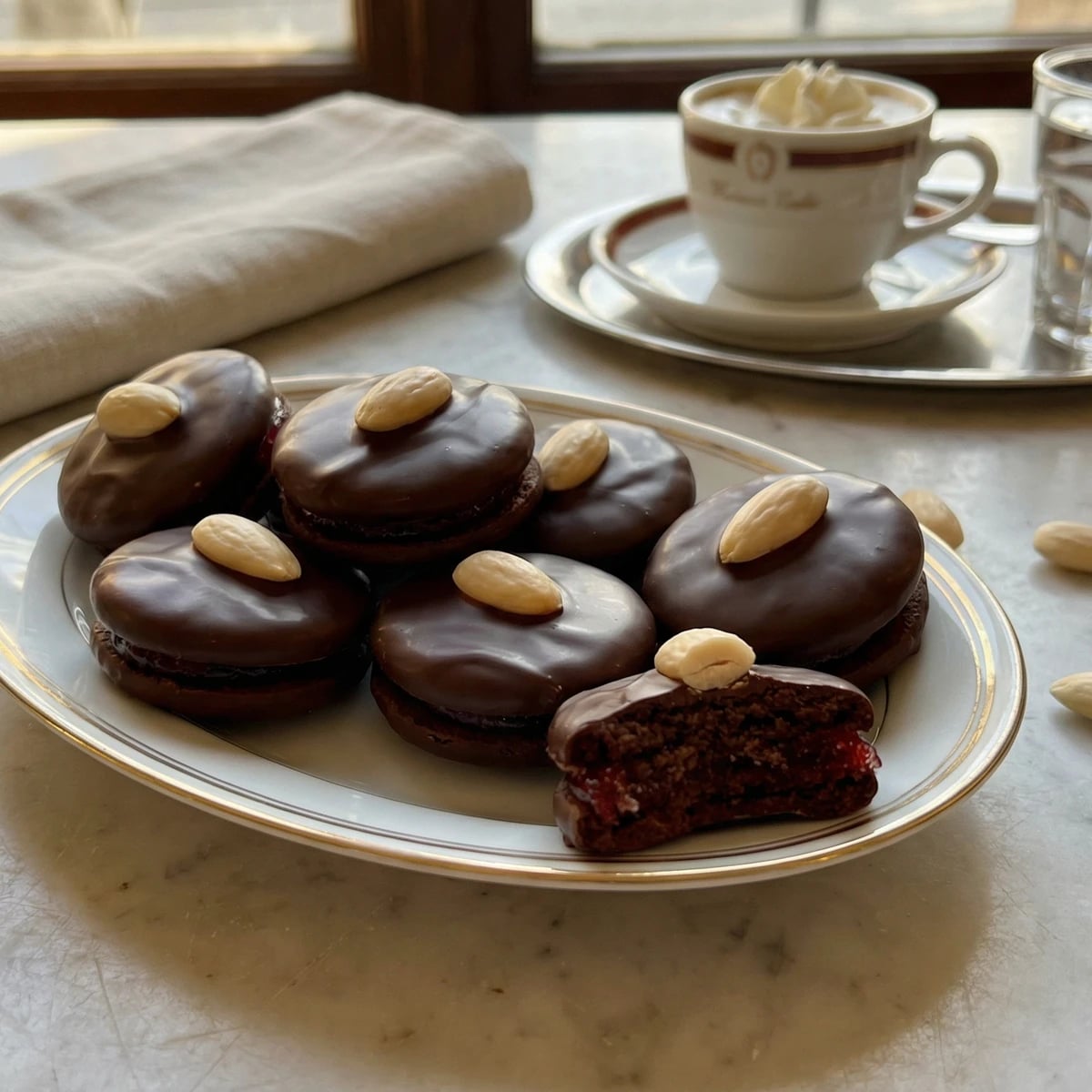
Viennese chocolate shortcrust rounds filled with sharp Ribisel jelly, dipped in dark chocolate, and crowned with a single blanched almond. The kind of Christmas cookie that makes you understand why Austrians start baking in November.

Pastries & Cookies
Austrian
Christmas
Holiday
Special Occasion
40 min
Active Time
25 min cook3 hr 30 min total
Yield24 sandwich cookies

In my grandmother Eva's kitchen in Kent, the Christmas baking started weeks before Advent. Gretel would arrive with her notebook and a tin of Dutch-process cocoa, and the two of them would work through the Weihnachtsbäckerei list like generals planning a campaign. Vanillekipferl first, because they needed time to soften. Then Linzer Augen. Then, near the end, the Brabanzerl, which Gretel insisted had to be made with a steady hand and good chocolate or not at all.

Brabanzerl are small, precise, and beautiful. Two rounds of dark, cocoa-rich shortcrust pressed together with a thin layer of Ribisel jelly (that's redcurrant, tart and jewel-bright), then the whole sandwich dipped in dark chocolate and finished with a single blanched almond on top. When you bite through, you get the snap of tempered chocolate, the sandy crumble of the biscuit, and then that sharp burst of fruit cutting through everything. Three textures, three flavors, in something no bigger than a walnut.

They take patience. The dough needs to chill properly or it fights you when you roll it. The jelly must be smooth and applied thin or it oozes out the sides. The chocolate coating needs to be the right temperature or it blooms and goes chalky. None of this is difficult, but all of it rewards you for paying attention. Gretel always said the Brabanzerl was where you learned whether a baker had discipline. I still hear her voice every time I temper the chocolate.

The name Brabanzerl points to the Duchy of Brabant in the Low Countries, a Habsburg territory for centuries, and reflects how Viennese Konditorei culture absorbed influences from across the empire's vast holdings. Brabanzerl became a fixture of the Viennese Weihnachtsbäckerei, the elaborate Christmas cookie tradition where households produce a dozen or more varieties in the weeks before Advent. The pairing of chocolate biscuit with Ribisel (redcurrant) jelly is distinctly Viennese, combining the city's love of cocoa with the sharp preserved fruits that Austrian cooks have relied on for centuries to cut through rich butter doughs.

The technique, the tradition, and the story behind every dish.

Discover Culinary Explorer

Ingredients

plain flour

Quantity

200g

ground almonds

Quantity

50g

Dutch-process cocoa powder

Quantity

30g

unsalted butter

Quantity

150g

cold and cubed

powdered sugar (Staubzucker)

Quantity

80g

egg yolks

Quantity

2

vanilla sugar (Vanillezucker)

Quantity

8g (1 packet)

fine salt

Quantity

pinch

Ribisel (redcurrant) jelly

Quantity

150g

sieved smooth

dark chocolate (minimum 60% cocoa)

Quantity

200g

finely chopped

blanched almond halves

Quantity

24

Equipment Needed

  • Rolling pin
  • 4cm round cookie cutter
  • Heatproof bowl for tempering chocolate
  • Small saucepan for water bath
  • Baking sheets lined with parchment
  • Wire cooling rack
  • Fine-mesh sieve (for the jelly)

Instructions

  1. 1

    Make the chocolate dough

    Sift the flour, cocoa powder, and ground almonds together into a large bowl. Add the cold cubed butter and rub it in with your fingertips until the mixture looks like damp, dark sand. Work quickly. You want the butter cold, not melted from the warmth of your hands. Add the Staubzucker, Vanillezucker, salt, and the two egg yolks. Bring everything together into a smooth dough. Don't knead it. The moment it holds together in a ball, stop. Overworked shortcrust turns tough because you've developed the gluten, and these biscuits should crumble, not chew.

    Use Dutch-process cocoa, not natural cocoa. Dutch-process has been alkalized, which gives it a deeper, rounder chocolate flavor and that dark color you want. Natural cocoa tastes sharper and bakes lighter, which is wrong for Brabanzerl.
  2. 2

    Chill the dough

    Flatten the dough into a disc about two centimeters thick, wrap it in cling film, and refrigerate for at least one hour. The dough needs to be firm and cold before you roll it. If it's soft, it sticks to everything and the rounds lose their clean edges. Don't skip this. Walk away and make yourself a coffee. The dough will tell you when it's ready by feeling firm but not rock-hard when you press it with your thumb.

    If your kitchen is warm, chill the dough for ninety minutes. In summer, I put it in the freezer for thirty minutes instead. You need it cold enough to roll cleanly but not so hard that it cracks.
  3. 3

    Roll and cut the rounds

    Preheat your oven to 170°C (340°F). Line two baking sheets with parchment. Roll the dough out on a lightly floured surface to about four millimeters thick. Dust your rolling pin with a little cocoa powder instead of extra flour to keep the color dark. Cut rounds with a 4cm cutter, pressing straight down without twisting. Twisting seals the edges and the biscuits won't rise evenly. Gather the scraps gently, press them together, chill for ten minutes, and roll again. You should get about 48 rounds, enough for 24 sandwich cookies.

  4. 4

    Bake the biscuits

    Place the rounds on the prepared sheets with a centimeter of space between them. They barely spread, so you can fit them close. Bake for 10 to 12 minutes. Here's the thing about chocolate biscuits: you can't judge doneness by color the way you would with a plain shortbread. They're already dark. Instead, touch one gently in the center. It should feel dry and just firm, not soft. They'll firm up further as they cool. Pull them at 10 minutes if you're unsure. A slightly underdone Brabanzerl is tender. An overbaked one is bitter and dry, and the cocoa turns unforgiving. Let them cool completely on the sheets before you touch them. They're fragile when warm.

  5. 5

    Fill with Ribisel jelly

    Push the Ribisel jelly through a fine sieve to remove any seeds or lumps. You want it perfectly smooth, almost like a glaze. Turn half the cooled biscuits flat-side up. Using a small spoon or piping bag, place about half a teaspoon of jelly in the center of each. Not too much. The jelly should stay inside the sandwich when you press it, not squish out the edges. Press a second biscuit gently on top, flat side down, until the jelly just reaches the edges. The tartness of the Ribisel is what makes these cookies sing. Without it, the chocolate would be one-dimensional. With it, every bite has somewhere to go.

    Ribisel jelly is redcurrant jelly. If you can't find it labeled as such, look for redcurrant jelly or redcurrant preserve in specialty shops. In a pinch, a good-quality seedless raspberry jam works, but the flavor is sweeter and less sharp. The tartness matters.
  6. 6

    Temper the chocolate

    Melt two-thirds of the chopped chocolate in a heatproof bowl set over barely simmering water. The bowl should not touch the water. Stir gently until smooth and the chocolate reaches about 50°C. Remove from the heat and add the remaining third of the chopped chocolate, stirring steadily until every piece has melted and the temperature drops to around 31°C. It should look glossy and feel cool when you dab a drop on your lower lip. This is a simple temper. It's what gives the finished coating that clean snap and shine instead of a dull, chalky surface.

    If you don't have a thermometer, the lip test works well. Dab a tiny bit of chocolate on your lower lip. If it feels just barely cool, not warm, not cold, you're in the right range. Gretel never owned a chocolate thermometer in her life and her coatings were always perfect.
  7. 7

    Coat and finish

    Hold each sandwich cookie between two fingers and dip it into the tempered chocolate, turning it to coat completely. Let the excess drip back into the bowl. Place the coated cookie on a sheet of parchment. While the chocolate is still wet, press a single blanched almond half gently into the top. Don't push it in deep. Just enough that it holds. Work with confidence. The chocolate sets quickly once tempered, and hesitation leaves fingermarks. Once all the cookies are coated and topped, leave them at cool room temperature until the chocolate sets firm and glossy, about thirty minutes. Don't refrigerate them. The fridge causes condensation and the chocolate loses its shine.

    If your chocolate starts to thicken as you work, set it back over the warm water for ten seconds at a time, stirring gently. You want it fluid enough to coat smoothly but not so warm that you've broken the temper.

Chef Tips

  • Buy your almonds whole and blanch them yourself by dropping them in boiling water for sixty seconds, then slipping the skins off. They split naturally into halves and look far better than the pre-blanched ones that have been sitting in a bag for months.
  • Store the finished Brabanzerl in a single layer in a cool, dry tin with parchment between layers. They keep beautifully for three weeks this way, which is why they're perfect for the Weihnachtsbäckerei. The flavors actually deepen after a few days as the jelly softens the biscuit just slightly from the inside.
  • If this is your first time tempering chocolate, do a test. Dip a spoon and set it down. If the chocolate sets glossy and snaps cleanly in five minutes, you've got it. If it stays soft or looks streaky, start the tempering over. Better to waste five minutes than coat all your cookies in chocolate that won't set properly.
  • The ground almonds in the dough aren't just for flavor. They absorb moisture and give the shortcrust that sandy, melt-on-the-tongue texture that plain flour alone can't achieve. Don't leave them out.

Advance Preparation

  • The dough can be made up to two days ahead, wrapped tightly, and refrigerated. Let it sit at room temperature for fifteen minutes before rolling.
  • The biscuit rounds can be baked three days ahead and stored in an airtight tin before filling and coating. They actually handle better when fully cooled and set.
  • Finished Brabanzerl keep for up to three weeks in a cool, dry tin, making them ideal for baking well ahead of Christmas.

Frequently Asked Questions

Nutrition Information

1 serving (about 35g)

Calories
175 calories
Total Fat
10 g
Saturated Fat
5 g
Trans Fat
0 g
Unsaturated Fat
5 g
Cholesterol
30 mg
Sodium
15 mg
Total Carbohydrates
19 g
Dietary Fiber
2 g
Sugars
11 g
Protein
2 g

Note: Chef personas and recipes are created with AI assistance. Cook with care: follow safe food-handling practices, check doneness with a thermometer when needed, and adapt for allergies and your kitchen.

Where cooking meets culture.

Culinary guides, cultural storytelling, and the editorial depth that makes cooking meaningful.

Discover Culinary Explorer

More from Weihnachtsbäckerei (Austrian Christmas Cookies)

Browse the full collection