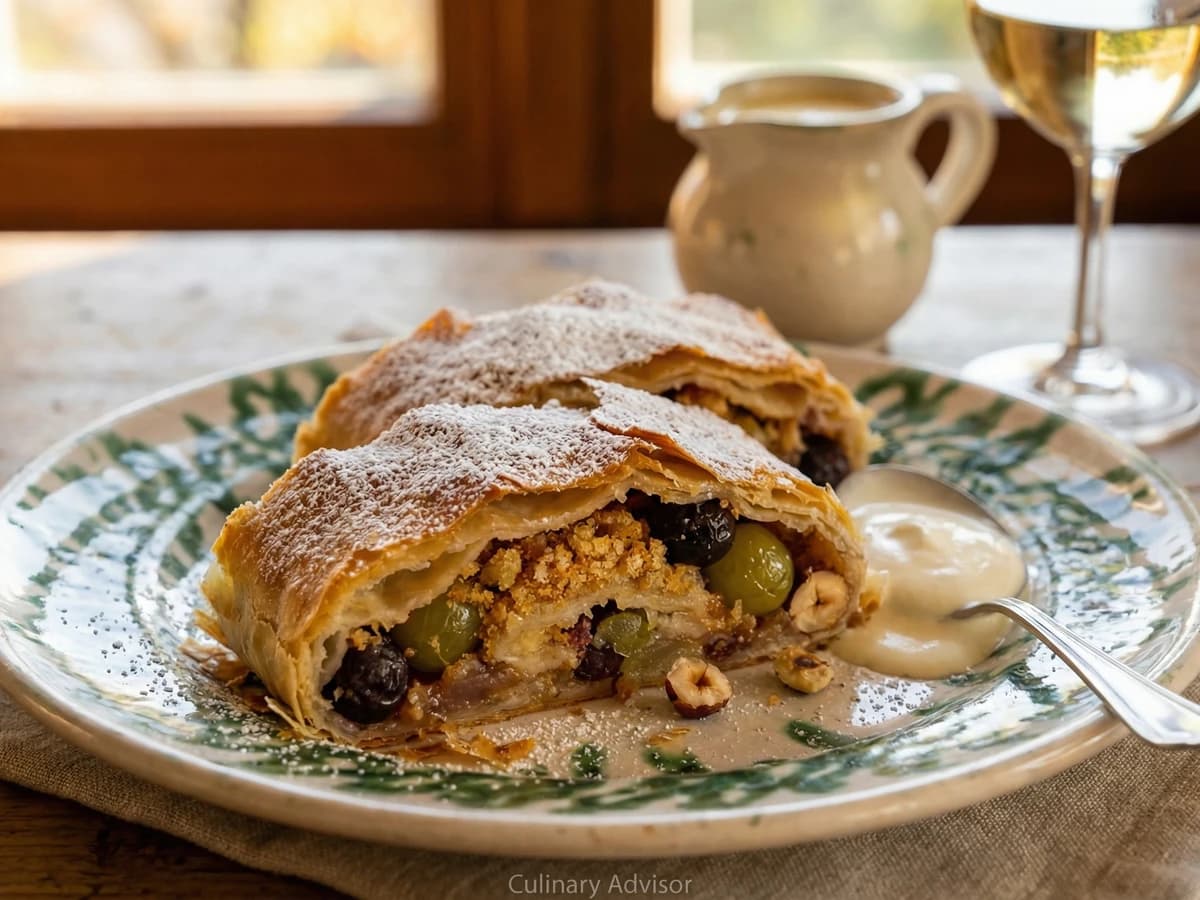
Buttery Mürbteig bars with piped marzipan tracks and Ribiselmarmelade gleaming between like signal lights, the Viennese Christmas cookie that rewards precision with something beautiful enough to give as a gift.
Pastries & Cookies
Austrian
Christmas
Holiday
Make Ahead
45 min
Active Time
18 min cook•2 hr total
YieldAbout 40 bars
In my grandmother Eva's kitchen in Kent, the Eisenbahner were always the last batch of Christmas cookies we made, because they required the steadiest hands. Gretel would pipe the marzipan in clean parallel lines along the dough, fast and sure, while I stood on my stool watching like she was performing surgery. When I tried it myself at eight or nine, my lines wobbled. She looked at them, looked at me, and said: "The train still runs. Fill the jam." That was Gretel. Perfection mattered, but not more than getting the cookies done.
Eisenbahner belong to the Austrian Weihnachtsbäckerei, the annual Christmas baking marathon that takes over every kitchen in Austria from late November until Advent. Most families have a list of six, eight, ten different Kekse they make every year, and everyone argues about which ones are essential. Vanillekipferl, always. Linzer Augen, usually. Eisenbahner sit in that second tier of cookies that separate a serious Christmas baker from someone just going through the motions. They take a little more effort, a little more patience, and the result is something that looks like it came from a Konditorei window.
The construction is simple once you understand the logic. You bake a sheet of Mürbteig, the fine, sandy shortcrust that Austrian baking runs on. Before it goes into the oven, you pipe parallel tracks of marzipan across the surface. After baking, you fill the channels between the marzipan with warm jam, let everything set, then slice into neat bars. The name comes from the finished look: those parallel marzipan ridges with the red jam between them reminded someone of railroad tracks. Austrians love naming food after what it looks like, and this one stuck.
Eisenbahner entered Austrian baking tradition in the mid-to-late 19th century, when the rapid expansion of the Kaiserin Elisabeth Westbahn and other Habsburg railway lines made trains a symbol of modernity and progress. Austrian bakers had a long habit of naming Kekse after everyday objects and professions: Husarenkrapferl for hussars, Bischofsbrot for bishops. The railroad cookie joined that tradition, its marzipan ridges and jam channels evoking the parallel rails and colored signal lights of the new railway age. By the early 20th century, Eisenbahner had become a fixture of the Viennese Weihnachtsbäckerei, appearing in Konditorei displays alongside Vanillekipferl and Linzer Augen.
The technique, the tradition, and the story behind every dish.
Sift the flour onto a clean work surface and scatter the cold butter cubes over it. Add the powdered sugar, egg yolks, Vanillezucker, salt, and lemon zest. Using a pastry scraper or your fingertips, work everything together quickly into a smooth dough. Quick is the word here. The butter must stay cold. If you knead this like bread dough, the warmth from your hands will melt the butter and you'll end up with a tough, greasy base instead of a sandy, crumbling one. As soon as the dough comes together, shape it into a flat disc, wrap it in cling film, and refrigerate for at least one hour.
Gretel always said: Mürbteig means 'tender dough,' and it will only be tender if you leave it alone. Work it fast, chill it long. That's the whole secret.
2
Roll the dough
Preheat your oven to 175°C (350°F). Line a large baking tray with parchment paper. On a lightly floured surface, roll the chilled dough into a rectangle about 25 by 35 centimeters and roughly four millimeters thick. The edges don't need to be razor-sharp, but aim for even thickness. Transfer the dough to the lined tray. If it cracks or tears during the move, just press it back together with your fingers. Mürbteig forgives that kind of thing.
3
Prepare the marzipan
Knead the marzipan until pliable. If it's dry or crumbly, work in the egg white a little at a time until the marzipan is smooth enough to pipe. You want a consistency firm enough to hold its shape but soft enough to push through a piping bag without a fight. Load the marzipan into a piping bag fitted with a round tip, about 8 to 10 millimeters wide.
Buy marzipan with at least 50% almond content. The cheap versions padded out with sugar and starch taste flat and go gritty when baked. Austrian and German brands like Niederegger or Lubeca are worth seeking out. This is not the place to economize.
4
Pipe the marzipan tracks
Pipe parallel lines of marzipan lengthwise along the dough, spacing them about two centimeters apart. You should end up with five or six tracks running the length of the rectangle, with channels between them. Keep the lines as straight and even as you can manage. These are the railroad tracks, and the channels will hold the jam after baking. Press the marzipan down very gently with a wet finger if any ridges stand up too high. You want them to bake evenly without browning too dark at the peaks.
5
Bake the base
Bake for 15 to 18 minutes, until the Mürbteig turns a pale golden color and the marzipan takes on a light toast at the edges. Watch it carefully from the 14-minute mark. Mürbteig goes from golden to too dark in about sixty seconds, and there's no rescuing it once it crosses that line. The dough should feel firm to the touch but still slightly yielding in the center. It firms up as it cools. Remove from the oven and let it cool on the tray for ten minutes.
6
Fill with jam
Warm the Ribiselmarmelade in a small saucepan over low heat until it loosens and becomes pourable. If there are fruit pieces, press it through a sieve first. You want a smooth, glossy jam that will set cleanly between the tracks. Using a small spoon or a piping bag, carefully fill the channels between the marzipan lines with the warm jam. Fill them generously but stop just below the top of the marzipan ridges. The jam will settle as it cools. Let the entire tray cool completely at room temperature until the jam sets firm. This takes about an hour. Do not rush this or you'll smear jam across the cuts when you slice.
Ribiselmarmelade, redcurrant jam, is the traditional choice and the best one. The tartness cuts through the sweetness of the marzipan and the buttery dough. Apricot jam (Marillenmarmelade) works too, especially if you can find one with real Wachau apricots. Avoid anything with seeds or chunks. The jam needs to be perfectly smooth.
7
Slice into bars
Once the jam has set completely, use a long, sharp knife to trim the uneven edges of the rectangle. Cut crosswise into bars about three centimeters wide. Each bar should have a marzipan track running along both edges with a stripe of jewel-red jam between. Clean the knife blade between cuts with a damp cloth. If jam smears across the marzipan, your jam hasn't set enough or your knife is dragging instead of slicing. A single confident stroke works better than sawing. Dust the finished bars lightly with powdered sugar. Mahlzeit!
Chef Tips
•If the dough warms up while you're rolling it and starts to stick or go soft, slide it back into the fridge for fifteen minutes. Mürbteig is forgiving about being re-chilled. It is not forgiving about being overworked at room temperature.
•No piping bag? Roll the marzipan into long ropes between your palms, about the thickness of a pencil, and lay them along the dough. Press them down gently. Gretel did it this way when she couldn't be bothered with the piping bag, and honestly it gives you a slightly more rustic, homemade look that I prefer.
•Store these in a tin with parchment paper between the layers. They keep beautifully for two to three weeks in a cool place, and they actually improve after a day or two as the flavors meld. This makes them perfect for the Weihnachtsbäckerei, where you're baking in batches through all of Advent.
Advance Preparation
•The Mürbteig dough can be made up to two days ahead and refrigerated, or frozen for up to a month. Thaw overnight in the fridge before rolling.
•The fully assembled and sliced Eisenbahner keep for two to three weeks stored in an airtight tin at cool room temperature, with parchment between layers. They're one of the best make-ahead Christmas cookies in the Austrian tradition.
•The marzipan can be prepared and loaded into the piping bag a day ahead. Wrap the filled bag tightly in cling film and refrigerate. Let it come to room temperature for 20 minutes before piping so it flows smoothly.
Frequently Asked Questions
Nutrition Information
1 serving (about 24g)
Calories
110 calories
Total Fat
6 g
Saturated Fat
3 g
Trans Fat
0 g
Unsaturated Fat
3 g
Cholesterol
20 mg
Sodium
13 mg
Total Carbohydrates
13 g
Dietary Fiber
0 g
Sugars
7 g
Protein
2 g
Where cooking meets culture.
Culinary guides, cultural storytelling, and the editorial depth that makes cooking meaningful.