
Chef Jeong-sun
Aehobak-guk (애호박국, Korean Zucchini Soup)
A clean summer soup of Korean zucchini and salted shrimp, built on quick anchovy-kelp broth and finished before the half-moons lose their shape on a weeknight table.
A cooking platform built around craft, culture, and the stories behind what we eat.
Created by
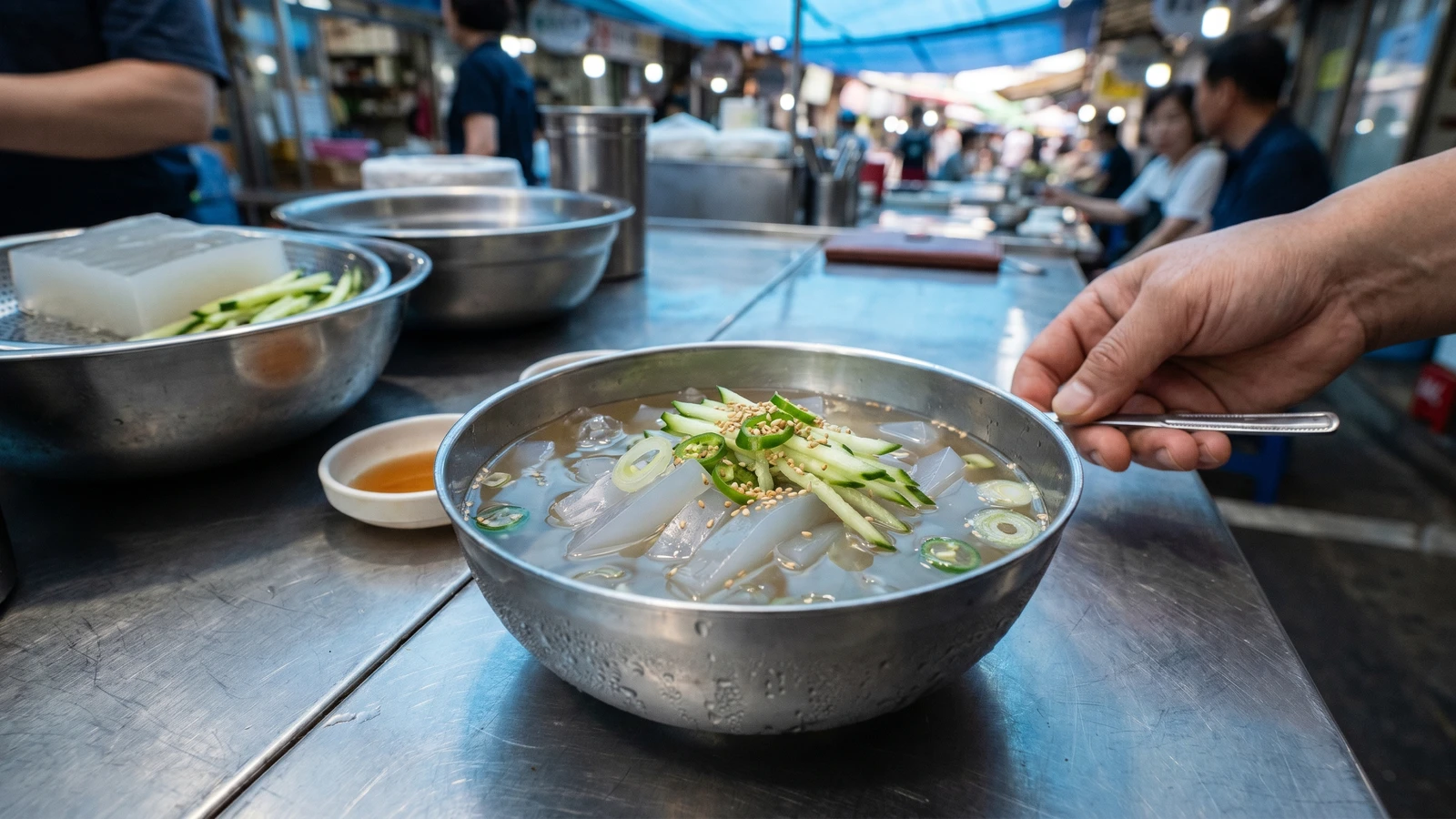
Long slivers of agar jelly in a clear soy-vinegar broth, served icy with cucumber and sesame; a quiet summer bowl where the knife work matters more than the stove.
High summer is when umu belongs on the table. In the market it sits in pale blocks, softer than muk and quieter than tofu, and people walk past because it looks like nothing. That is its nature. Umu-naengguk is almost all texture, so the cook's work is not to decorate it but to cut it long and make the broth cold and sharp enough to wake it.
Master Seong-nyeo made us cut the jelly with the same patience she gave to japchae vegetables, long slivers no wider than a matchstick. Short pieces sink and disappear. Long ones carry the vinegar and chill to the spoon, which is why the knife work matters in a dish that has no heat and almost no cooking.
This is a weeknight summer bowl, often eaten when rice feels heavy and the kitchen should not get hotter. Buy the umu-muk if your market has it; that corner is safe to cut. Do not shorten the chilling, and do not guess at the seasoning. 손맛 is real; I measure it anyway, because a clear broth has nowhere to hide too much soy sauce or too little vinegar.
Umu (우무) is Korean agar jelly made by simmering and straining 우뭇가사리, a Gelidium red seaweed, then cooling the liquid until it sets. The seaweed was gathered along rocky southern coasts and Jeju waters, and agar, called 한천 (hancheon), became a wider commercial food in Korea in the twentieth century as coastal processing grew. Umu-naengguk belongs to practical summer cooking, not palace records: cheap jelly cut into threads, sharpened with vinegar, and eaten cold when the kitchen needed to stay quiet.
Quantity
3 cups
Quantity
1 piece, about 3 inches square
Quantity
450g
well chilled
Quantity
1 Korean cucumber or 2 Persian cucumbers (about 160g)
julienned
Quantity
3/4 teaspoon
divided
Quantity
3 tablespoons
Quantity
1 tablespoon
Quantity
1 1/2 teaspoons
Quantity
1/4 teaspoon
finely grated
Quantity
1
very thinly sliced
Quantity
1
thinly sliced
Quantity
1 teaspoon
Quantity
1 cup
to serve
| Ingredient | Quantity |
|---|---|
| cold filtered water | 3 cups |
| dried kelp (dasima) | 1 piece, about 3 inches square |
| prepared umu-muk (agar jelly block)well chilled | 450g |
| Korean cucumber or Persian cucumbersjulienned | 1 Korean cucumber or 2 Persian cucumbers (about 160g) |
| fine sea saltdivided | 3/4 teaspoon |
| rice vinegar or Korean apple vinegar | 3 tablespoons |
| guk-ganjang (Korean soup soy sauce) | 1 tablespoon |
| sugar | 1 1/2 teaspoons |
| garlicfinely grated | 1/4 teaspoon |
| scallionvery thinly sliced | 1 |
| green chili (optional)thinly sliced | 1 |
| toasted sesame seeds | 1 teaspoon |
| cracked iceto serve | 1 cup |
Put the cold water and kelp in a measuring jug and refrigerate 30 minutes, or up to overnight. Lift out the kelp. Cold-steeping gives the broth a little body without making it taste cooked; boiling is for other soups, not this clear summer bowl.
Rinse the agar jelly under cold running water and drain it well. Cut the block into 3 mm, or 1/8 inch, sheets, then stack a few sheets and cut them into long strips, 10 to 12 cm long. Do not cube it. Short pieces slide off the spoon; long strips catch the broth and make the dish what it is.
Toss the julienned cucumber with 1/4 teaspoon of the salt and set it aside for 5 minutes. Drain off any liquid, but do not squeeze it dry. The salt seasons the cucumber and pulls away water that would thin the broth.
In a large bowl, whisk the cold kelp water with the vinegar, guk-ganjang, sugar, remaining 1/2 teaspoon salt, and grated garlic until the sugar dissolves. Taste it cold. It should be a little sharper and saltier than a soup you would drink alone, because the umu brings almost no flavor and the ice will soften the edges.
Add the umu strips and salted cucumber to the broth. Fold them through with chopsticks or clean fingers, lifting instead of stirring hard. Agar jelly breaks if you bully it, and broken bits make the bowl look tired before it reaches the table.
Divide the soup among chilled bowls and add the cracked ice. Scatter scallion, green chili if using, and toasted sesame seeds over the top. Taste after the ice sits for 1 minute; if the broth has gone flat, add 1 teaspoon vinegar and a small pinch of salt to each bowl. Serve at once, while the vessel is beaded with cold.
1 serving (about 390g)
Culinary guides, cultural storytelling, and the editorial depth that makes cooking meaningful.
Discover Culinary ExplorerChef Jeong-sun
A clean summer soup of Korean zucchini and salted shrimp, built on quick anchovy-kelp broth and finished before the half-moons lose their shape on a weeknight table.
Chef Jeong-sun
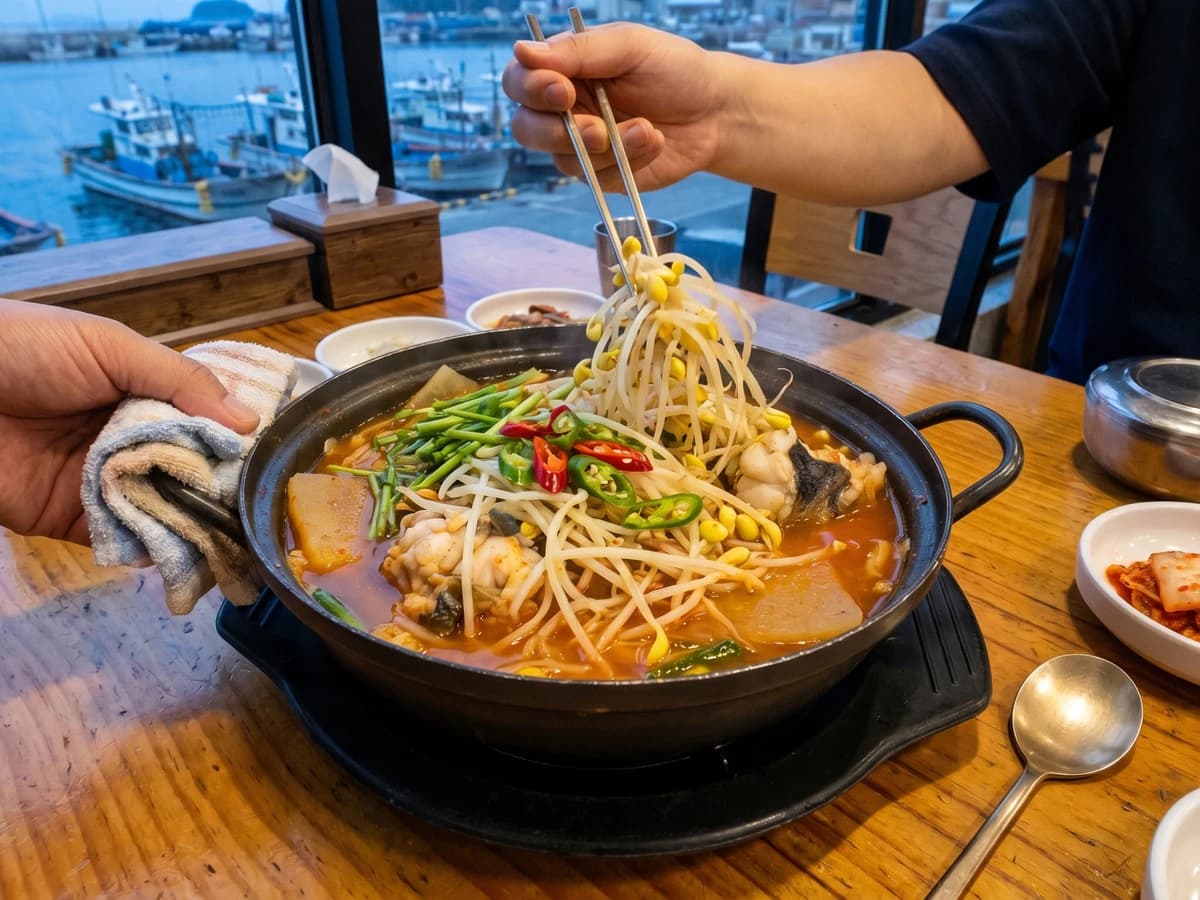
A Masan coast monkfish stew with firm white meat, gelatin at the bones, soybean sprouts for crunch, and a red broth seasoned to carry the fish, not bury it.

Chef Jeong-sun
A weeknight fish roe stew with radish and crown daisy in a clean spicy broth, where the whole success depends on adding the roe late enough that it sets tender, not chalky.

Chef Jeong-sun
Late-summer mallow leaves rubbed with salt until the bitter green water runs off, then simmered in a clean doenjang broth with dried shrimp, the quiet soup a Korean weeknight deserves.