Culinary Explorer

A cooking platform built around craft, culture, and the stories behind what we eat.
Discover Culinary Explorer
Tranca de Cochinita Pibil Campechana

Tranca de Cochinita Pibil Campechana

Created by

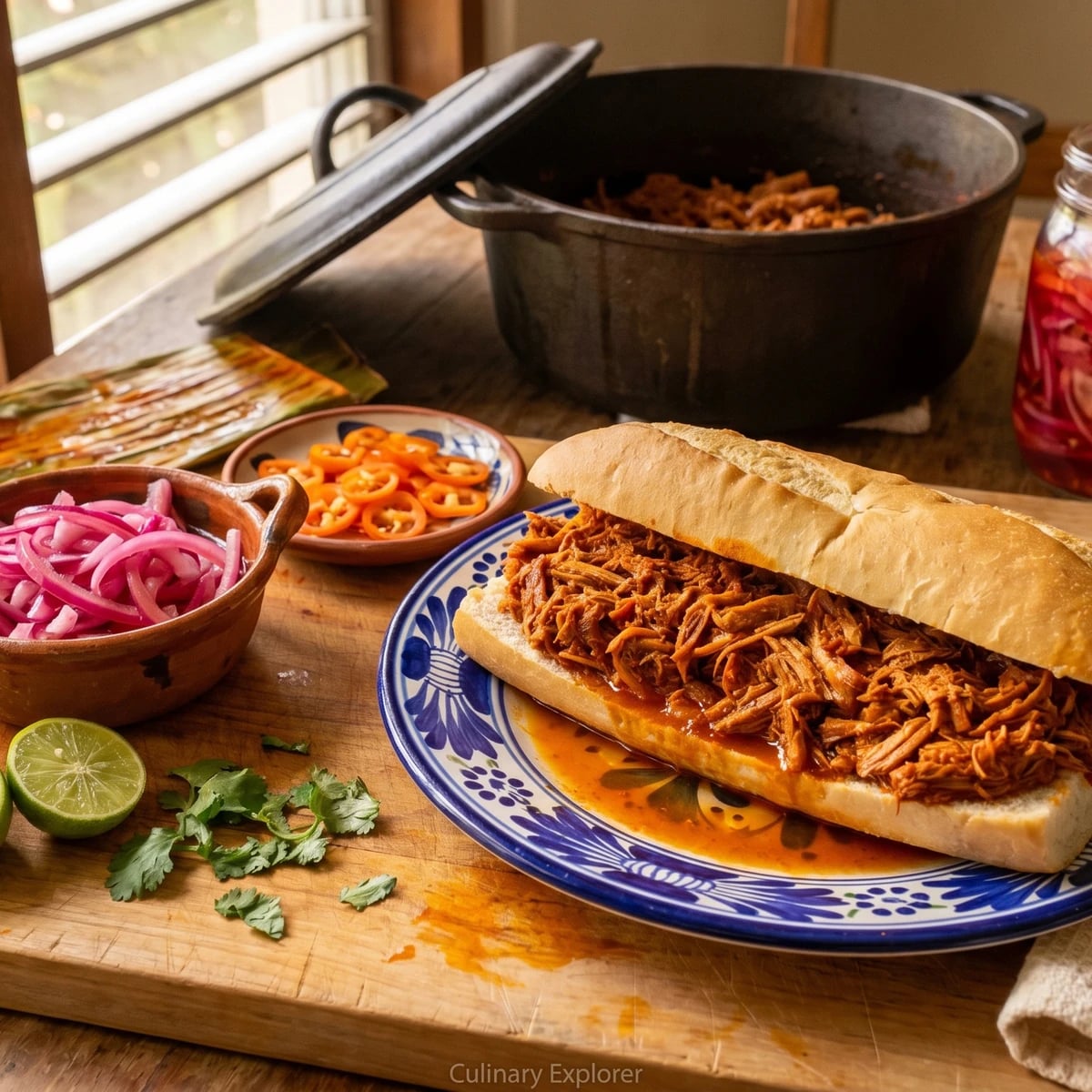
Campeche's full-length pan francés piled with banana-leaf cochinita, the bread soaking in the achiote-stained juices, pickled red onion and habanero served on the side for the table to build its own bites.

Sandwiches & Wraps
Mexican
Comfort Food
Game Day
Make Ahead
45 min
Active Time
4 hr cook12 hr total
Yield6 trancas

This is from Campeche. Not Mérida. Yucatán has its tortas of cochinita, sold by the dozen at corner panucherias and eaten standing up. Campeche has the tranca, and the tranca is a different animal: a full pan francés the length of a baguette, piled the entire way with cochinita, the soft crumb deliberately soaking in the achiote juices until the bottom of the bread is stained red and dripping. You eat it with two hands. You eat it slowly. You finish it because to leave half a tranca on the plate is to insult the cook.

The cochinita itself belongs to the whole Peninsula. Recado rojo for the color, naranja agria for the tenderizing acid, banana leaf for the steam and the grassy perfume it gives the pork. The Maya cooked this in a pib, a pit dug in the earth, lined with stones, heated with wood coals, and sealed with banana leaves and dirt for hours. We do not all have a backyard and a shovel. The oven, sealed tight with a heavy lid and a generous wrap of banana leaves, gets you close. Not identical. Close. La manteca es el sabor and the pork belly is what makes the difference between cochinita and dry shredded pork in red sauce.

The Peninsula has its own grammar and the tranca speaks it fluently. Recado, not just spice paste. Naranja agria, not lime juice with a wish. Habanero on the side, never blended into the meat, because the heat is the diner's decision, not the cook's. Pickled red onion that turns magenta from the sour orange, not pink from white vinegar. If your panucheria's cochinita looks orange and tastes flat, that cook used food coloring and Sazón. No me vengas con atajos. The recado does the work or the dish does not get made.

My mother never made cochinita. She was from Jalisco and she knew her limits. The first time I ate a tranca was at a small fonda near the malecón in Campeche in my second year of the 32-state project. The cocinera served it on a talavera blue-and-white plate with the onions piled high and a saucer of habanero on the side. She watched me take the first bite and waited for the question every visitor asks. I asked it: how long in the pib? She said, with no expression, all night. Saber cocinar es saber vivir.

Cochinita pibil descends directly from the pre-Columbian Maya practice of pit-cooking, the pib, which the Maya used to cook venison, peccary, and turkey long before the Spanish arrived with pigs in the 16th century. The achiote that gives the dish its signature red color comes from the seeds of the Bixa orellana tree, native to the Yucatán Peninsula and used by the Maya for both food and body paint for at least two thousand years; naranja agria is a Spanish introduction that replaced pre-Columbian acidic fruits like sour pitaya. The tranca itself emerged in 20th-century Campeche as a working-class lunch sold at market stalls and torterías, distinct from Mérida's smaller torta de cochinita and named for its sheer size; 'tranca' in Mexican Spanish suggests something that braces or blocks, a fitting word for a sandwich the length of your forearm.

The technique, the tradition, and the story behind every dish.

Discover Culinary Explorer

Ingredients

bone-in pork shoulder

Quantity

4 pounds

cut into large chunks

pork belly with skin

Quantity

1 pound

cut into large pieces

recado rojo (achiote paste)

Quantity

1 brick (3.5 ounces)

naranja agria juice

Quantity

1 cup

or substitute 2/3 cup orange juice with 1/3 cup lime juice and 2 tablespoons grapefruit juice

garlic cloves

Quantity

8

peeled

dried Mexican oregano

Quantity

1 tablespoon

toasted on a comal

whole black peppercorns

Quantity

1 teaspoon

whole cumin seed

Quantity

1 teaspoon

whole allspice berries (pimienta gorda)

Quantity

4

whole cloves

Quantity

2

kosher salt

Quantity

1 tablespoon

manteca de cerdo (pork lard)

Quantity

1/4 cup

melted

banana leaves

Quantity

1 large package

passed over an open flame until pliable and shiny

pan francés (Mexican French rolls, 10 to 12 inches each)

Quantity

6 whole

or 6 short baguettes

red onions

Quantity

2 large

sliced into thin half-moons

naranja agria juice for the pickled onions

Quantity

1 cup

kosher salt for the pickled onions

Quantity

1 teaspoon

dried Mexican oregano for the pickled onions

Quantity

1 teaspoon

fresh chile habanero

Quantity

6

sliced, or left whole on the side

lime halves (optional)

Quantity

for serving

Equipment Needed

  • Heavy enameled Dutch oven or deep roasting pan with a tight-fitting lid
  • Molcajete or spice grinder for the toasted spices
  • High-powered blender for the recado
  • Cast iron comal or open gas flame for prepping the banana leaves
  • Glass jar for the pickled onions
  • Sharp serrated knife for the pan francés

Instructions

  1. 1

    Build the recado

    Toast the peppercorns, cumin, allspice, and cloves on a dry comal over medium heat for about a minute, until they smell like the spice stall at the Mercado Pedro Sáinz de Baranda. Grind them in a molcajete or spice grinder to a fine powder. Break the brick of recado rojo into a blender. Add the toasted spices, the garlic, the oregano, the salt, and the naranja agria juice. Blend until smooth and the color of red clay. This is the marinade. The achiote does the staining, the sour orange does the tenderizing, the spices do the work the achiote alone cannot.

    Buy a real Yucatecan brand of recado rojo if you can. La Anita and El Yucateco are widely sold and reliable. Avoid generic achiote pastes that list yellow #5 before annatto on the label. That is not recado, that is a costume.
  2. 2

    Marinate the pork

    Place the pork shoulder and pork belly in a large nonreactive bowl. Pour the marinade over the meat and rub it into every surface with your hands. The meat will turn the color of brick. Cover and refrigerate for at least 8 hours, ideally overnight. The pork belly is not negotiable. It provides the fat that bastes the shoulder as it cooks. Lean cochinita is sad cochinita.

  3. 3

    Pickle the red onions

    Bring a small pot of water to a boil. Drop the sliced red onions in for 10 seconds, then drain immediately. Transfer to a glass jar. Add the naranja agria juice, salt, and oregano. Stir, cover, and let sit at room temperature for at least 2 hours, then refrigerate. The blanching takes the raw bite off without cooking them. The naranja agria turns them magenta. This is the only acceptable color for cochinita onions. Pink from regular vinegar is wrong.

  4. 4

    Prepare the banana leaves

    Pass each banana leaf over an open gas flame for a few seconds on each side, until it turns from matte to glossy and pliable. The heat releases the natural oils and keeps the leaves from cracking when you fold them. If you have an electric stove, hold them briefly over a hot dry comal. Cut the thick central rib out and tear the leaves into pieces large enough to wrap the meat. The banana leaf is not garnish. It is the flavor of the pib.

  5. 5

    Wrap and cook the cochinita

    Line a heavy Dutch oven or a deep roasting pan with overlapping banana leaves, letting them hang over the sides. Pour in the marinated pork with all of its marinade. Drizzle the melted lard over the top. Fold the overhanging leaves over the meat to seal it. Cover the pot tightly with a lid or a sheet of foil pressed down hard. Cook at 300°F for 3 1/2 to 4 hours, until the meat is falling apart and the juices at the bottom are a deep red-orange. This is your oven version of the pib, the underground pit oven the Maya have been using for centuries. It will not taste exactly the same. It will taste close enough.

    Do not open the pot during cooking. The trapped steam from the meat and the banana leaves is doing all the work. Every time you lift the lid, you are losing the pib.
  6. 6

    Shred and bathe

    Pull the pot from the oven and let it rest for 15 minutes. Open the leaves. Lift the meat onto a cutting board and shred it with two forks, discarding any large pieces of bone or skin you do not want. Return the shredded meat to the cooking juices in the pot. Stir well. The meat should be wet, glossy, and brick-red. If it looks dry, you did not use enough belly. Add another spoonful of melted lard. The juices are the soul of the dish. Do not throw them out.

  7. 7

    Build the trancas

    Slice each pan francés lengthwise, leaving a hinge along one side. Pull out a little of the soft interior crumb to make room. Pile the cochinita generously down the length of the bread, spooning extra juices over the meat so the bottom of the bread soaks up the achiote-stained fat. That soaked bread is the entire point of a tranca. This is not a delicate sandwich. This is a meal that takes both hands and a napkin tucked into your shirt.

    Pan francés in Campeche is closer to a soft, slightly sweet baguette than to a French baguette. If you cannot find it, a soft Italian roll or a tender bolillo stretched out will work. Hard, crusty sourdough will fight the cochinita instead of soaking it up.
  8. 8

    Serve with the side plate

    Set each tranca on a plate. Pile the pickled red onions on the side. Add the sliced habanero on a separate small dish so each person can build to their own tolerance. Lime halves go on the table. The diner builds each bite: a pinch of onion, a slice of habanero if they dare, a squeeze of lime, then the bread. Cada estado, su propia cocina, and the tranca belongs to Campeche.

Chef Tips

  • If you cannot find naranja agria (Seville orange), the standard Yucatecan substitute is two parts sweet orange juice to one part lime juice with a splash of grapefruit. It is a compromise. Naranja agria has a floral bitterness that the substitute does not capture. If you live anywhere with a Mexican or Cuban grocery, look for bottled jugo de naranja agria. Goya makes a passable one.
  • Pork belly is the secret of a good cochinita. Some cooks use only shoulder. Their cochinita is drier and they will tell you it is fine. They are wrong. The belly renders fat into the shoulder as it cooks and that fat is what makes the meat glossy and the juices rich enough to soak into the pan francés.
  • Do not be tempted to blend the habanero into the meat. The Peninsula serves it on the side for a reason. Cochinita is not a spicy dish. It is a deeply flavored dish, and the habanero is the diner's punctuation, not the cook's.
  • If your banana leaves crack when you fold them, you skipped the flame. Hold them over a gas burner for five seconds per side. They will turn glossy and become flexible like leather. This is not optional. Cracked leaves leak juice and the cochinita dries out.

Advance Preparation

  • The cochinita can and should be made one day ahead. The flavor deepens overnight and the meat soaks up more of the juices. Reheat gently with a splash of water or more lard so it does not dry out.
  • The pickled red onions need at least 2 hours to take color but are better after 24. They keep refrigerated for a week.
  • The recado paste can be made up to 3 days ahead and held in the refrigerator. Bring it to room temperature before marinating the pork.
  • Toast and grind the spices fresh the day you make the recado. Pre-ground spices lose half their flavor within weeks.

Frequently Asked Questions

Nutrition Information

1 serving (about 400g)

Calories
1090 calories
Total Fat
67 g
Saturated Fat
22 g
Trans Fat
0 g
Unsaturated Fat
42 g
Cholesterol
200 mg
Sodium
1650 mg
Total Carbohydrates
62 g
Dietary Fiber
3 g
Sugars
3 g
Protein
60 g

Note: Chef personas and recipes are created with AI assistance. Cook with care: follow safe food-handling practices, check doneness with a thermometer when needed, and adapt for allergies and your kitchen.

Where cooking meets culture.

Culinary guides, cultural storytelling, and the editorial depth that makes cooking meaningful.

Discover Culinary Explorer

More from Yucatecan Panuchos, Salbutes & Handhelds

Browse the full collection