Culinary Explorer

A cooking platform built around craft, culture, and the stories behind what we eat.
Discover Culinary Explorer
Pan Pichón de Pomuch

Pan Pichón de Pomuch

Created by

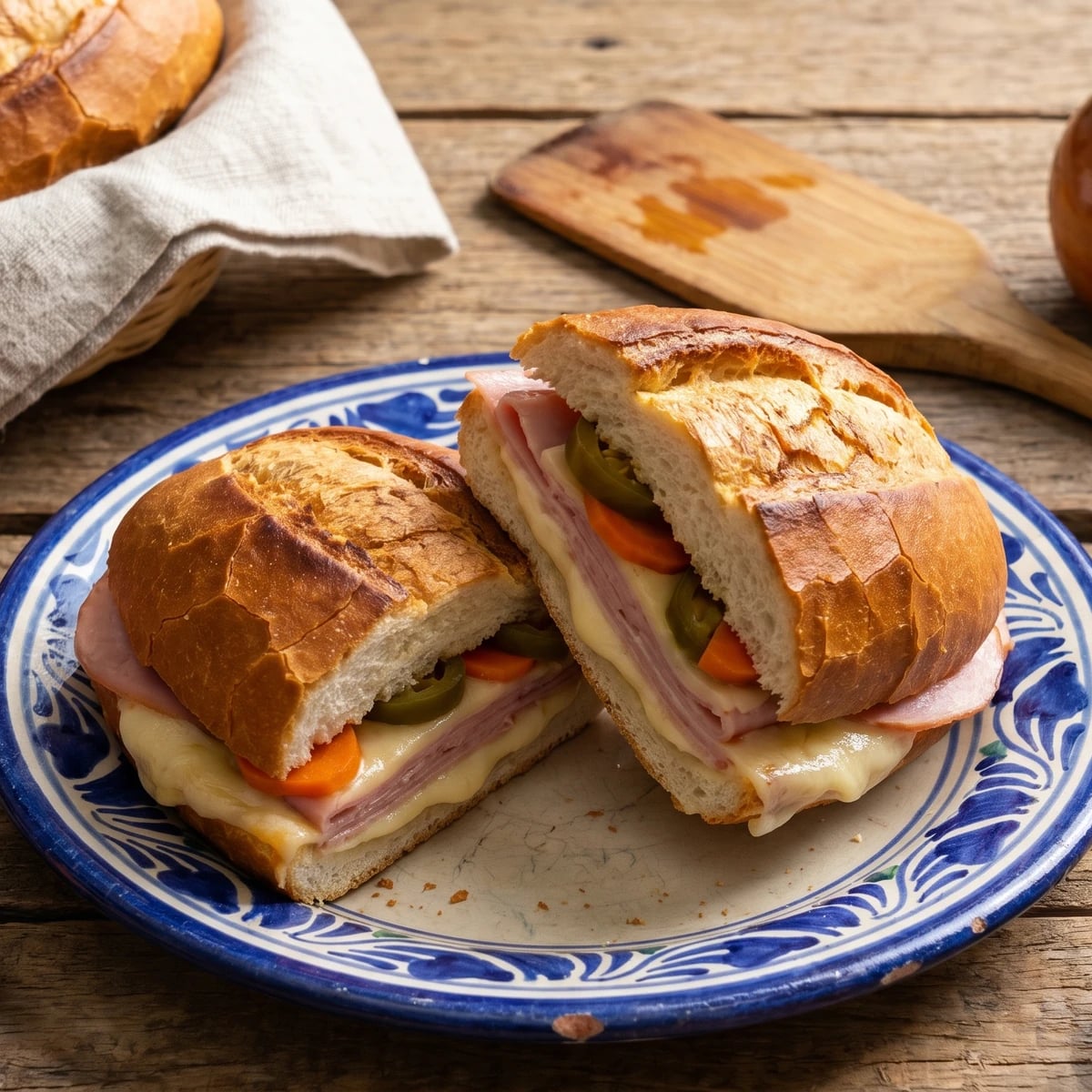
Pomuch's wood-fired handheld from northern Campeche: pan francés baked in stone ovens, split and stuffed with ham, queso Daysi, and pickled jalapeño, then fired again until the crust crackles and the cheese binds the layers.

Sandwiches & Wraps
Mexican
Comfort Food
Picnic
Make Ahead
20 min
Active Time
8 min cook28 min total
Yield4 sandwiches

This is from Pomuch, a small Maya town in the municipality of Hecelchakán, in the state of Campeche. Buses stop there because of the bread. The town has dozens of panaderías and the ovens are stone, fired with tukul wood, and the pan francés that comes out of them has a crust that crackles and a crumb that stays soft for hours. The pan pichón is what the bakers and the women at the bus stops do with that bread once it has cooled: split it, fill it with ham and queso Daysi and pickled jalapeño, and slide it back into the same hot oven for a few minutes until everything melts together.

This is not a Mexico City sandwich and it is not a torta. The torta is from the center of the country, built on telera or bolillo with avocado and beans and a dozen layers. The pan pichón is a Campeche thing, peninsular grammar: pan francés, queso Daysi (the local Campeche cheese, a relative of queso de bola), and jalapeños en escabeche, no avocado, no beans, no lettuce. The ingredients are few because the bread does the work. Every layer earns its place.

Queso Daysi is the detail that makes this Campeche's sandwich and not somebody else's. It is a semi-soft, slightly tangy cheese that melts cleanly without going greasy, and it is made by small producers in the state. If you cannot find it, queso de bola Edam, the same family of cheese the Yucatán Peninsula has been working with since the Dutch trade routes ran through the Gulf, is the honest substitute. Not mozzarella. Not cheddar. Cada estado, su propia cocina.

My mother's notebook does not have this recipe. She was from Jalisco. I learned this at a bus stop in Pomuch in 2011, from a woman named Doña Maribel who sold them out of a basket lined with a clean cloth, still warm. She watched me eat the first one and asked if I understood what made it work. I said the bread. She said no, the oven.

Pomuch's bread tradition dates to the colonial period, when Spanish and Maya bakers adapted European pan francés (a yeasted white roll closer to a small baguette than to bolillo) to the local wood and corn-husk-fired hornos de piedra still in use today; the town's pre-Columbian Maya identity is preserved in parallel through the famous ossuary at the local cemetery, where families clean ancestral bones each year for the Hanal Pixán observance. Queso Daysi is a 20th-century Campeche cheese descended from the queso de bola Edam tradition that reached the Yucatán Peninsula through Dutch and Caribbean trade routes in the 17th and 18th centuries, and which became fully integrated into peninsular cuisine through dishes like queso relleno. The pan pichón itself is a 20th-century working-class invention, a hot handheld designed to be eaten by travelers and laborers at the bakery door, and it remains almost entirely a regional dish, rarely served outside Campeche state.

The technique, the tradition, and the story behind every dish.

Discover Culinary Explorer

Ingredients

pan francés rolls from Pomuch

Quantity

4

or the closest local pan francés you can find

ham, pierna or jamón de pierna style

Quantity

8 slices

queso Daysi

Quantity

8 slices

or queso de bola Edam sliced thin as a substitute

pickled jalapeños en escabeche

Quantity

1/2 cup

drained

carrots and onions from the escabeche jar

Quantity

1/4 cup

sliced

manteca de cerdo

Quantity

2 tablespoons

melted

mayonnaise (optional)

Quantity

1 tablespoon

for spreading

pickled red onion with naranja agria (optional)

Quantity

for serving

sliced habanero (optional)

Quantity

for serving

lime wedges (optional)

Quantity

for serving

Equipment Needed

  • Pizza stone or heavy cast iron pan
  • Bread knife with a serrated edge
  • Pastry brush for the manteca
  • Wooden paddle or large spatula for moving the sandwiches in and out of the oven

Instructions

  1. 1

    Find the right bread

    Start with pan francés. In Pomuch the bread is baked daily in wood-fired stone ovens (hornos de piedra) heated with tukul wood, and that is what makes the crust shatter the way it does and the crumb stay tender inside. If you are not in Campeche, find the best pan francés your local panadería bakes that morning. Day-old bread will not give you what you need. Si no conoces el mercado, no conoces la cocina.

    Pomuch is a Maya town about 50 kilometers north of Campeche city, on the road to Hecelchakán. The bread is the reason buses stop there. If you can buy it directly, do.
  2. 2

    Split and dress the rolls

    Slice each pan francés horizontally, keeping the two halves attached on one side like a hinge. Open the roll flat. Brush the interior of both sides lightly with the melted manteca de cerdo. La manteca es el sabor. If you want to add mayonnaise, spread it thinly on one side. The fat does two things: it carries flavor and it keeps the bread from drying out under the heat.

  3. 3

    Build the sandwich

    Layer two slices of ham on the bottom half of each roll. Top with two slices of queso Daysi. Scatter the pickled jalapeños and the carrots and onions from the escabeche jar over the cheese. Close the roll firmly and press down with the palm of your hand so the layers settle. The proportions matter: ham and cheese in equal weight, escabeche enough to taste in every bite but not so much it soaks the bread through.

  4. 4

    Heat the oven properly

    If you have a wood-burning oven, build a small fire and let the stone floor reach around 230C (450F). If you are working with a home oven, preheat it as hot as it will go with a pizza stone or cast iron on the middle rack, at least 250C (475F). The Pomuch ovens fire much hotter and faster than that, which is why the crust crackles and the interior melts in under five minutes. A cooler oven gives you a soft, sad sandwich. No me vengas con atajos.

  5. 5

    Bake until the crust crackles

    Place the sandwiches directly on the hot stone or on a sheet of foil on the stone. Bake for six to eight minutes. You are looking for three things: the crust should turn deeper gold and harden so it cracks when you press it, the cheese should melt fully and start to bind the ham to the bread, and you should see a little fat shine from the manteca through the crumb. Pull them the moment all three signs are there.

    The cooks in Pomuch slide the bread in and pull it out fast with a wooden paddle. The point is contact heat from below and dry heat from the stone walls. Do not wrap these sandwiches in foil during baking. The crust is the dish.
  6. 6

    Serve hot, with the Peninsula on the side

    Cut each pan pichón in half on the diagonal. Set them on a talavera blue-and-white plate with pickled red onion made with naranja agria, a few slices of habanero, and a lime wedge alongside. Each diner dresses their own. The escabeche jalapeño inside is the constant. The habanero on the side is the choice. Así se hace y punto.

Chef Tips

  • Pan francés from Pomuch is the ideal. Pan francés from any wood-fired bakery in Campeche or Mérida is the next best. Bolillo from a supermarket is a compromise, and the sandwich will be flatter for it. If bolillo is what you have, use it the day it was baked, not the day after.
  • Queso Daysi has a specific tang and melt. Queso de bola Edam is the honest substitute and is widely available. Do not use mozzarella (too stringy, too bland) or cheddar (wrong flavor, wrong cuisine, wrong country). A peninsular sandwich takes a peninsular cheese.
  • The pickled jalapeños should be the kind that come en escabeche with carrots, onions, and a little oregano, the same jar that lives on every fonda counter in Mexico. La Costeña or San Marcos brand both work. Fresh sliced jalapeño is not the same thing.
  • If you want to eat it the way they do at the panaderías in Pomuch, eat it standing up, with a Coca-Cola in the other hand, before it cools.

Advance Preparation

  • The escabeche jalapeño can be made several days ahead and only improves in the jar.
  • The pickled red onion with naranja agria should be made at least two hours ahead and keeps refrigerated for a week.
  • Assemble the sandwiches just before baking. If you build them more than an hour ahead the escabeche will start to soak through the bottom of the roll and the crust will lose its crackle in the oven.
  • Leftover baked pan pichón can be reheated on a hot comal or in a 200C oven for three minutes to recover the crust. Do not microwave. The bread turns to rubber.

Frequently Asked Questions

Nutrition Information

1 serving (about 190g)

Calories
480 calories
Total Fat
26 g
Saturated Fat
11 g
Trans Fat
0 g
Unsaturated Fat
14 g
Cholesterol
70 mg
Sodium
1650 mg
Total Carbohydrates
36 g
Dietary Fiber
2 g
Sugars
3 g
Protein
26 g

Note: Chef personas and recipes are created with AI assistance. Cook with care: follow safe food-handling practices, check doneness with a thermometer when needed, and adapt for allergies and your kitchen.

Where cooking meets culture.

Culinary guides, cultural storytelling, and the editorial depth that makes cooking meaningful.

Discover Culinary Explorer

More from Yucatecan Panuchos, Salbutes & Handhelds

Browse the full collection