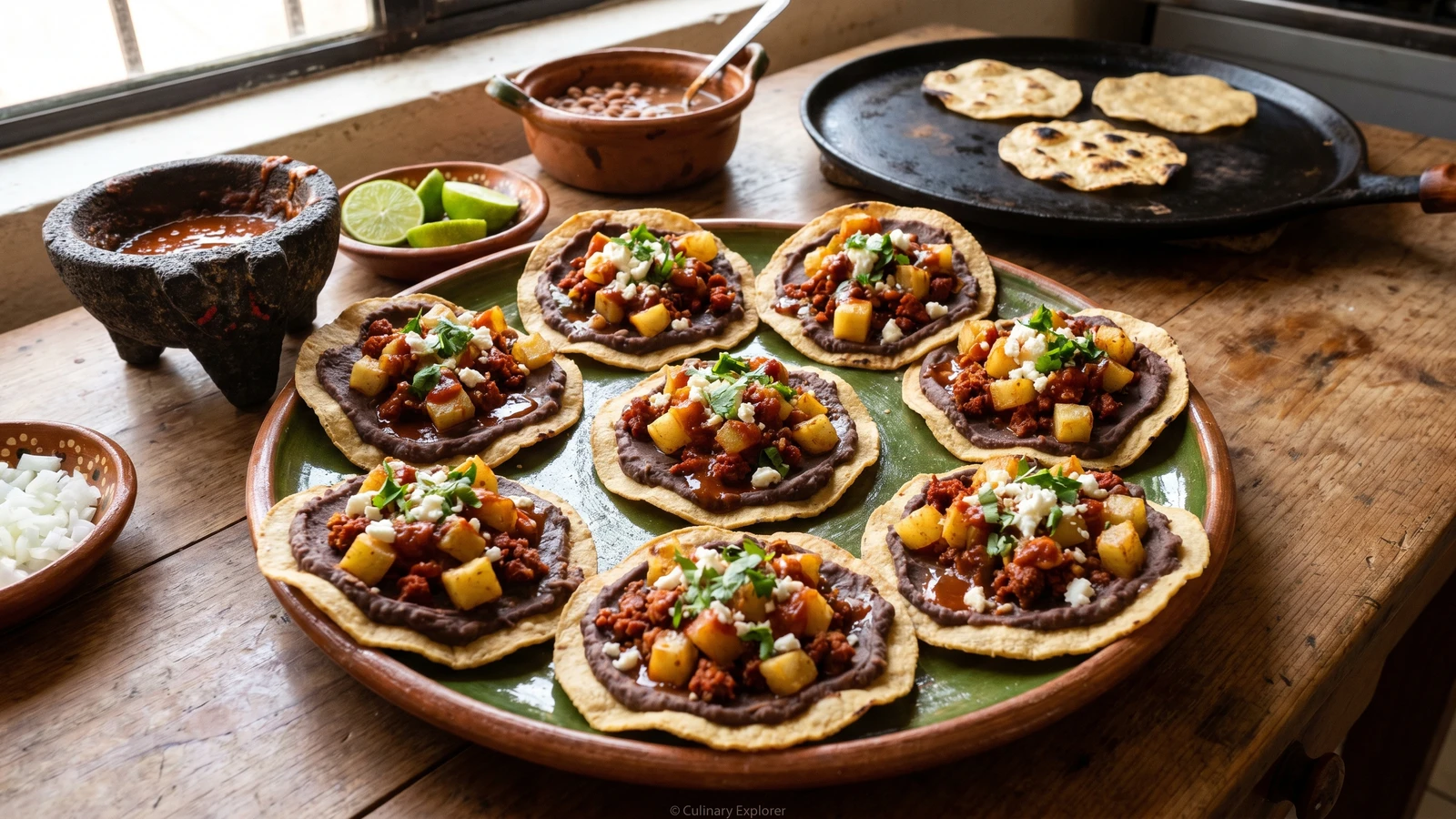
Querétaro's arriero tostadas are crisp corn tortillas spread with epazote-scented beans, chorizo browned with papa, and a guajillo-ancho salsa built for the road between the Bajío and the Sierra Gorda.
Appetizers & Snacks
Mexican
Weeknight
Comfort Food
Budget Friendly
25 min
Active Time
45 min cook•1 hr 10 min total
Yield8 tostadas, 4 servings
Querétaro, between the Bajío and the Sierra Gorda, is where these tostadas live. You find the logic of them on the old road, from Santiago de Querétaro toward Cadereyta and up toward Jalpan: corn tortilla made crisp, frijol flor de mayo or bayo, chorizo, papa, and a red salsa that tastes of toasted chile guajillo and ancho. This is road food that came home to the kitchen table.
Do not confuse arriero food with poor food. The arriero, the muleteer, ate what could survive the saddlebag and still feed a body after a day with animals and dust. The women at the stove perfected it: beans refried thick with epazote, papa cut small so it browns before it dries out, chorizo cooked until the chile-stained fat coats every cube. The tostada is not decoration. It is the plate you eat.
I learned my version from a señora outside Cadereyta, not from a restaurant menu. She had a small barro cazuela of beans, a black comal, and a molcajete with salsa roja still clinging to the stone. My mother's Jalisciense notebook had no page for this, so I wrote it down myself. Cada estado, su propia cocina. Querétaro's bite is lean, practical, and full of road sense.
The Camino Real de Tierra Adentro developed after the silver discoveries of Zacatecas in 1546 and Guanajuato in 1548, and Querétaro became one of the supply and livestock nodes on that route. Arrieros moved goods between Mexico City, the Bajío mining districts, and the northern settlements, so their food favored corn, beans, dried chiles, cured pork, and potatoes because those ingredients could survive travel and return to life on a comal. Potatoes entered central Mexican kitchens through the colonial movement of Andean crops into New Spain, and by the 19th century they were common enough in Bajío home cooking to stretch chorizo without pretending to be meat.
The technique, the tradition, and the story behind every dish.
papa blanca or small waxy potatoespeeled and cut into 1/2-inch cubes
12 ounces
fresh Mexican pork chorizocasing removed and crumbled
8 ounces
white onion for chorizo-papafinely chopped
1/4 medium
cooked frijol flor de mayo or frijol bayowith 1/2 cup cooking liquid
2 cups
white onion for beansfinely chopped
1/4 medium
garlic cloveminced
1
fresh epazote
1 small sprig
queso fresco or queso ranchero (optional)crumbled
1/2 cup
raw white onion (optional)finely chopped
1/4 cup
fresh cilantro leaves (optional)torn
1/2 cup
lime wedges (optional)
for serving
Equipment Needed
•Cast iron comal or clay comal for toasting chiles and roasting vegetables
•Blender for the chile salsa
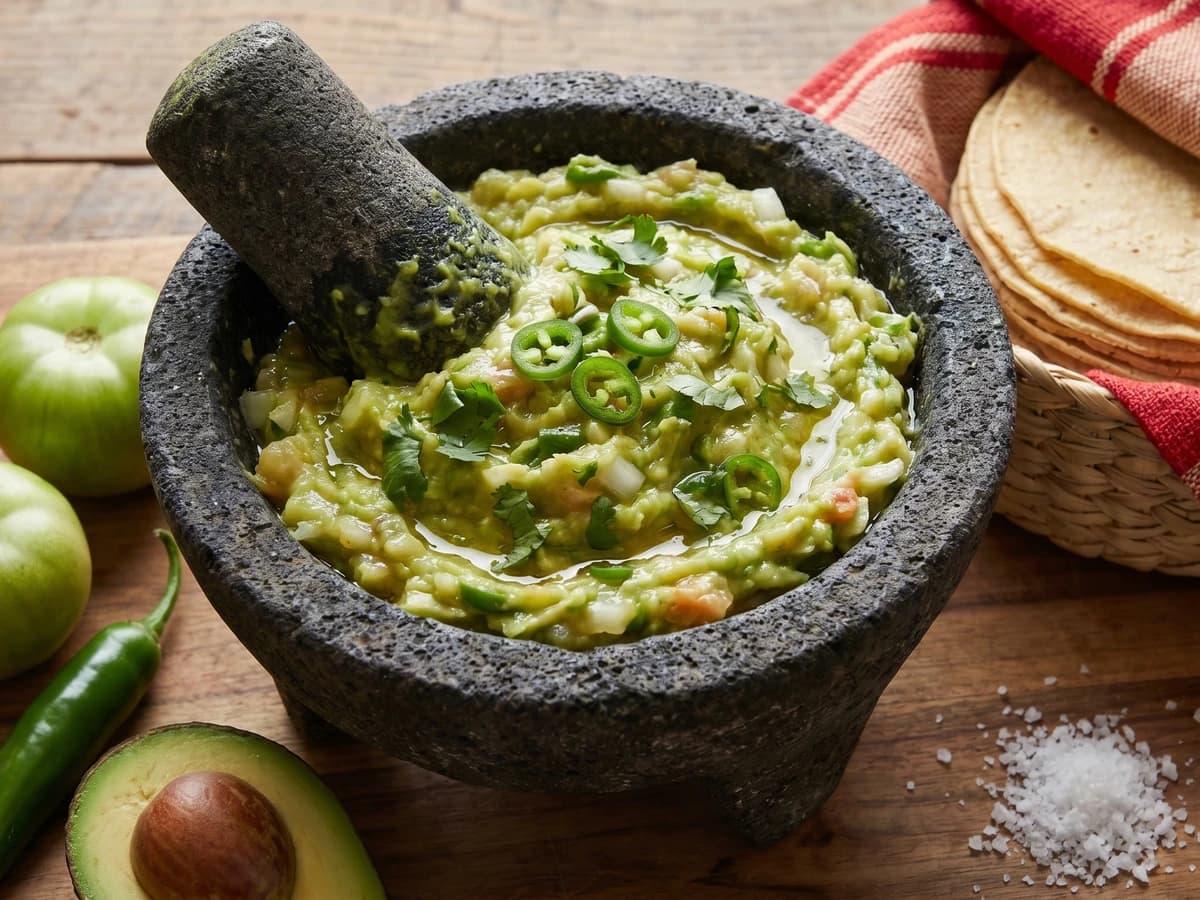
•Volcanic stone molcajete for serving extra salsa at the table
•10-inch clay cazuela or heavy skillet for refrying beans
•Wide skillet and wire rack for frying tostadas
Instructions
1
Toast the chiles
Heat a dry comal over medium. Toast the guajillo chiles for about 20 seconds per side and the ancho for about 30 seconds per side, just until the skins puff and the smell deepens. Do not blacken them. Put the toasted chiles in a bowl and cover with hot water for 15 minutes. On the same comal, roast the tomatoes, onion, and unpeeled garlic until they have dark spots and the tomato skins loosen.
Guajillo is thinner than ancho and burns faster. Burned chile turns bitter. Throw it out and toast another if it goes black. No me vengas con atajos.
2
Fry the salsa
Peel the roasted garlic. Drain the chiles and blend them with the roasted tomatoes, roasted onion, peeled garlic, Mexican oregano, sal de grano, and 1/2 cup of the chile soaking water. Blend until smooth. Melt 1 tablespoon manteca de cerdo in a small cazuela or skillet over medium heat. Pour in the salsa and cook 6 to 8 minutes, stirring often, until it darkens to brick red and the lard leaves a thin orange edge around the sauce. La manteca es el sabor.
3
Parcook the papa
Put the potato cubes in a saucepan and cover with salted water. Simmer 6 to 8 minutes, until the edges are tender but the centers still hold their shape. Drain well and let them sit in the colander for five minutes. Wet potatoes splatter in lard and brown poorly. Dry potatoes know their job.
4
Brown chorizo-papa
Heat 1 tablespoon manteca de cerdo in a heavy skillet over medium. Add the chorizo and break it up with a wooden spoon. Cook 6 to 8 minutes, until no raw spots remain and the fat turns red from the chile. Add the chopped onion and the drained potato cubes. Cook 8 to 10 minutes more, turning gently, until the potatoes are golden at the edges and coated in chorizo fat. Taste before adding salt. Chorizo brings its own.
5
Refry the beans
Melt 1 tablespoon manteca de cerdo in a clay cazuela or heavy skillet over medium. Add the chopped onion and cook until translucent, about 4 minutes. Add the minced garlic and cook 30 seconds. Add the cooked frijoles with their liquid and the epazote sprig. Mash with a bean masher or the back of a spoon until thick and spreadable. Cook 6 to 8 minutes, stirring, until the beans can hold a trail when you drag the spoon through them. Remove the epazote.
6
Fry the tostadas
Heat the 1 1/4 cups manteca de cerdo in a wide skillet over medium-high until the edge of a tortilla bubbles the moment it touches the fat, about 350F if you use a thermometer. Fry the tortillas one at a time, 45 to 60 seconds per side, pressing lightly with tongs so they cook flat. They should be crisp, golden, and firm enough to hold beans without bending. Drain on a wire rack and salt lightly while warm. Do not stack them while warm or they soften.
7
Assemble and serve
Spread each tostada with a thick layer of refried beans. The beans go first because they glue the topping to the tortilla. Spoon the chorizo-papa over the beans, then drizzle with the fried guajillo-ancho salsa. Finish with queso fresco, raw white onion, cilantro, and lime at the table. Serve immediately, before the salsa softens the tortilla. Recetas probadas y garantizadas.
Chef Tips
•Use frijol flor de mayo if you can find it. It belongs to central Mexico and has a creamy skin that refried beans need. Frijol bayo is the second choice. Black beans are not wrong in Mexico, but they are not the Querétaro choice here.
•Buy fresh Mexican pork chorizo from a carnicería, the kind bright with chile and vinegar. Do not use smoked Spanish chorizo. It slices instead of crumbling and the fat does not season the papa the same way.
•Chile guajillo gives the salsa its brick-red color. Chile ancho gives body and a little dried-fruit sweetness. If someone wants more fire, put salsa de chile de arbol on the table. Do not turn the whole dish into a dare.
•If you buy prepared tostadas, buy thick corn tostadas from a tortillería. Thin bagged tostadas break under beans and chorizo-papa. A substitution is a compromise, not an upgrade.
•No cheddar, no sour cream, no shredded lettuce. That is a different border food. Querétaro does not need it.
Advance Preparation
•Cook the frijol flor de mayo or frijol bayo up to 2 days ahead with onion, garlic, and salt. Keep the cooking liquid. That liquid is what makes the beans refry properly.
•The guajillo-ancho salsa can be made up to 3 days ahead and refrigerated. Reheat it in a spoonful of manteca de cerdo before serving so the flavor wakes back up.
•The potatoes can be parcooked earlier in the day and held uncovered in the refrigerator. Brown them with the chorizo right before serving.
•Fry the tostadas up to 4 hours ahead and hold them uncovered at room temperature once cool. Do not refrigerate them.
Frequently Asked Questions
Nutrition Information
1 serving (about 400g)
Calories
810 calories
Total Fat
45 g
Saturated Fat
17 g
Trans Fat
0 g
Unsaturated Fat
26 g
Cholesterol
80 mg
Sodium
1650 mg
Total Carbohydrates
76 g
Dietary Fiber
17 g
Sugars
9 g
Protein
26 g
Where cooking meets culture.
Culinary guides, cultural storytelling, and the editorial depth that makes cooking meaningful.