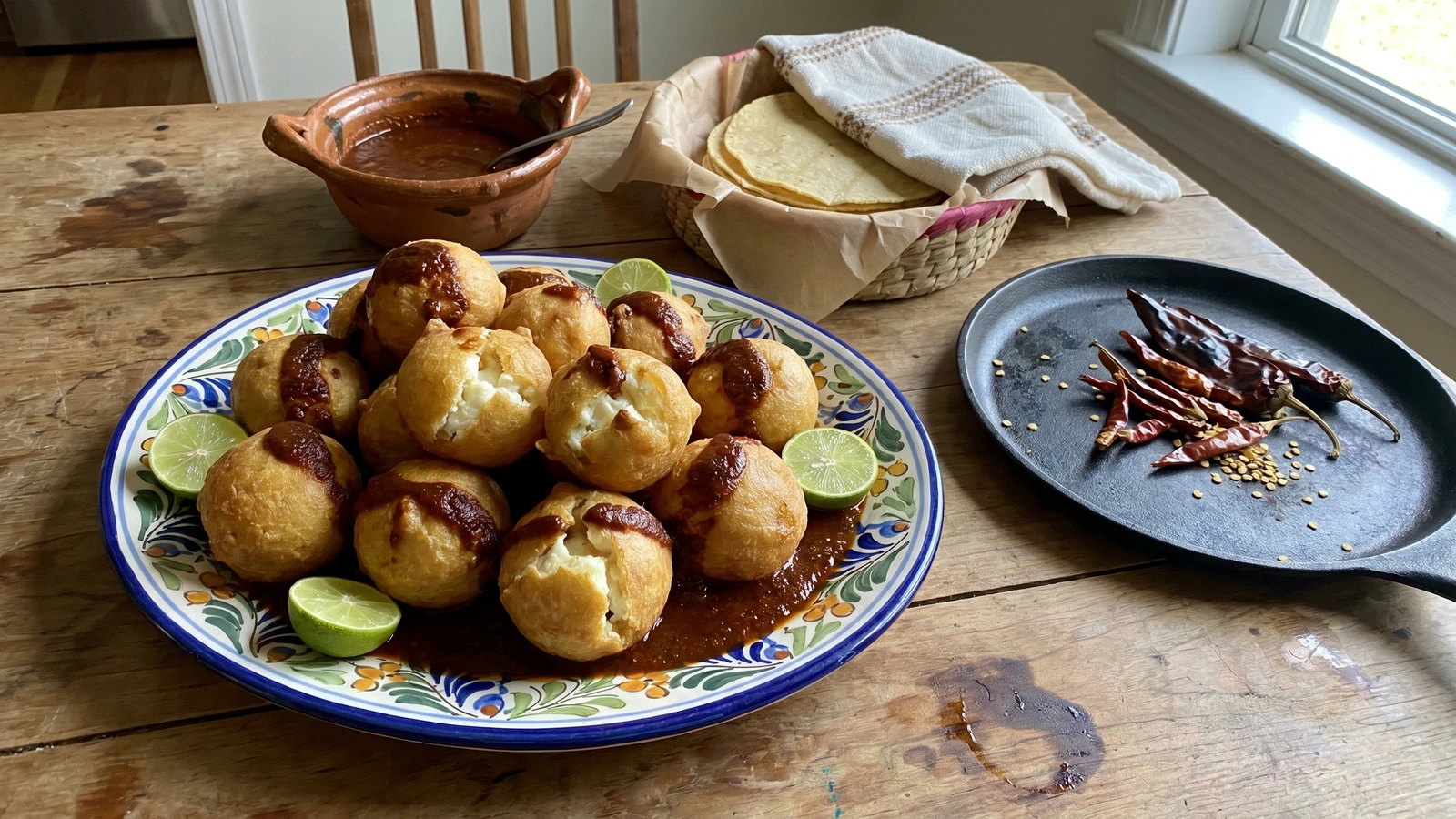
Guanajuato's La Pulga snack: fresh cow's milk cheese sealed in nixtamalized masa, dipped in egg capeado, fried in manteca, and dragged through a roasted guajillo and chile de árbol salsa.
Appetizers & Snacks
Mexican
Game Day
Picnic
Budget Friendly
45 min
Active Time
30 min cook•1 hr 15 min total
Yield16 bolas, 6 to 8 servings
Guanajuato, specifically León in the Bajío, is where these bolas de queso belong. Not in a restaurant with white plates. At La Pulga, the tianguis where people buy shoes, tools, used clothes, and something hot enough to stain the paper before they walk home. The snack is direct: queso fresco de rancho sealed inside nixtamalized masa, passed through egg capeado, and fried until the outside turns gold.
Doña Isabel's version has lasted because she understands proportion. Too much masa and you chew paste. Too much cheese and it leaks into the manteca. The women who make these by the hundreds do not need a thermometer to read the fat; they watch the bubbling around the batter and know. I give you the thermometer because your kitchen is not a León tianguis. Tools are fine when the principle is right.
Use fresh masa if you can get it, from a tortillería that smells like cooked corn. The cheese should be firm, fresh cow's milk queso that tastes clean and milky, not rubber. The salsa needs chile guajillo for body and chile de árbol for bite, not because all Mexican food has to burn, but because fried masa asks for something sharp. Cada estado, su propia cocina.
León sits in Guanajuato's Bajío, a commercial corridor shaped by ranching, leather work, and weekly markets, so its antojitos lean practical: corn masa, fresh cow's milk cheese, hot fat, and salsa. La Pulga, the city's well-known tianguis, helped make bolas de queso visible as late 20th-century market food, especially through vendors like Doña Isabel, whose 28-year routine turned a stall snack into a León reference point. The dish belongs to the same Bajío logic as gorditas and enchiladas mineras: nixtamalized corn carrying dairy from ranch country, fried hard enough to travel in a paper-lined basket.
The technique, the tradition, and the story behind every dish.
•Blender or volcanic stone molcajete for the salsa
Instructions
1
Toast the salsa
Heat a dry comal over medium. Toast the chile guajillo about 20 seconds per side, just until flexible and fragrant. Toast the chile de árbol for only a few seconds, turning constantly. It burns fast and burned chile tastes bitter. Roast the tomatoes, onion, and unpeeled garlic on the same comal until the tomatoes blister and the garlic softens. Put the toasted guajillo in hot water for 10 minutes to soften. Hot water, not boiling. No me vengas con atajos.
If a chile de árbol turns black, throw it out. Six chiles cost less than one ruined salsa.
2
Blend and fry
Peel the roasted garlic. Blend the softened guajillo, chile de árbol, tomatoes, onion, garlic, dried Mexican oregano, kosher salt, and 1/2 cup of the guajillo soaking water until smooth. Melt 1 tablespoon manteca de cerdo in a small cazuela or skillet over medium heat. Pour in the salsa and cook 5 to 7 minutes, stirring, until it darkens to brick red and thickens enough to coat a spoon. The salsa should taste sharp enough to cut through fried masa.
3
Knead the masa
Put the fresh masa in a bowl. Add the softened manteca de cerdo, sea salt, and baking powder. Knead with your hand for 3 minutes, pressing and folding until the fat disappears into the masa. Add warm water a tablespoon at a time only if the masa cracks when pressed. You want soft masa that holds together without sticking to your palms. Fresh masa should smell like cooked corn, not dust.
4
Wrap the cheese
Divide the masa into 16 equal portions. Flatten one portion into a 3-inch disk in your palm, set a cube of queso fresco in the center, and close the masa around it. Pinch the seam shut and roll gently into a ball. Cover the shaped bolas with a damp towel while you work. The surface must be smooth. A crack becomes a leak, and a leak turns your frying fat into a mess.
Use firm queso fresco de rancho, not Oaxaca cheese and not yellow cheese. Melting cheese runs out before the masa cooks. Queso fresco softens and stays where it belongs.
5
Beat the capeado
Put the flour in a shallow dish. In a clean bowl, beat the egg whites with 1/4 teaspoon sea salt until they hold soft peaks. Beat the yolks separately, then fold them into the whites with a light hand. This capeado should be airy, not stiff. It is the same logic as chiles rellenos: the egg protects the filling while the outside turns golden.
6
Heat the manteca
Melt the manteca de cerdo in a heavy pot or small cazo, deep enough to hold 2 inches of fat. Do not fill the pot more than halfway. Heat to 340F, or until a tiny pinch of masa sinks for one second, then rises with steady bubbles around it. La manteca es el sabor. At La Pulga, vendors may use oil because a stall has its own economy. At home, use manteca and understand the difference.
7
Batter and fry
Roll 4 masa balls lightly in flour and shake off the excess. Dip each one into the egg capeado, coating it completely, then lower it into the hot manteca with a spoon. Fry 5 to 6 minutes, turning gently, until the outside is deep gold and the masa feels firm under the spoon. Keep the fat between 330F and 345F. Too hot and the egg browns before the masa cooks. Too cool and the balls drink fat.
8
Drain and serve
Lift the bolas out with a slotted spoon and drain on a wire rack set over a sheet pan. Let them rest 3 minutes before serving because the cheese inside holds heat. Spoon the guajillo and chile de árbol salsa over them or serve it in a small clay cazuelita for dipping. Add lime halves on the side. Eat them standing, seated, at a game, at a picnic, it does not matter. What matters is that the masa is cooked, the cheese stays inside, and the salsa wakes the whole thing up. Recetas probadas y garantizadas.
Chef Tips
•Fresh masa from a tortillería is best. If you cannot get it, use 2 cups masa harina with about 1 1/2 cups warm water, then knead in the manteca, salt, and baking powder. Let it rest 20 minutes. It will work, but it will not taste as deep as fresh nixtamal. A substitution is a compromise, not an upgrade.
•The queso fresco must be firm and dry. If yours is wet, wrap it in a clean towel and press it under a plate for 20 minutes before cutting. Wet cheese leaks.
•Do not use Oaxaca cheese, mozzarella, cheddar, or anything that melts into strings. This is not a quesadilla hiding inside a ball. The cheese should soften, not escape.
•If you refuse manteca de cerdo, use a high-heat neutral oil and accept that you changed the snack. The texture will be lighter and the flavor flatter. La manteca es el sabor.
Advance Preparation
•The salsa can be made 2 days ahead and refrigerated. Reheat gently or serve at room temperature.
•The masa balls can be shaped up to 4 hours ahead. Keep them covered with a damp towel in the refrigerator and bring them close to room temperature before battering.
•Do not batter them ahead. Capeado waits for nobody. Beat the eggs right before frying.
•Fried bolas are best the day they are made. To reheat, place them on a rack in a 400F oven for 8 to 10 minutes until the outside firms again.
Frequently Asked Questions
Nutrition Information
1 serving (about 240g)
Calories
700 calories
Total Fat
43 g
Saturated Fat
18 g
Trans Fat
0 g
Unsaturated Fat
22 g
Cholesterol
150 mg
Sodium
1000 mg
Total Carbohydrates
62 g
Dietary Fiber
8 g
Sugars
4 g
Protein
20 g
Where cooking meets culture.
Culinary guides, cultural storytelling, and the editorial depth that makes cooking meaningful.