
Chef Lupita
Acambaritas de Acámbaro
Guanajuato's daily bread from Acámbaro, a small glazed roll built on pata, enriched with manteca de cerdo, and baked until the top shines lightly for merienda.
A cooking platform built around craft, culture, and the stories behind what we eat.
Created by
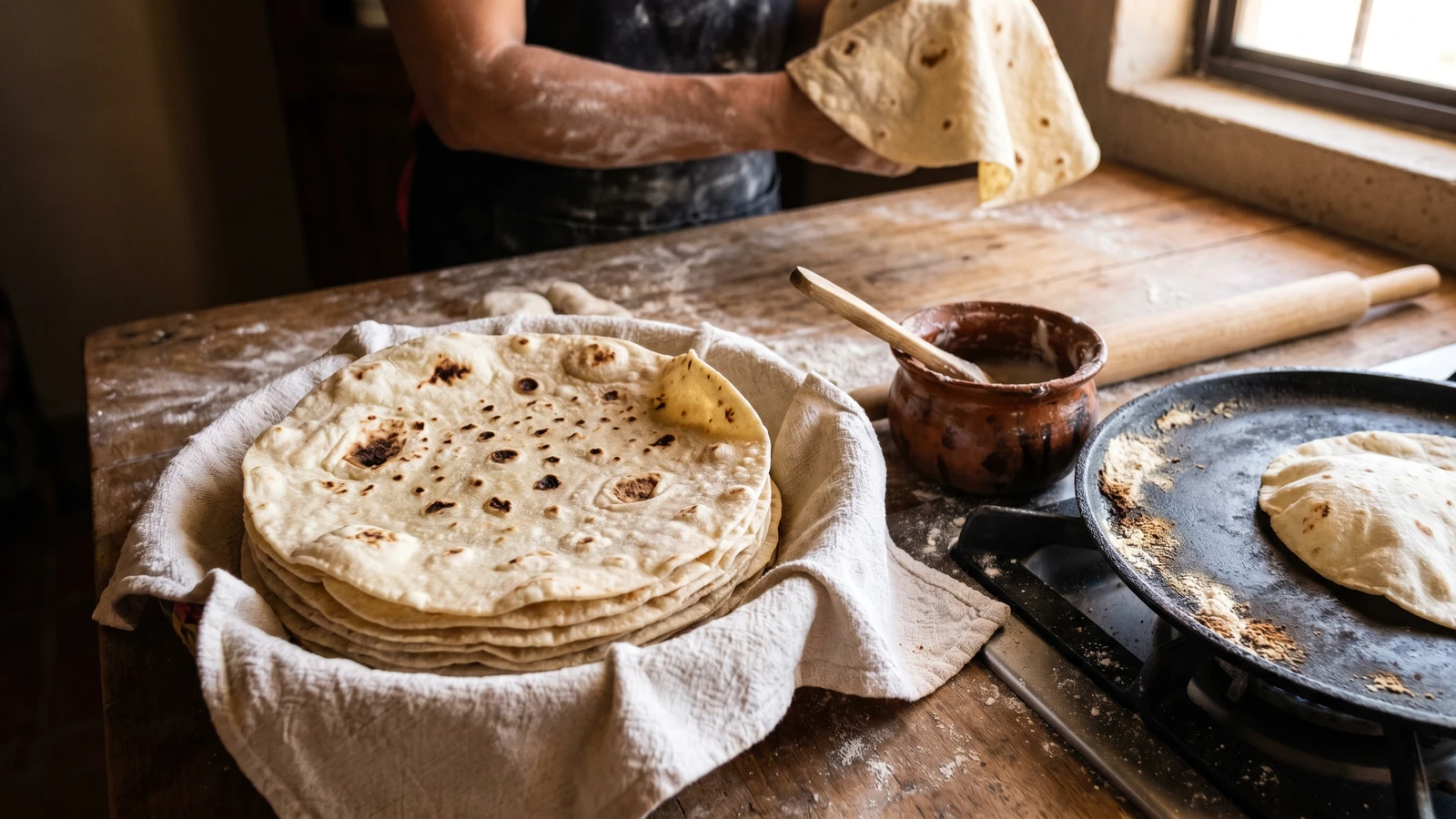
Sonora's daily bread, paper-thin wheat tortillas blistered on a hot comal with manteca de cerdo and hot water. The flour tortilla is the bread of the north, not corn but trigo.
This is Sonora. The flour tortilla is northern and the north is wheat country, not corn country. South of Zacatecas the bread is masa de maiz. North of it, in Sonora, Chihuahua, Coahuila, the bread is trigo. Anyone who tells you the corn tortilla is the only real Mexican tortilla has never eaten breakfast in Hermosillo.
The Sonoran version is thin. Very thin. Translucent at the edges, almost as wide as the plate it goes on. The senoras stretch them by hand, draping the dough over the forearm and rotating it until the disc is wider than the comal. That is where the name sobaquera comes from, sobaco, armpit, because the tortilla reaches there when she stretches it. There is nothing delicate about how this bread is made and there is nothing delicate about how it is eaten. It wraps carne asada, machaca with eggs, frijoles maneados, beans and cheese folded straight off the comal.
The fat is manteca de cerdo. Not butter, not vegetable shortening, not oil. Lard. The ranches of Sonora have raised pigs for four centuries and the lard is what makes the tortilla pliable, savory, and pull-apart layered. Substitute and you will get something that resembles a flour tortilla but does not taste like one. La manteca es el sabor.
My mother was from Jalisco and she made corn tortillas every day. The first time I ate a real sobaquera was in a roadside fonda outside Magdalena de Kino, served folded around carne asada with green onions and a wedge of lime. The senora at the comal was stretching them on her forearm and slapping them onto the iron one after another. I watched her for half an hour. Saber cocinar es saber vivir. She let me try. My first one tore. My fifth one was almost a tortilla. The rest is practice.
Wheat arrived in Sonora with the Jesuit missions of the late 17th century, most influentially through Father Eusebio Kino, who established a network of missions across the Pimeria Alta beginning in 1687 and introduced European grains, cattle, and irrigation to the indigenous Pima, Opata, and Yaqui peoples. The flour tortilla developed as a regional adaptation: where central and southern Mexico continued the millennia-old practice of nixtamalizing corn, the wheat-growing valleys of Sonora produced a bread that could be made daily on the same comal that had served corn. The sobaquera, the oversized hand-stretched version that can reach two feet across, is documented in Sonoran kitchens by the 19th century and remains a marker of household skill: a woman who could stretch a perfect sobaquera by hand was, until recently, considered ready to run her own kitchen.
Quantity
4 cups
plus more for the table
Quantity
1 1/2 teaspoons
Quantity
1/2 teaspoon
Quantity
1/3 cup
at room temperature
Quantity
1 1/4 cups
plus more as needed, not boiling
| Ingredient | Quantity |
|---|---|
| all-purpose flourplus more for the table | 4 cups |
| fine sea salt | 1 1/2 teaspoons |
| baking powder | 1/2 teaspoon |
| manteca de cerdo (pork lard)at room temperature | 1/3 cup |
| hot waterplus more as needed, not boiling | 1 1/4 cups |
In a wide bowl, whisk together the flour, salt, and baking powder. Use your hand to feel for any lumps in the salt. This is bread dough, not pastry. You want everything evenly distributed before the fat goes in.
Add the room-temperature lard. Use your fingertips to rub the lard into the flour until the mixture looks like coarse damp sand, with no large lumps of fat visible. This takes three or four minutes. La manteca es el sabor. Vegetable shortening will give you a tortilla. Manteca de cerdo will give you a Sonoran tortilla. There is a difference and you will taste it.
Pour in the hot water in a slow stream while you mix with your other hand. Hot water, not boiling. Boiling water cooks the flour and the dough goes gummy. You want water hot enough that you cannot keep your finger in it for more than a second. Mix until a shaggy dough comes together. If it looks dry, add another tablespoon of hot water. If it looks wet, add a tablespoon of flour.
Turn the dough onto a lightly floured surface. Knead for eight to ten minutes. Push with the heel of your hand, fold, rotate, repeat. The dough will start sticky and end smooth, soft, and elastic. When you press a finger into it, the dough should spring back slowly. This is the gluten doing its work. Short kneading gives you tortillas that tear. No me vengas con atajos.
Divide the dough into twelve equal pieces, about 70 grams each if you have a scale. Roll each piece into a tight ball between your palms, pinching the seam closed underneath. Arrange them on a tray, cover with a clean cloth dampened with warm water, and let them rest for at least 30 minutes. The rest is non-negotiable. Skip it and the dough fights you when you try to roll it out.
Set a cast iron comal or heavy skillet over medium-high heat. Let it heat for a full five minutes. The pan must be hot before the first tortilla touches it. Flick a few drops of water on the surface. They should dance and evaporate in a second. If they sit and bubble slowly, the comal is not ready.
Lightly flour the work surface. Take one dough ball, flatten it with the heel of your hand, and roll it out with a thin rolling pin. Roll from the center outward, rotating the dough a quarter turn after each pass. Keep going until the tortilla is between ten and twelve inches across and so thin you can almost see your hand through it. This is the Sonoran size. If yours is small and thick, you have made a Mexico City tortilla, not a Sonoran one.
Lay the rolled tortilla on the hot comal. Cook for about 30 seconds, until the surface bubbles and the underside has light brown spots. Flip. Cook another 30 to 45 seconds. The tortilla should puff in spots, blister, and develop dark freckles where it touches the iron. Press gently with a clean cloth if it needs encouragement to puff. Flip one more time for a quick five seconds. Three flips total. That is the rhythm.
Stack the finished tortillas inside a cloth-lined basket or wrapped in a clean tea towel. They steam each other soft as they rest. A stiff cold tortilla is a failed tortilla. Roll and cook the next while the comal stays hot, working through all twelve. Eat them within the hour, or refrigerate and reheat directly on the comal. Asi se hace y punto.
1 serving (about 62g)
Culinary guides, cultural storytelling, and the editorial depth that makes cooking meaningful.
Discover Culinary ExplorerChef Lupita
Guanajuato's daily bread from Acámbaro, a small glazed roll built on pata, enriched with manteca de cerdo, and baked until the top shines lightly for merienda.

Chef Lupita
Michoacan's Tinguindin aguacatas are flat, leaf-scored sweet breads made with harina de trigo, piloncillo, anise, and manteca de cerdo, shaped by hand for the wood oven.

Chef Lupita
From Ajijic on Lake Chapala, Pan Tachihual is a lightly sweet wedding loaf built with harina de trigo, harina de maiz, piloncillo, manteca, anise, and the old Guadalajara pata.

Chef Lupita
Comitán's pan de yema shaped into little pigs, birds, and rabbits, a Chiapas bakery bread rich with egg yolks, manteca de cerdo, and anís, baked golden on hoja de plátano.