
Chef Lupita
Birria Tacos with Consome
Jalisco's goat birria, born around Cocula and carried into Guadalajara's markets, slow-braised in ancho, guajillo, cascabel, and chile de arbol, then tucked into corn tortillas crisped in its own red fat.
A cooking platform built around craft, culture, and the stories behind what we eat.
Created by
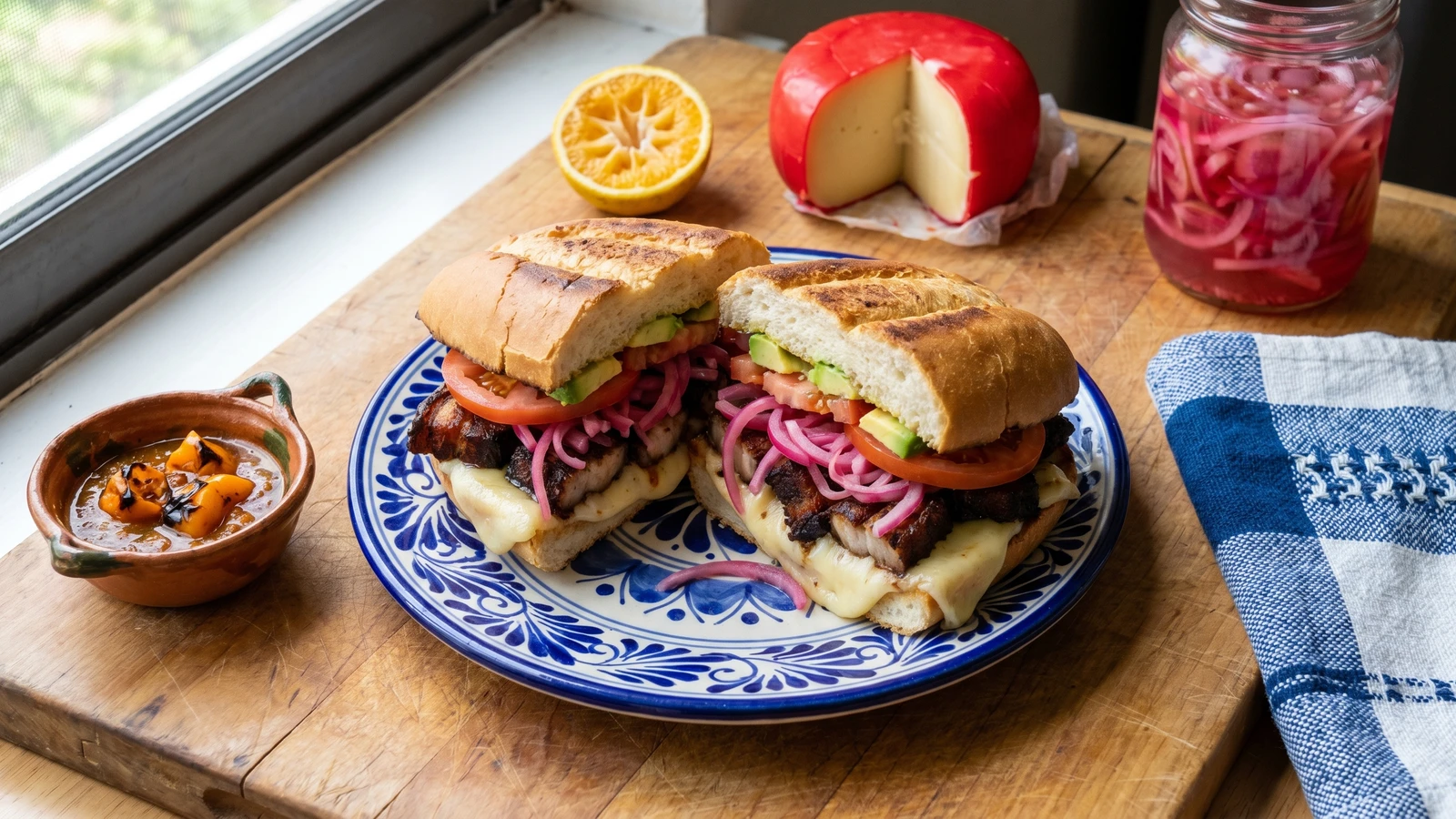
Mérida's torta of slow-cooked pork belly fried into castacán, layered with melted queso de bola on pan francés, dressed with pink pickled onions and salsa xnipec that lights the tongue.
This is from Mérida. Yucatán. Specifically from the loncherías and torta stands that line the streets around the Mercado Lucas de Gálvez, where the cooks have been doing this same combination for a hundred years and they do not need to be told it works.
Castacán is pork belly simmered first, then fried. The skin crackles under your teeth. The fat underneath is soft, almost spreadable. That contrast is the whole dish. You cannot skip the simmer. You cannot skip the fry. Either step alone gives you something else. Together they give you castacán, and castacán on pan francés with melted queso de bola is one of the great sandwiches of the Peninsula.
The queso de bola is not a substitution for something else. It is the cheese of Yucatán. Edam, wrapped in red wax, came through the port of Sisal in the nineteenth century when the henequen trade brought European goods into Mérida, and the Yucatecos absorbed it into their cooking the way they absorbed everything else worth keeping. It does not melt the way a Mexican queso would. It softens, slumps, holds its shape. That is what you want. The pickled red onions and the salsa de habanero are not decoration. They are the acid and the heat that cut through the fat. Without them, this torta is too rich to finish. With them, you finish it and you want another.
My mother did not cook Yucatecan food. She was from Jalisco and she stayed loyal to her state. But I spent two months in Mérida in my second year of the 32-state project, sleeping in a hammock in a guesthouse off Calle 60, eating tortas for breakfast almost every morning. There is a señora at a small lonchería near the Parque de Santa Lucía who taught me how she fries her castacán. She told me her grandmother used to render the lard in a copper pot in the patio. Saber cocinar es saber vivir.
The Yucatán Peninsula's culinary distinctness from the rest of Mexico stems from its geographic isolation before the construction of the railroad to Mérida in the late 19th century, which kept the region trading more easily with Cuba, New Orleans, and Europe than with central Mexico. Queso de bola, the Yucatec name for Dutch Edam, arrived through the port of Sisal during the henequen boom of the 1800s and was rapidly absorbed into local cooking, appearing in queso relleno, marquesitas, and the tortas of the Mérida lonchería tradition. The word castacán is Yucatec Maya in origin and refers specifically to the cut and preparation of pork belly that has been first boiled in a seasoned liquid then fried in its own rendered fat, a technique that parallels the cochinita pibil tradition of breaking down pork through long, slow cooking before finishing it with heat.
Quantity
2 pounds
cut into 2-inch wide strips
Quantity
1 tablespoon
Quantity
1
halved crosswise
Quantity
2
Quantity
1/4 cup
or 3 tablespoons orange juice mixed with 1 tablespoon lime juice and 1 tablespoon white vinegar
Quantity
1 tablespoon, plus more for the comal
Quantity
4 pieces
or small baguettes split lengthwise
Quantity
8 ounces
thinly sliced or grated
Quantity
1 large
sliced into thin rings
Quantity
1/2 cup
Quantity
1 teaspoon
Quantity
1/2 teaspoon
Quantity
4
stemmed
Quantity
1/4 cup
Quantity
1/4 teaspoon
Quantity
for serving
sliced
Quantity
for serving
sliced
| Ingredient | Quantity |
|---|---|
| pork belly with skin oncut into 2-inch wide strips | 2 pounds |
| kosher salt | 1 tablespoon |
| head of garlichalved crosswise | 1 |
| bay leaves | 2 |
| naranja agria juiceor 3 tablespoons orange juice mixed with 1 tablespoon lime juice and 1 tablespoon white vinegar | 1/4 cup |
| manteca de cerdo (pork lard) | 1 tablespoon, plus more for the comal |
| pan francés (Yucatecan French bread)or small baguettes split lengthwise | 4 pieces |
| queso de bola (Edam)thinly sliced or grated | 8 ounces |
| red onionsliced into thin rings | 1 large |
| naranja agria juice (for the pickled onions) | 1/2 cup |
| dried Mexican oregano | 1 teaspoon |
| kosher salt (for the pickled onions) | 1/2 teaspoon |
| chiles habanerostemmed | 4 |
| naranja agria juice (for the salsa) | 1/4 cup |
| kosher salt (for the salsa) | 1/4 teaspoon |
| ripe tomato (optional)sliced | for serving |
| avocado (optional)sliced | for serving |
Drop the sliced red onion into a bowl of boiling water for exactly ten seconds. Drain immediately. Transfer to a glass jar and pour in the half cup of naranja agria juice. Add the dried oregano and half teaspoon of salt. Stir. Let it sit for at least thirty minutes while you cook the castacán. The onions will turn bright pink. This is not optional garnish. In Yucatán, the pickled onions are part of the dish.
Place the pork belly strips in a heavy pot. Add the garlic, bay leaves, salt, and quarter cup of naranja agria. Cover with cold water by one inch. Bring to a gentle simmer over medium heat. Skim the gray foam in the first ten minutes. Lower the heat and cook at a lazy bubble for two hours, until the meat is tender enough to pierce with a fork and the skin has softened. Cold water start, slow simmer. A rolling boil toughens the belly.
Lift the pork belly out of the broth and let it drain on a wire rack. Pat each piece dry with a clean cloth. The skin must be dry before it hits the fat. Wet skin in hot lard is dangerous and it will not crisp. You can do this step up to a day ahead. The pork actually fries better when it has cooled and the skin has tightened.
Char the habaneros directly over an open flame or on a hot comal until the skin blackens in patches, about two minutes per side. Drop them into a molcajete with the quarter teaspoon of salt. Grind to a rough paste. Add the quarter cup of naranja agria and grind again until the salsa is loose. Taste it. It should bite hard and finish citrus. In Mérida this is called salsa xnipec, dog's nose, because it will make you sniff like one.
Heat the tablespoon of lard in a heavy skillet or cast iron pan over medium-high heat. Place the pork belly skin-side down and press it flat. Do not crowd the pan. Fry for about four to five minutes until the skin turns deep golden and crackles audibly. Flip and fry the meat side for another three minutes until the edges turn mahogany. La manteca es el sabor. The belly is releasing its own fat now and frying in it. That is castacán. Pull the pieces onto a board and let them rest for two minutes.
Split each pan francés lengthwise without cutting all the way through. Smear a little lard on the cut sides. Heat the comal or a wide skillet over medium. Press the open bread cut-side down onto the comal until the inside toasts to a light gold, about a minute. Lift the top half, lay the slices of queso de bola onto the bottom half while it is still on the heat, and let the cheese soften and slump into the bread. Queso de bola is the cheese. Edam. Yucatán has eaten it since the Dutch traded it through the port of Sisal in the nineteenth century. No cheddar. No Monterey Jack. No me vengas con atajos.
Chop or slice the fried castacán roughly. Pile it generously over the melted queso de bola on the bottom half of the pan francés. The hot fat will keep melting the cheese into the bread. Top with a tangle of the bright pink cebollas encurtidas and a few slices of tomato and avocado if you are using them. Close the torta and press it down with your palm so the fat and the cheese marry the bread. Serve immediately with the salsa de habanero on the side. Each bite should crack at the edge of the skin, give to the soft fat, hit the salty cheese, and finish with the sting of habanero and citrus. Así se hace y punto.
1 serving (about 325g)
Culinary guides, cultural storytelling, and the editorial depth that makes cooking meaningful.
Discover Culinary ExplorerChef Lupita
Jalisco's goat birria, born around Cocula and carried into Guadalajara's markets, slow-braised in ancho, guajillo, cascabel, and chile de arbol, then tucked into corn tortillas crisped in its own red fat.

Chef Lupita
Sonora's working morning burrito: chicharrón de cáscara stewed in chile colorado with diced potato, rolled tight in a paper-thin tortilla sobaquera and eaten standing up at the carreta.

Chef Lupita
Mocorito's pork chilorio, shredded and confited in lard with chile ancho and pasilla, rolled into a thin handmade flour tortilla. The burrito Sinaloa sends out into the world.

Chef Lupita
Sonora's morning burrito of mashed pinto frijoles puercos and melted queso asadero, wrapped in a paper-thin sobaquera and seared on the comal until the cheese pulls in long strings.