
Chef Fai
Sticky Rice Dumplings in Coconut Cream (Bua Loi)
Glutinous rice flour, palm sugar, coconut cream, and a pinch of salt. Thai dessert follows the same governing rules as every savory dish. The system doesn't stop at the sweet course.
A cooking platform built around craft, culture, and the stories behind what we eat.
Created by
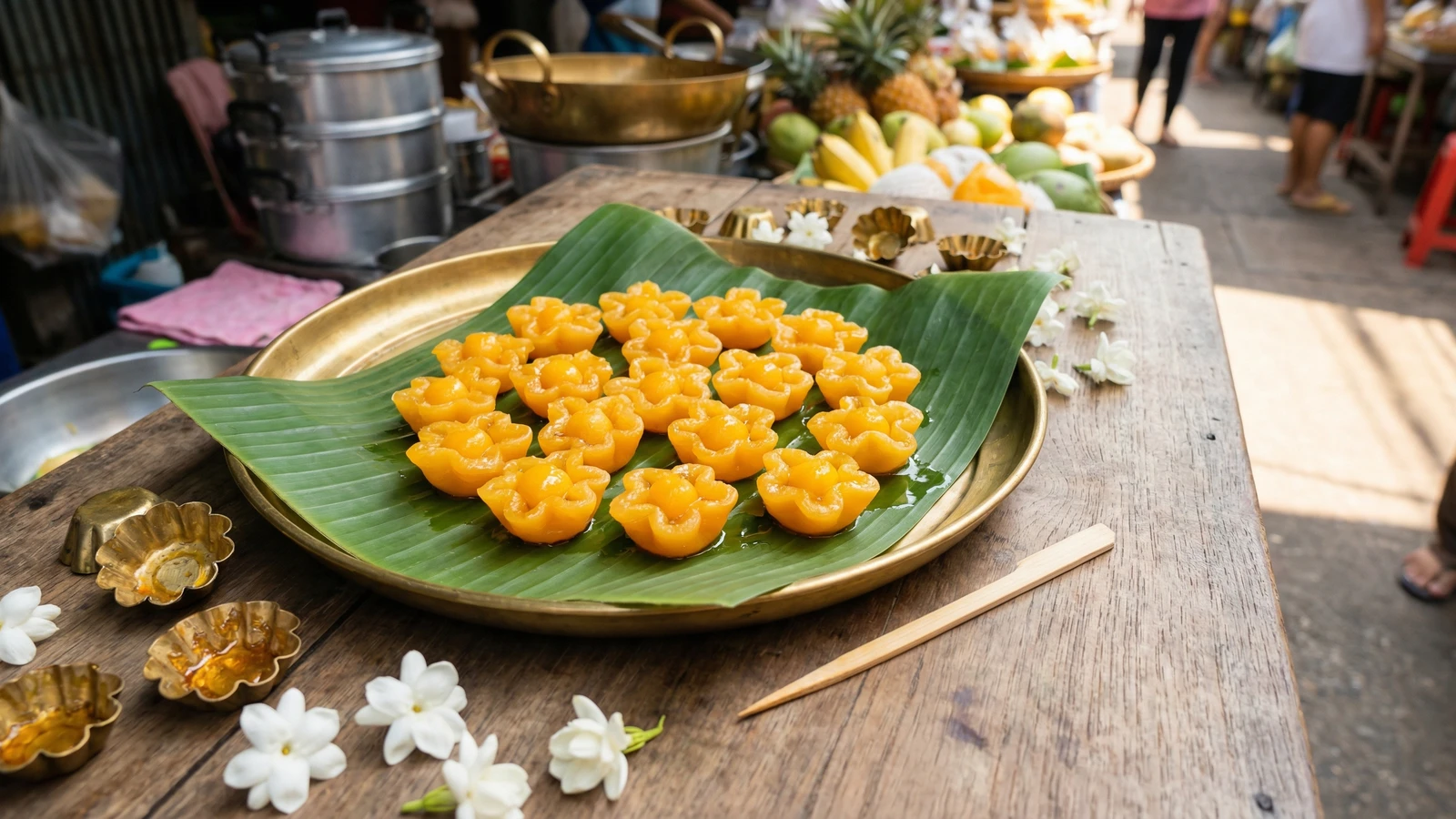
Egg yolks poached in jasmine and pandan palm sugar syrup, pinched into five-petal golden flowers while still warm enough to shape. A Portuguese technique absorbed by the Thai system four centuries ago. The sweet pillar made visible.
The sweet pillar is the one everyone underestimates. People think sugar is sugar. It's not. Palm sugar (nam tan pip) is to Thai dessert what fish sauce is to savory cooking: the non-negotiable. It carries caramel depth, mineral complexity, a warmth that granulated white sugar can't touch. Ajarn always said the four pillars govern everything, even dessert. Especially dessert. If you swap palm sugar for white sugar in thong yip, you don't get a slightly different version. You get a different dish.
Thong yip (ทองหยิบ) breaks most people's idea of what Thai cooking looks like. No wok. No fire. No mortar. Just egg yolks, palm sugar syrup scented with jasmine and pandan, and your fingers. You poach pure strained yolks in small brass cups floating in syrup until they just set, then you turn them out and pinch five petals into each one while the yolk is still warm enough to shape. Too hot, it falls apart. Too cool, it cracks. There's a window of maybe thirty seconds where the texture is right. That window is the entire skill.
At my Fai Thai workshops, this is the dish that humbles people. Everyone walks in thinking they have steady hands. Then they try to pinch five even petals into a walnut-sized cup of cooked egg yolk on a timer. By the third attempt, they're laughing. By the tenth, they're focused. By the twentieth, they start to feel what the temple fair vendors feel: the exact moment when the yolk is pliable, warm, ready. That moment isn't in any recipe. It's in your fingertips.
The technique came from Portugal. The principles are Thai. Palm sugar, not white sugar. Pandan and jasmine, not vanilla. The system absorbed a foreign method and made it follow the rules. That's what the system does. Thai food doesn't reject outside influence. It governs it.
Thong yip is one of the 'three golds' (thong sam yang, ทองสามย่าง) of Thai celebratory desserts, alongside thong yod (gold drops) and foi thong (gold threads). All three trace to Maria Guyomar de Pinha, a woman of Portuguese, Japanese, and Bengali descent who served in the Ayutthaya court of King Narai in the late 17th century. She brought Portuguese egg yolk confection techniques (ovos moles) that Thai court cooks adapted with palm sugar, pandan, and jasmine, replacing the white sugar, vanilla, and cinnamon of the Iberian originals. The name thong yip means 'pinched gold,' and the five petals symbolize five blessings in Thai Buddhist tradition, making these compulsory at weddings, ordinations, and housewarming ceremonies where their golden color signals wealth and prosperity.
Quantity
15
strained through muslin cloth
Quantity
400g
Quantity
1½ cups
Quantity
3
knotted
Quantity
2 tablespoons
Quantity
for greasing molds
Quantity
for lining tray
| Ingredient | Quantity |
|---|---|
| duck egg yolks (khai phet)strained through muslin cloth | 15 |
| palm sugar (nam tan pip) | 400g |
| water | 1½ cups |
| pandan leaves (bai toei)knotted | 3 |
| jasmine water (nam dok mali) | 2 tablespoons |
| vegetable oil | for greasing molds |
| banana leaves (bai tong) | for lining tray |
Combine the palm sugar and water in a wide, shallow pan over medium heat. Stir until the palm sugar dissolves completely. Drop in the knotted pandan leaves. Bring to a gentle boil and cook for 8 to 10 minutes, skimming any foam that rises. You're looking for 'one thread' consistency: dip a spoon in, let the syrup drip, and it should form a single fine thread before breaking. Not two threads, not a sheet. One thread. Remove from heat, fish out the pandan leaves, and stir in the jasmine water. The syrup should smell like a temple garden. That fragrance is the soul of every thong yip you'll make today.
Separate your duck egg yolks carefully. Not a speck of white. Egg white will make your thong yip tough and opaque instead of smooth and glossy. Pass the yolks through a fine muslin cloth or double layer of cheesecloth into a clean bowl. Push them through gently with a spoon. What comes through should be pure liquid gold with no chalazae, no membrane, no lumps. This step is not optional. Every impurity shows in the finished piece.
Lightly grease each small brass cup (thuay thong yip, ถ้วยทองหยิบ) with a thin film of vegetable oil on a paper towel. The coating should be barely there, just enough to prevent sticking. If your cups are over-greased, the yolks will slip around and won't hold the cup shape. Line a tray with banana leaf. This is where your finished thong yip will rest. The banana leaf isn't decoration. It prevents sticking and keeps the pieces from drying out.
Return the syrup to the pan and bring it to a very gentle simmer. Barely bubbling. Spoon the strained yolk into each brass cup, filling about two-thirds full. Don't overfill. The yolk expands slightly as it cooks. Carefully lower the filled cups into the simmering syrup. The syrup should come up about halfway on the outside of the cups. If you're working in batches, do five or six cups at a time. Let them poach for 4 to 5 minutes. Watch the surface of the yolk. It will go from glossy liquid to matte and set, pulling slightly from the edges of the cup. When the surface looks firm and doesn't jiggle when you nudge the cup, it's done. Lift each cup out with tongs and set on a wire rack.
This is where the skill lives. Let each cup cool for about 30 to 45 seconds after coming out of the syrup. The yolk needs to be warm enough to be pliable but cool enough to hold a shape. Gently invert the cup and ease the yolk out onto your fingertips or a lightly oiled surface. It should release cleanly. Now, using a thin pointed stick (mai jaew, ไม้แจว) or a wooden toothpick, pinch the rim inward at five equidistant points to form five petals. The motion is: press inward and slightly upward, creating a crease that narrows the rim and opens the cup into a flower. Five points. Five petals. Evenly spaced. Work quickly. You have about 30 seconds before the yolk firms up and cracks instead of folds. If it cracks, the piece was too cool. If it slumps, too warm. That window is the whole art.
Once pinched, you can briefly dip each thong yip back into the warm syrup for a glossy finish. Just a second, in and out. This gives them that lacquered, jewel-like sheen you see at wedding dessert tables. Place each finished piece on the banana leaf-lined tray. Arrange them in neat rows or concentric circles. They should look like a tray of golden flowers. Serve at room temperature within a few hours. Thong yip doesn't wait overnight. The syrup crystallizes, the texture changes. Make them, present them, eat them. That's the rhythm of Thai celebratory desserts.
1 serving (about 22g)
Culinary guides, cultural storytelling, and the editorial depth that makes cooking meaningful.
Discover Culinary ExplorerChef Fai
Glutinous rice flour, palm sugar, coconut cream, and a pinch of salt. Thai dessert follows the same governing rules as every savory dish. The system doesn't stop at the sweet course.

Chef Fai
Portuguese fios de ovos arrived in Ayutthaya and Thailand rewrote the rules: palm sugar replaced white, jasmine water replaced plain, and a foreign technique became Thai the moment it followed the system.

Chef Fai
Palm sugar and coconut cream frozen on a street cart with nothing but salted ice and strong arms. The sweet pillar of Thai cuisine in its coldest, purest form. Three ingredients in the base. A lifetime of principle behind them.

Chef Fai
Two layers, one principle: palm sugar for sweet, coconut cream for richness, pandan for fragrance, salt on top to prove that Thai cuisine balances even its desserts. The system governs everything, including sweets.