
Chef Fai
Sticky Rice Dumplings in Coconut Cream (Bua Loi)
Glutinous rice flour, palm sugar, coconut cream, and a pinch of salt. Thai dessert follows the same governing rules as every savory dish. The system doesn't stop at the sweet course.
A cooking platform built around craft, culture, and the stories behind what we eat.
Created by
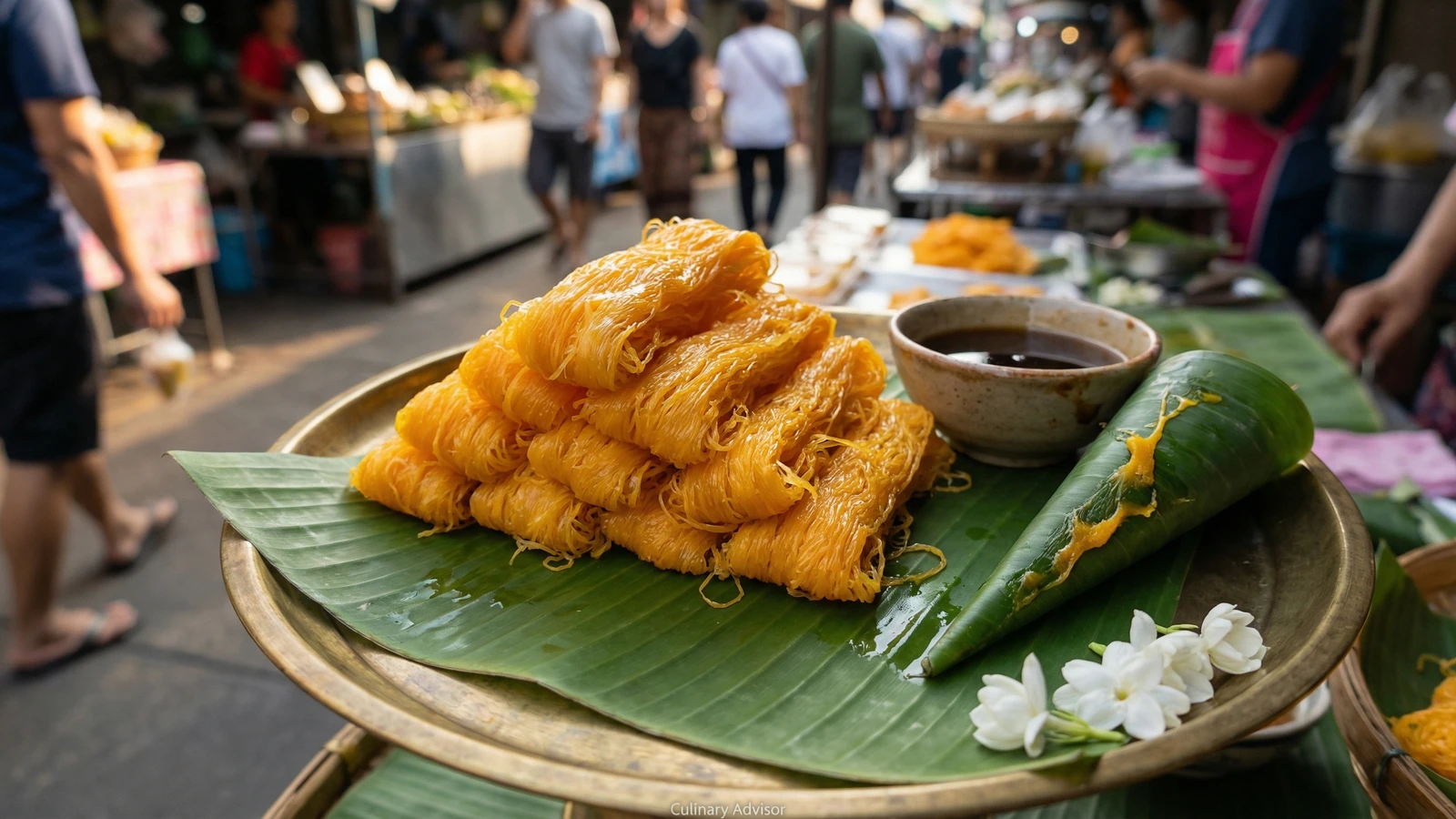
Portuguese fios de ovos arrived in Ayutthaya and Thailand rewrote the rules: palm sugar replaced white, jasmine water replaced plain, and a foreign technique became Thai the moment it followed the system.
Palm sugar. That's where every Thai sweet begins. Not granulated white sugar, not cane sugar, not corn syrup. Nam tan pip (น้ำตาลปี๊บ), rendered from the sap of coconut or palmyra palms, carrying a caramel depth and mineral richness that no refined sugar can touch. Ajarn always said the four pillars govern everything, including dessert. The sweet pillar isn't just "add sugar." It's "add the right sugar." Palm sugar carries flavor. White sugar carries nothing.
Foi thong is the most beautiful proof that Thai cuisine doesn't borrow. It absorbs. In the 1600s, a woman of Portuguese descent named Maria Guyomar de Pinha brought the technique of drizzling egg yolks into sugar syrup from her European heritage into the royal kitchens of Ayutthaya. Portuguese fios de ovos used white cane sugar and plain water. Thailand took the technique and ran it through the system: palm sugar replaced white, jasmine-scented water replaced plain, pandan wove its way into the syrup pot, and what emerged was something entirely Thai. The technique is Portuguese. The soul is Thai. That's not fusion. That's the system doing what it does, absorbing what's useful and governing it with Thai rules.
The science is straightforward but the execution is brutal. Egg yolks strained through cloth, loosened with a touch of lime water (nam boon sai, น้ำปูนใส) so they hold their shape in hot syrup. Palm sugar syrup brought to exactly the right consistency: too thin and the threads dissolve, too thick and they clump into lumps. You drizzle the yolk mixture through a tiny hole in a cone of banana leaf, moving your hand in steady circles over the simmering syrup. The threads set within seconds. Golden, delicate, impossibly fine. You lift them with chopsticks, fold them into bundles, and lay them on a tray. Every thread is evidence of your control.
I failed my first dozen attempts in Ajarn's kitchen. The threads broke. The syrup scorched. The cone leaked. He just watched and said, "Again." That's the only way with foi thong. Patience and repetition. But when you finally get it right, when those golden threads pile up like silk on a banana leaf scented with jasmine and pandan, you understand why Thai families serve this at weddings, ordinations, and New Year celebrations. In Thai, "thong" (ทอง) means gold. Foi thong is golden threads. Thong yip is pinched gold. Thong yod is dropped gold. Every one of these sweets carries the word for gold in its name because gold means prosperity, luck, and blessing. Sweetness as ritual. Sweetness as skill. The system governs even dessert.
Foi thong descends directly from the Portuguese confection fios de ovos ('threads of egg'), introduced to the Siamese court at Ayutthaya by Maria Guyomar de Pinha (sometimes written Guimar), a woman of Japanese-Portuguese-Bengali heritage who became head of the royal dessert kitchen under King Narai in the late 17th century. She also introduced thong yip (pinched gold) and thong yod (dropped gold), forming the trio of Thai egg sweets collectively called 'thong' (ทอง, gold) that became mandatory offerings at royal ceremonies, weddings, and ordinations. The defining Thai adaptation was replacing European white cane sugar with palm sugar (nam tan pip) and scenting the syrup with jasmine water (nam dok mali) and pandan (bai toey), transforming a European technique into something governed by the Thai sweet framework.
Quantity
15 duck (or 20 chicken)
separated, whites reserved for another use
Quantity
400g
chopped into small pieces
Quantity
2½ cups
Quantity
2
knotted
Quantity
1 teaspoon
Quantity
10 flowers, or 2 teaspoons jasmine water
for scenting water
Quantity
1 piece, about 8 inches square
for making the drizzling cone
| Ingredient | Quantity |
|---|---|
| duck egg yolks (or chicken egg yolks)separated, whites reserved for another use | 15 duck (or 20 chicken) |
| palm sugar (nam tan pip)chopped into small pieces | 400g |
| jasmine-scented water (nam dok mali) | 2½ cups |
| pandan leaves (bai toey)knotted | 2 |
| lime water (nam boon sai) | 1 teaspoon |
| fresh jasmine flowers (dok mali)for scenting water | 10 flowers, or 2 teaspoons jasmine water |
| banana leaffor making the drizzling cone | 1 piece, about 8 inches square |
The night before you plan to make foi thong, place the jasmine flowers in a bowl with 2½ cups of water. Cover with a cloth and leave at room temperature overnight. The water should smell intensely floral by morning, sweet and heady, like walking past a temple at dawn. Strain out the flowers. This is your nam dok mali. If you're using bottled jasmine water, dilute 2 teaspoons in 2½ cups of plain water. Fresh is better. The aroma is the whole point.
Combine the jasmine-scented water, chopped palm sugar, and knotted pandan leaves in a wide, shallow pan (at least 10 inches across; width matters more than depth). Set it over medium heat and stir until the palm sugar dissolves completely. The syrup should be the color of dark honey. Bring it to a gentle boil, then lower the heat until the surface barely simmers. Skim off any foam or scum that rises. You want a clean, clear syrup. The consistency at this stage should be thin, like maple syrup at room temperature. If it thickens too much, the threads will clump instead of flowing. Keep the pandan leaves in the syrup throughout. They're not decoration. They're releasing aromatic compounds into the liquid every second they sit there.
Pass the egg yolks through a fine-mesh strainer or a piece of muslin cloth into a bowl. Press them through gently with a spoon. You're removing the chalazae (those white stringy bits) and any membrane. The result should be a smooth, uniform liquid, no lumps, no strings. Add the lime water (nam boon sai) and stir gently. Don't whisk. Don't beat air into it. Fold it in with a spoon. The lime water is calcium hydroxide dissolved in water: it strengthens the protein structure of the yolk so the threads hold their shape in the hot syrup instead of dissolving into scrambled egg soup. Pour the strained yolk mixture into a vessel with a spout, a measuring cup works, for easy pouring into the cone later.
Take the banana leaf square and roll it into a tight cone, like a paper funnel. The opening at the narrow end should be tiny: about 2 millimeters, the width of a thick sewing needle. Secure the cone's shape by pinning it with a toothpick or stapling the overlapping edge. Test it by pouring a little water through. The stream should be thin and steady, not dripping, not gushing. If the hole is too big, your threads will be thick ropes. If it's too small, nothing comes out. This is the tool that makes foi thong. The banana leaf isn't decoration. It's a precision instrument.
Make sure the syrup is at a gentle, steady simmer. Not a rolling boil. Not motionless. Small bubbles breaking the surface. Fill the cone about half full with the yolk mixture. Hold it about 6 inches above the syrup. Now: move your hand in a smooth, continuous circular motion and let the yolk drizzle out in a thin, steady stream. The yolk should hit the syrup and set almost instantly into golden threads. Keep the circles tight and overlapping. Work in batches, each batch about 15-20 seconds of drizzling. Don't overload the pan. After 1 to 2 minutes in the syrup, the threads will be cooked through: firm but still tender, deeply golden. Use chopsticks or a wooden skewer to gently lift the bundle of threads from the syrup. Let excess syrup drip back into the pan.
As you lift each batch from the syrup, gently fold the threads into a small bundle or nest shape while they're still pliable. Lay them on a tray lined with banana leaf or parchment. They'll firm up as they cool, holding whatever shape you give them. Continue until all the yolk mixture is used, adjusting the syrup's heat between batches if it starts to thicken. If the syrup does get too thick, add a splash of jasmine water and bring it back to a simmer. When all the threads are done, arrange the golden bundles on a serving tray. They should glisten with a light coating of syrup. The color should be deep gold, not pale yellow. If they're pale, your palm sugar syrup wasn't rich enough. If they're too dark, the syrup was too hot.
1 serving (about 90g)
Culinary guides, cultural storytelling, and the editorial depth that makes cooking meaningful.
Discover Culinary ExplorerChef Fai
Glutinous rice flour, palm sugar, coconut cream, and a pinch of salt. Thai dessert follows the same governing rules as every savory dish. The system doesn't stop at the sweet course.

Chef Fai
Palm sugar and coconut cream frozen on a street cart with nothing but salted ice and strong arms. The sweet pillar of Thai cuisine in its coldest, purest form. Three ingredients in the base. A lifetime of principle behind them.

Chef Fai
Two layers, one principle: palm sugar for sweet, coconut cream for richness, pandan for fragrance, salt on top to prove that Thai cuisine balances even its desserts. The system governs everything, including sweets.

Chef Fai
Rice flour and mung bean flour. No wheat, no butter, no oven. Spread paper-thin on a hot griddle, filled sweet or savory, folded and gone in two bites. Single-dish mastery is the principle. The vendor's wrist is the technology.