
Chef Fai
Sticky Rice Dumplings in Coconut Cream (Bua Loi)
Glutinous rice flour, palm sugar, coconut cream, and a pinch of salt. Thai dessert follows the same governing rules as every savory dish. The system doesn't stop at the sweet course.
A cooking platform built around craft, culture, and the stories behind what we eat.
Created by
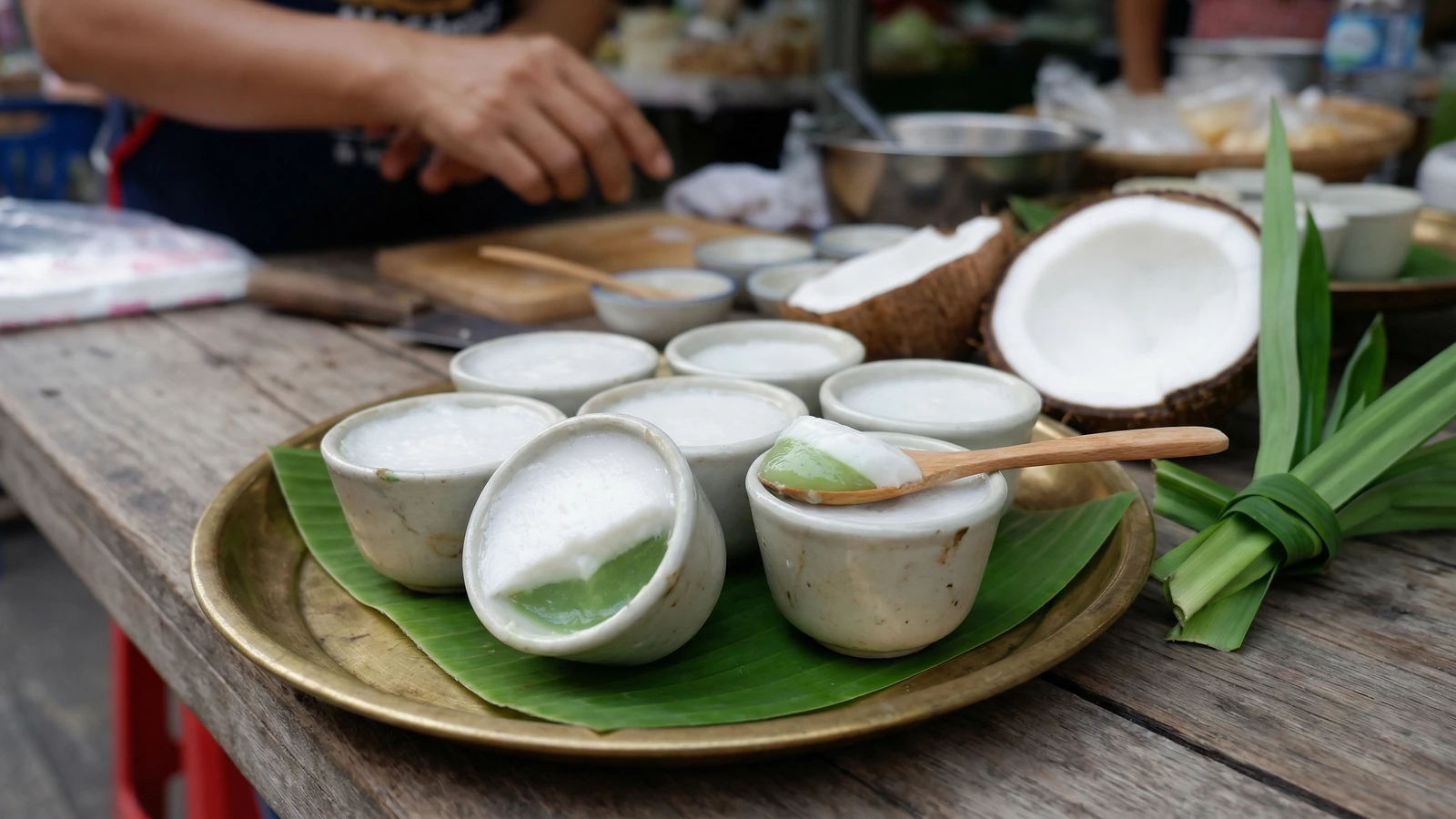
Two layers, one principle: palm sugar for sweet, coconut cream for richness, pandan for fragrance, salt on top to prove that Thai cuisine balances even its desserts. The system governs everything, including sweets.
Thai sweets follow the same system as savory food. That's the thing most people never realize.
Ajarn always said the four pillars govern all of Thai cuisine: fish sauce for salt, palm sugar for sweet, tropical fruit acids for sour, chili for heat. In desserts, the sweet pillar steps forward and takes the lead. Palm sugar (nam tan pip) is the only sweetener. Not granulated white sugar, not honey, not agave. Palm sugar. It has depth: caramel, butterscotch, a slight smokiness from the boiling process. White sugar gives you sweetness. Palm sugar gives you flavor. That distinction matters everywhere in Thai cooking, but nowhere more than in khanom (ขนม), Thai sweets, where sugar is the foundation, not the accent.
Kanom tuay (ขนมถ้วย) is two layers in a small cup. The bottom layer is rice flour cooked with palm sugar and pandan water until it sets into a soft, jade-green custard. The top layer is thick coconut cream with a pinch of salt and just enough rice flour to hold its shape. Sweet on the bottom. Salty on top. You eat them together in one spoonful, and the contrast is the whole point. This is Thai balance at work. Even in dessert, salt has a job. It sharpens the sweetness, gives it dimension, keeps it from being one-note.
The rice flour here is paeng khao jao (แป้งข้าวเจ้า), regular rice flour, not glutinous. That distinction matters. Glutinous rice flour (paeng khao niew) gives you stretch and chew, which is wrong for this dish. Regular rice flour sets into a clean, smooth custard that holds its shape when you tip the cup. A small addition of tapioca starch gives the bottom layer its signature translucency. When you see that pale green layer through the white coconut top, slightly glassy, slightly see-through, that's the tapioca doing its work.
I teach kanom tuay in every Fai Thai workshop because it's the clearest proof that the system governs dessert too. Palm sugar, coconut cream, pandan, salt. Four ingredients doing exactly what the principles demand. No shortcuts. No substitutions. If you understand why this works, you understand Thai sweets.
Kanom tuay is a Central Thai sweet predating the Ayutthaya-era Portuguese influence that introduced egg-based desserts like foi thong, thong yip, and thong yod through Maria Guyomar de Pinha (แม่มะรี กีมาร์ เดอ ปีนา), the Japanese-Portuguese-Bengali woman who adapted European egg confections to Thai ingredients in the 17th century. Unlike those adopted sweets, kanom tuay belongs to the indigenous coconut-and-rice flour tradition that is purely Southeast Asian. The name literally means 'cup sweet' (ขนมถ้วย), referring to the small ceramic or porcelain cups it's steamed in, and the dish remains a fixture at temple fairs (งานวัด), morning markets, and street stalls across Central Thailand.
Quantity
120g
not glutinous rice flour
Quantity
30g
Quantity
180g
shaved or chopped
Quantity
5
knotted
Quantity
300ml
Quantity
250ml
ideally fresh-pressed
Quantity
2 tablespoons
for the top layer
Quantity
1/2 teaspoon
Quantity
20
| Ingredient | Quantity |
|---|---|
| regular rice flour (paeng khao jao)not glutinous rice flour | 120g |
| tapioca starch (paeng man sampalang) | 30g |
| palm sugar (nam tan pip)shaved or chopped | 180g |
| pandan leaves (bai toey)knotted | 5 |
| water | 300ml |
| thick coconut cream (hua kati)ideally fresh-pressed | 250ml |
| regular rice flour (paeng khao jao)for the top layer | 2 tablespoons |
| fine sea salt | 1/2 teaspoon |
| small ceramic cups or banana leaf cups | 20 |
Take three of the pandan leaves, cut them into rough pieces, and blend them with the 300ml of water until the liquid turns vivid green. Strain through a fine sieve, pressing out every drop. Discard the pulp. This is your pandan water. The color should be deep jade, not pale. If it looks washed out, your pandan leaves aren't fresh enough. The remaining two knotted pandan leaves go into the pot later for extra fragrance.
Pour the pandan water into a saucepan. Add the shaved palm sugar and the two remaining knotted pandan leaves. Heat over medium-low, stirring constantly, until the sugar dissolves completely. Don't let it boil. You're dissolving, not caramelizing. The liquid should be a warm amber-green with the deep aroma of caramel and pandan filling your kitchen. Strain out the pandan leaves and any undissolved bits. Let this cool to room temperature.
In a bowl, combine the 120g regular rice flour and 30g tapioca starch. Pour in the cooled palm sugar pandan water gradually, whisking as you go to prevent lumps. Whisk until completely smooth. Strain the mixture through a fine sieve. This step is non-negotiable. One lump ruins a cup. The batter should be thin and pourable, like heavy cream. The color should be a translucent amber-green.
In a separate bowl, whisk together the thick coconut cream, 2 tablespoons of rice flour, and the salt. Whisk until smooth. The salt is not optional. It's doing the same job it does in every Thai dish: creating contrast. Without the salt, the top layer is just fat. With it, it sharpens the sweetness of the bottom layer and makes the whole thing sing. Strain this mixture too.
Get a large steamer going with water at a rolling boil. If you're using banana leaf cups, cut banana leaf into circles and press them into small molds or simply use them to line ceramic cups. Banana leaf is a cooking tool here, not decoration. It adds a subtle grassy aroma to the custard and prevents sticking. If using plain ceramic cups, lightly oil them. Arrange the cups in the steamer basket.
Give the bottom-layer batter one final stir (it settles fast). Pour it into each cup, filling them about two-thirds full. Cover the steamer and steam over high heat for 10 minutes. The bottom layer is set when it's firm to the touch and slightly translucent, not opaque. It should jiggle like set gelatin, not slosh like liquid. If you see liquid pooling on top, give it another 2 minutes. Do not open the steamer constantly. Every time you lift the lid, you lose heat and the custard sets unevenly.
Once the bottom layer is fully set and firm, stir the coconut cream mixture one more time and gently spoon it over each cup, filling them to just below the rim. Don't pour from height. You'll disturb the set bottom layer. Gentle. Close the lid and steam for another 8 minutes. The top layer is done when it's set but still slightly wobbly, like panna cotta. It should be opaque white with no visible liquid. Remove from the steamer.
Let the cups cool completely to room temperature before serving. This is not optional. Kanom tuay is a room-temperature sweet. The textures only develop fully as it cools: the bottom layer firms up to a smooth, sliceable custard, the top layer becomes a dense, salty cream. Eating it warm is eating it wrong. Patience. The best vendors make their kanom tuay before dawn and sell them through the morning. Time is part of the recipe.
1 serving (about 45g)
Culinary guides, cultural storytelling, and the editorial depth that makes cooking meaningful.
Discover Culinary ExplorerChef Fai
Glutinous rice flour, palm sugar, coconut cream, and a pinch of salt. Thai dessert follows the same governing rules as every savory dish. The system doesn't stop at the sweet course.

Chef Fai
Portuguese fios de ovos arrived in Ayutthaya and Thailand rewrote the rules: palm sugar replaced white, jasmine water replaced plain, and a foreign technique became Thai the moment it followed the system.

Chef Fai
Palm sugar and coconut cream frozen on a street cart with nothing but salted ice and strong arms. The sweet pillar of Thai cuisine in its coldest, purest form. Three ingredients in the base. A lifetime of principle behind them.

Chef Fai
Rice flour and mung bean flour. No wheat, no butter, no oven. Spread paper-thin on a hot griddle, filled sweet or savory, folded and gone in two bites. Single-dish mastery is the principle. The vendor's wrist is the technology.