
Chef Lupita
Agua de Alfalfa
Ciudad de México's highland market agua fresca, fresh alfalfa blended with pineapple and lime until bright green, strained clean, and poured cold from the vitrolero.
A cooking platform built around craft, culture, and the stories behind what we eat.
Created by
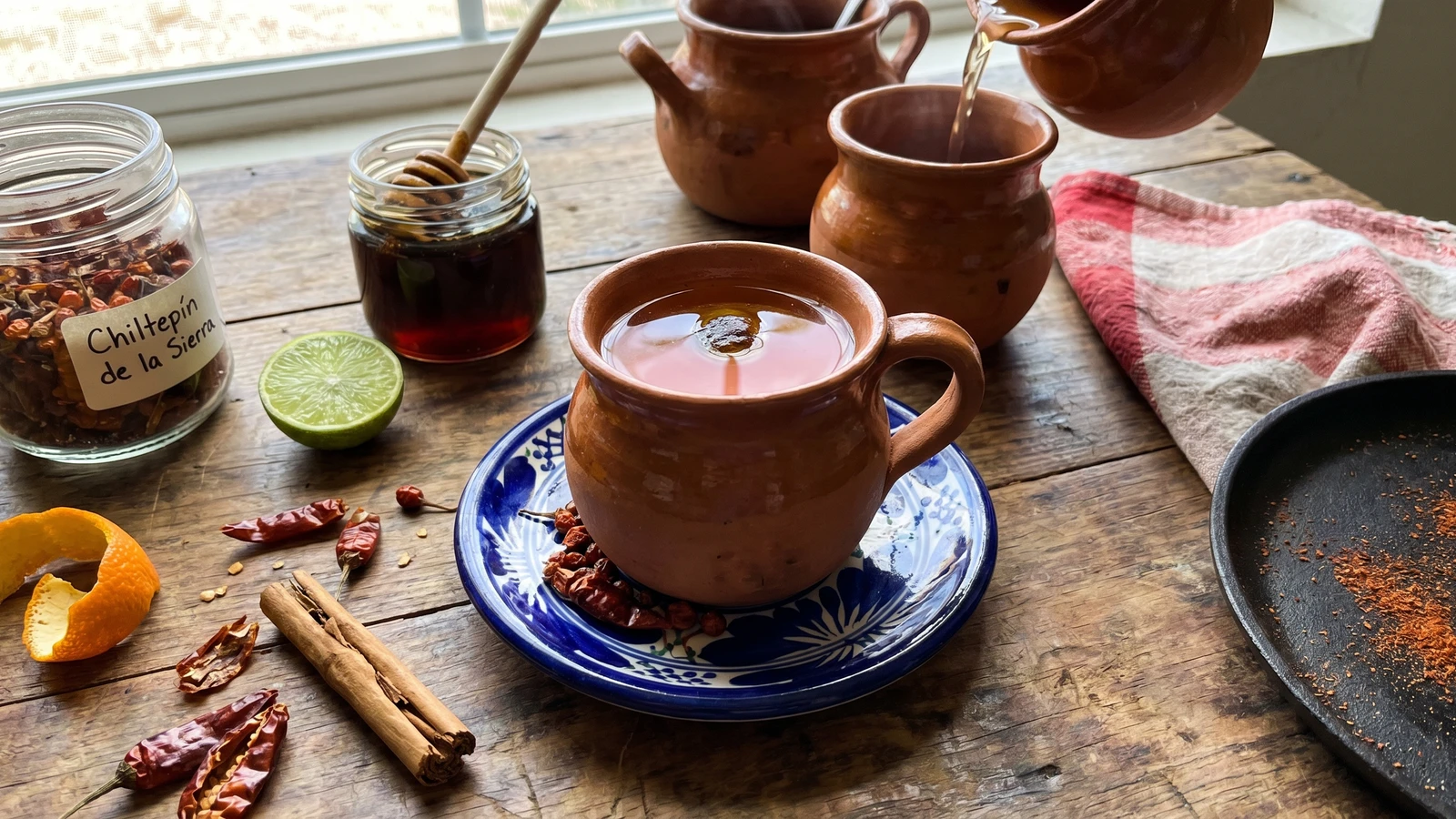
Sonora's wild bird-pepper tea, brewed from cracked chiltepín, canela, and piloncillo. The desert's folk remedy for a cold, a fever, or a chest that will not clear.
This is from Sonora. Not from a generic 'northern Mexico,' which flattens five very different states into one idea. From Sonora, from the Río Sonora valley specifically, from towns like Baviácora and Aconchi where the chiltepín grows wild on thorny shrubs along the riverbanks and is harvested by hand every autumn by families who have done this for generations.
The chiltepín is the mother of all chiles. Botanists call it the wild ancestor of every cultivated capsicum in the Americas. In Sonora it is not a seasoning. It is a tiny round pod, no bigger than a peppercorn, with a heat that arrives fast, peaks, and leaves clean. The Comcáac, the Yaqui, the Mayo, and the Sonoran ranchero kitchens all use it, and a jar of dried chiltepín on the kitchen shelf is as standard in a Sonoran home as a salt cellar in mine.
This tea is medicine. Sonoran grandmothers brew it for colds, for fever, for a chest that will not clear, for the kind of slow stomach that comes from eating too much carne asada. The canela and the piloncillo are not decoration. They round the chile heat and turn a sharp infusion into something a sick child can drink without crying. The orange peel and clove are how the women in Hermosillo and Ures finish theres, and the pinch of salt is the trick I learned from a señora at the mercado in Magdalena de Kino who told me, 'sin sal, el chiltepín muerde; con sal, abraza.' Without salt the chiltepín bites; with salt, it embraces.
No me vengas con atajos. Do not substitute crushed red pepper. Do not use cayenne. Find the chiltepín, real chiltepín from Sonora, sold in small glass jars at any decent Mexican mercado or online from a Sonoran producer. The pod is the point. Cada estado, su propia cocina, and this cup belongs to Sonora.
The chiltepín (Capsicum annuum var. glabriusculum) is the only chile native to the present-day United States and northern Mexico that still grows wild, and the Sonoran sierra is its undisputed heartland; the pre-Columbian Comcáac, Ópata, and Pima Bajo peoples gathered it for both food and medicine long before the Spanish arrival. The wild harvest, called the 'chiltepinada,' remains a seasonal economy in Sonoran towns like Baviácora, where October pickers can earn more per kilo of chiltepín than per kilo of cultivated chile, and the pod has been protected since 1999 as a Sonoran cultural and ecological heritage product. Té de chiltepín as a domestic remedy is documented in Sonoran herbalist tradition going back at least to 18th-century Jesuit mission records, where it appears alongside gobernadora and damiana in the materia medica of the northwest.
Quantity
6 cups
preferably filtered
Quantity
8 to 12
use 8 for milder, 12 for the Sonoran ranchero version
Quantity
1 stick (about 4 inches)
broken in half
Quantity
2 ounces (about one small cone)
chopped, or 3 tablespoons dark brown sugar
Quantity
3
Quantity
1 small strip
no white pith
Quantity
1 tablespoon, plus more to taste
Quantity
pinch
Quantity
for serving
| Ingredient | Quantity |
|---|---|
| waterpreferably filtered | 6 cups |
| dried chiltepín podsuse 8 for milder, 12 for the Sonoran ranchero version | 8 to 12 |
| canela (true Mexican cinnamon)broken in half | 1 stick (about 4 inches) |
| piloncillochopped, or 3 tablespoons dark brown sugar | 2 ounces (about one small cone) |
| whole cloves | 3 |
| fresh orange peelno white pith | 1 small strip |
| fresh lime juice | 1 tablespoon, plus more to taste |
| sea salt | pinch |
| Sonoran desert honey (mesquite or sahuaro flower) (optional) | for serving |
Pour the dried chiltepín onto a plate and pick through them. They should be brick-red to brown, hard as small pebbles, with no soft spots and no white powder of mold. Real chiltepín is wild-harvested in the Sonoran sierra, mostly around Baviácora and the Río Sonora, and the pods are small, irregular, and round. If what you have is uniform and oblong, that is pequín, not chiltepín. Use what you can find but know what you are working with.
Heat a dry comal or small cast iron skillet over medium-low. Add the chiltepín and the canela stick. Toast for 60 to 90 seconds, shaking the pan, until the kitchen smells sharply of pepper and warm bark. The chiltepín will not puff like an ancho. You are waking the oils, not coloring the pod. The moment you cough from the fumes, pull it off the heat. That cough is the signal.
Tip the toasted chiltepín into a small bowl. Press them gently with the back of a wooden spoon until each pod cracks open. You are not making a paste. You are opening the pod so the water can pull the heat and flavor out cleanly. Whole pods give a shy tea. Cracked pods give the tea Sonora drinks.
Bring the water to a boil in a small clay olla or a heavy saucepan. As soon as it boils, lower to a bare simmer. Add the cracked chiltepín, the toasted canela, the cloves, the orange peel, the piloncillo, and the pinch of salt. Stir until the piloncillo dissolves. The salt is not for seasoning. It is the trick the women in Hermosillo use to round the heat and make the tea drinkable for a sick child.
Hold the pot at the gentlest simmer for 15 minutes, partially covered. The liquid will turn the color of weak tea, a transparent pinkish amber. You do not want a hard boil. Hard-boiled chiltepín turns the tea harsh and acrid, the way over-boiled chile breaks a salsa. Soft heat pulls a clean, warm capsaicin that sits on the back of the throat without burning the tongue.
Strain the tea through a fine-mesh sieve into a clay jarrito or a heavy mug. Discard the spent chiltepín, canela, cloves, and orange peel. Stir in the lime juice. Taste. The tea should be warming, mildly sweet, with the chile heat building two or three seconds after the swallow. If it tastes flat, add another half teaspoon of lime. If it bites too hard, a touch more piloncillo. Asi se hace y punto.
Pour into small clay jarritos or thick ceramic mugs. Add a spoonful of mesquite honey at the table if you like, especially for someone fighting a cold. Drink it slowly. This is not a tea you gulp. The Sonoran abuelas say a cup of té de chiltepín before bed opens the chest and breaks a fever by morning. Saber cocinar es saber vivir, and in Sonora, the kitchen is also the medicine cabinet.
1 serving (about 325g)
Culinary guides, cultural storytelling, and the editorial depth that makes cooking meaningful.
Discover Culinary ExplorerChef Lupita
Ciudad de México's highland market agua fresca, fresh alfalfa blended with pineapple and lime until bright green, strained clean, and poured cold from the vitrolero.

Chef Lupita
Aguascalientes' Lenten agua fresca, jewel-red from cooked beet and full of apple, banana, orange, lettuce, and ground peanuts, served cold when Holy Week meets the Feria de San Marcos.

Chef Lupita
Sonora and Sinaloa's creamy malted barley water, built on toasted cebada perla, Mexican canela, vanilla from Papantla, and evaporated milk. Pink-beige, rich, and served cold over heavy ice in a heavy glass tumbler. Liquid cookie comfort the northwest way.

Chef Lupita
Yucatán's everyday tonic of boiled chaya leaves blended with lima agria, sugar, and ice. The bright green jarra that sits on every Peninsula table from Mérida to Valladolid.