
Chef Fai
Isan Beef Larb (Larb Nua)
No sugar. That's the rule. Isan larb strips Thai cuisine down to three pillars: nam pla for salt, manao for sour, prik for heat, bound by the smoky crunch of freshly pounded khao khua. The absence defines the dish.
A cooking platform built around craft, culture, and the stories behind what we eat.
Created by
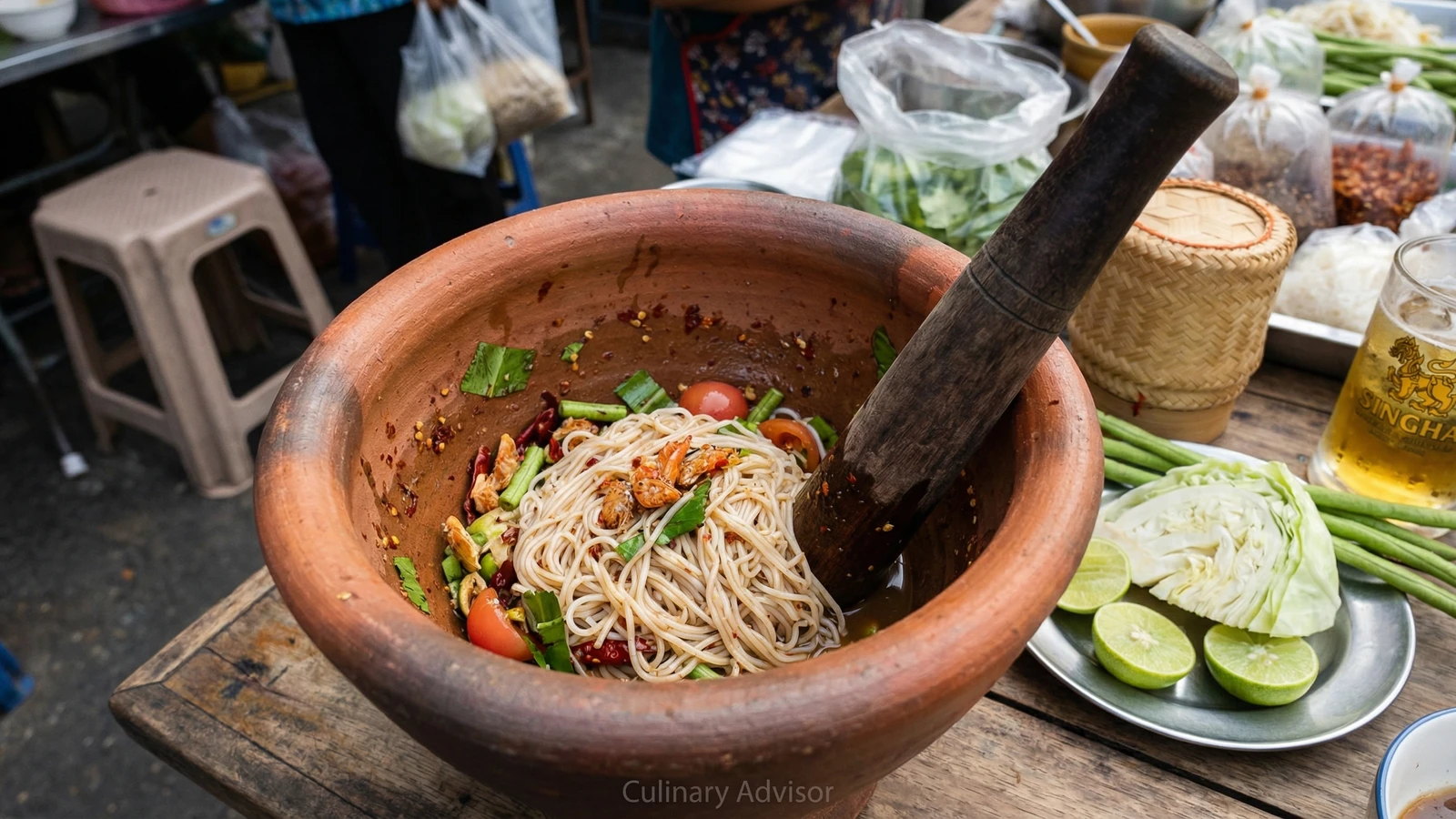
Same mortar, same technique, same four pillars. Swap the papaya for chewy fermented rice noodles and you've got tam sua: proof that the system works with any ingredient you throw in the krok.
Tam is a technique. Not a single dish. Once you understand the mortar, you can pound anything: papaya, corn, cucumber, fruit, noodles. The same governing method, the same four-pillar dressing, the same rhythm of pound, taste, adjust. That's the system at work. Tam sua proves it.
Sua means tiger. The name comes from the way khanom jeen (fermented rice noodles) tangle and coil in the mortar, striped like a tiger's markings. These noodles aren't like Italian pasta or Chinese wheat noodles. Khanom jeen are fermented, slightly sour, with a springy chew that holds up to the pestle. Where green papaya absorbs dressing through bruised cell walls, khanom jeen absorbs it through its porous, fermented structure. Different ingredient, same principle: the mortar opens the surface. The dressing enters. That's physics.
This is Isan territory. The dressing is leaner than the Central Thai som tam you're used to. Less palm sugar. More lime. More funk. Pla ra (fermented fish) goes in, and it's not optional. That deep, murky salinity is what separates Isan tam from the sweet, tourist-friendly version with peanuts and dried shrimp. Pla ra is an acquired taste for people who didn't grow up with it. For Isan cooks, it's the foundation. Fish sauce for salt. Pla ra for soul. Lime for sour. Chili for heat. That's the law.
Ajarn always said: learn the method, forget the recipe. When I teach tam sua at Fai Thai workshops, I use it as the proof. You already know how to pound garlic and chilies. You already know the dressing. Now swap the papaya for noodles. See? The system works. Principles, not recipes.
Tam sua is part of the broader tam (pounded salad) family that originated in Isan (northeastern Thailand) and Laos, where the mortar-and-pestle method of salad preparation predates any written recipe. Khanom jeen, the fermented rice noodles used in this dish, have roots in Mon-Khmer culinary traditions and are among the oldest noodle forms in mainland Southeast Asia, made by fermenting rice flour dough for several days before pressing it through a sieve into boiling water. The name 'sua' (เสือ, tiger) refers to the tangled, stripe-like appearance of the noodles after pounding, a playful visual metaphor typical of Isan food naming conventions.
Quantity
200g (about 2 nests)
Quantity
4 cloves
Quantity
5
Quantity
3
cut into 1-inch pieces
Quantity
4
halved
Quantity
1 tablespoon
Quantity
1.5 tablespoons
Quantity
1 tablespoon
strained
Quantity
2 tablespoons (about 2 limes)
Quantity
1 teaspoon
Quantity
1 teaspoon
Quantity
small handful
torn
| Ingredient | Quantity |
|---|---|
| khanom jeen (fermented rice noodles) | 200g (about 2 nests) |
| garlic | 4 cloves |
| bird's eye chilies (prik khi nu) | 5 |
| long beans (thua fak yao)cut into 1-inch pieces | 3 |
| cherry tomatoeshalved | 4 |
| dried shrimp (goong haeng) | 1 tablespoon |
| fish sauce (nam pla) | 1.5 tablespoons |
| pla ra liquid (fermented fish)strained | 1 tablespoon |
| lime juice (nam manao) | 2 tablespoons (about 2 limes) |
| palm sugar (nam tan pip) | 1 teaspoon |
| dried chili flakes (prik pon) | 1 teaspoon |
| sawtooth coriander (pak chi farang)torn | small handful |
Drop the garlic and bird's eye chilies into your clay mortar (krok din). Pound them to a rough paste. Not smooth. You want chunks of garlic still visible, chili seeds scattered. The sharp, burning aroma should hit your eyes before it hits your nose. That's how you know the cells are breaking. Add the long bean pieces and give them four or five firm strikes. You're bruising, not mashing. The beans should crack and soften slightly but hold their shape.
Toss in the dried shrimp. A few light strikes to crack them open. You want their salt and ocean funk to start bleeding into the mix. Add the halved cherry tomatoes and press them gently with the pestle. One or two strikes. The juice should release and pool at the bottom of the mortar, mixing with the garlic and chili. That's your flavor base building.
Add the palm sugar, fish sauce, pla ra liquid, dried chili flakes, and lime juice. Use the pestle to stir everything together and dissolve the sugar. Taste this. Right now, before the noodles go in. Sour should lead. Then salty, with the deep funk of pla ra sitting underneath. Sweet should be barely there, just enough to round the edges. Heat building. If it needs more lime, add it now. More pla ra for depth. This is Isan dressing: lean, bright, funky. Not sweet.
Add the khanom jeen to the mortar. Now here's where tam sua demands a lighter hand than som tam with papaya. The noodles are soft. They'll break apart if you hit them too hard. The motion is: press down with the pestle, toss with a spoon in your other hand, press again. You're folding the dressing into the noodles, bruising their surface so they absorb the liquid, tangling them around the long beans and tomatoes. Eight to ten gentle strikes. The noodles should be glossy, coated in dressing, slightly broken in places but still holding their strand shape. Some tangled, some loose. Irregular. That's correct.
Scatter the torn pak chi farang (sawtooth coriander) over the top. Toss once more with the spoon. Taste a noodle strand with some dressing clinging to it. Sour, salty, funky, with chili heat rising at the end. That's the target. Serve it right out of the mortar with a basket of sticky rice (khao niew) and raw vegetables on the side: cabbage wedge, long beans, fresh mint. Tear a piece of sticky rice, pinch some tam sua on top, eat. That's the Isan way. Don't plate this on a white dish. It lives in the krok.
1 serving (about 215g)
Culinary guides, cultural storytelling, and the editorial depth that makes cooking meaningful.
Discover Culinary ExplorerChef Fai
No sugar. That's the rule. Isan larb strips Thai cuisine down to three pillars: nam pla for salt, manao for sour, prik for heat, bound by the smoky crunch of freshly pounded khao khua. The absence defines the dish.

Chef Fai
No sugar. That's the line between Isan and Central Thai larb. Grilled catfish flaked while warm, dressed with nam pla, manao, khao khua, prik pon, and a storm of fresh herbs. The plateau on a plate.

Chef Fai
No sugar. That's the rule. Isan larb strips Thai cuisine down to three pillars: nam pla for salt, manao for sour, prik for heat, with khao khua tying it together in a way nothing else can.

Chef Fai
Duck brings gamey depth to the Isan larb formula. No sugar. Lime, fish sauce, khao khua, prik pon, and a wall of fresh herbs. This is the celebration table standard, and the governing rule is restraint.