
Chef Fai
Isan Beef Larb (Larb Nua)
No sugar. That's the rule. Isan larb strips Thai cuisine down to three pillars: nam pla for salt, manao for sour, prik for heat, bound by the smoky crunch of freshly pounded khao khua. The absence defines the dish.
A cooking platform built around craft, culture, and the stories behind what we eat.
Created by
This is the som tam that som tam vendors eat for themselves. Field crab and pla ra together in the krok din, the full Isan: no peanuts, no dried shrimp, no Central Thai sweetness. Just funk, sour, and fire.
This is the one that separates people who eat Thai food from people who understand it.
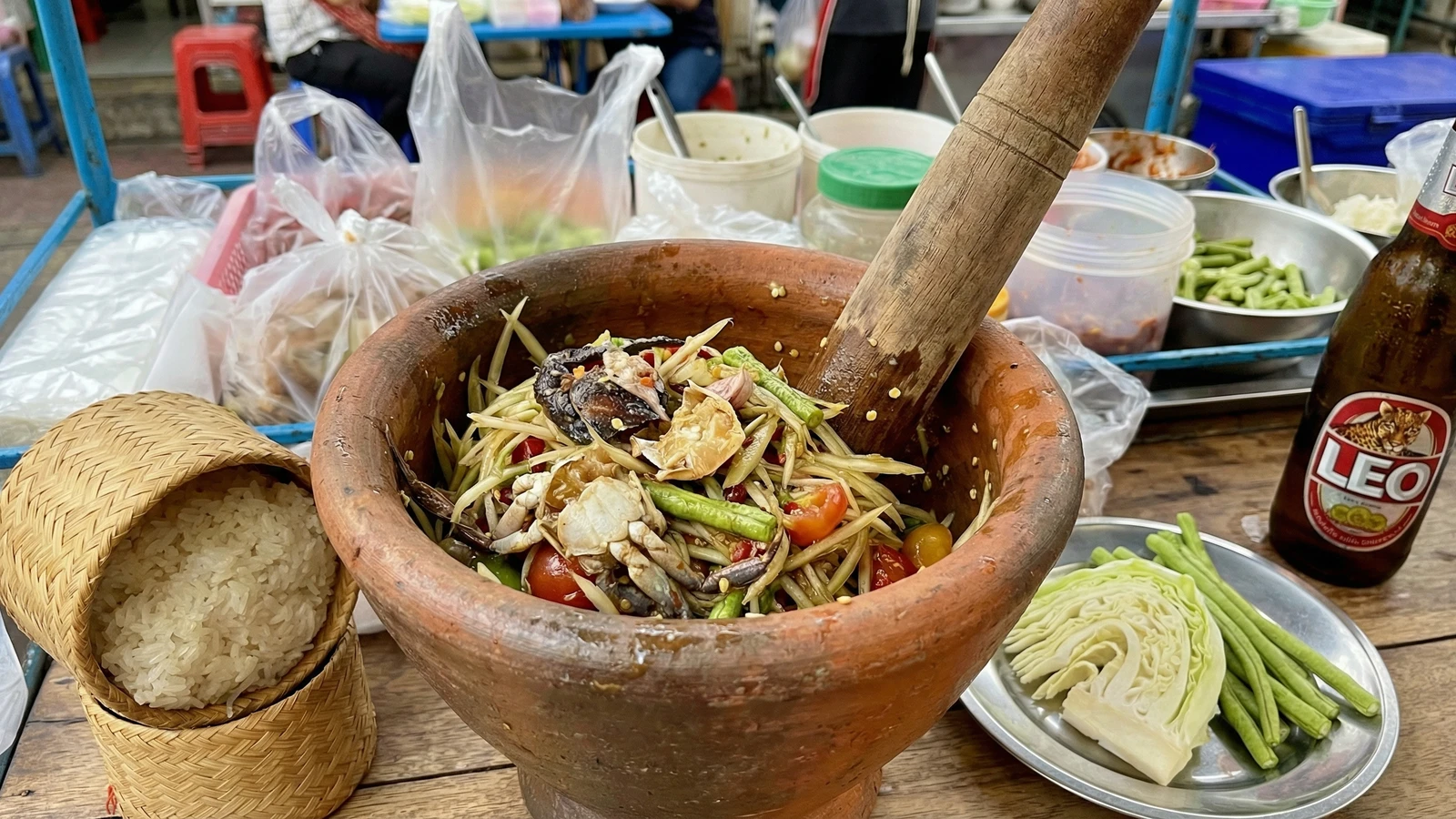
Som tam poo pla ra is the full Isan. Salted field crab and fermented fish, pounded together in the krok din with green papaya, chilies, garlic, long beans, tomatoes, and enough lime to make your eyes water. No peanuts. No dried shrimp. No palm sugar softening the blow. This is the version that som tam vendors eat when the customers go home. The version my mother made for herself after twenty-five years of pounding the Thai adaptation for people who wanted it sweeter, milder, safer.
Ajarn always said the four pillars govern everything: fish sauce for salt, palm sugar for sweet, tropical fruit acids for sour, chili for heat. In som tam poo pla ra, the pillars shift. The salt doesn't come from plain nam pla alone. It comes from pla ra (fermented fish), which brings salinity plus a deep, funky umami that fish sauce can only hint at. The sweetness is dialed way down, just a whisper of palm sugar if any at all. The sour is aggressive, lime juice front and center. And the heat? Isan heat. The kind that builds and doesn't stop.
The field crabs (poo na, ปูนา) are the part that makes outsiders nervous. They're small, salted, and raw. They go into the mortar whole and get cracked open by the pestle, their brine and juices mixing into the dressing. You don't cook them. You pound them. The salted crab is a preservation technique as old as Isan rice farming itself: farmers caught crabs in the paddy fields, salted them to keep, and pounded them into whatever they were eating. That's not a recipe. That's survival turned into cuisine.
This dish is pure principle. The krok din does the work. The pestle bruises the papaya so it absorbs the funky, sour, salty dressing. The irregular texture, some strands crushed, some still crunchy, that's the signature. A food processor can't do this. A bag and a rolling pin can't do this. Only the mortar. Krok ก่อน, krok ก่อน.
Som tam poo pla ra is the original Isan (northeastern Thai) som tam, predating the Central Thai adaptation (som tam Thai) that most of the world knows. In Isan's rice-farming communities, field crabs (poo na) were caught in flooded paddies and preserved in salt, while pla ra (fermented fish) was a staple protein source made from freshwater fish packed in rice bran and salt for months. The dish was working-class fuel, never intended for restaurant menus, and remains the standard lunch at som tam stalls across Isan provinces like Khon Kaen, Udon Thani, and Nakhon Ratchasima. The Central Thai version with peanuts and dried shrimp emerged when Isan migrants adapted the dish for Bangkok palates in the mid-20th century.
Quantity
2 cups
shredded into long strands
Quantity
4
cleaned, top shell removed if large
Quantity
2 tablespoons
strained through a fine mesh to remove bones
Quantity
4 cloves
Quantity
5-8
stems removed
Quantity
4
halved
Quantity
3
cut into 1.5-inch pieces
Quantity
2 tablespoons
Quantity
3 tablespoons (about 2-3 limes)
Quantity
1 teaspoon
Quantity
for serving
Quantity
for serving alongside
| Ingredient | Quantity |
|---|---|
| green papaya (malakor)shredded into long strands | 2 cups |
| salted field crabs (poo na kem)cleaned, top shell removed if large | 4 |
| pla ra (fermented fish liquid)strained through a fine mesh to remove bones | 2 tablespoons |
| garlic | 4 cloves |
| bird's eye chilies (prik khi nu)stems removed | 5-8 |
| cherry tomatoeshalved | 4 |
| long beans (thua fak yao)cut into 1.5-inch pieces | 3 |
| fish sauce (nam pla) | 2 tablespoons |
| lime juice (nam manao) | 3 tablespoons (about 2-3 limes) |
| palm sugar (nam tan pip) (optional) | 1 teaspoon |
| sticky rice (khao niew) | for serving |
| raw vegetables (cabbage, long beans, morning glory) | for serving alongside |
Drop the garlic cloves and bird's eye chilies into your clay mortar (krok din). Pound them to a rough paste. Not smooth. You want the garlic crushed and the chilies split open, seeds exposed, their oils mixing with the garlic. Five to eight chilies is Isan standard. If that scares you, start with three, but know you're dialing down the principle. Heat is a pillar. It belongs here.
Add the salted field crabs to the mortar. Pound them firmly. You're cracking the shells open so their brine and juices release into the mixture. A few solid strikes. The crabs should be broken but still in recognizable pieces, not smashed to powder. Their salty liquid is your first layer of seasoning. This is the ingredient that makes this som tam Isan, not Bangkok.
Throw the long bean pieces into the mortar. Give them three or four firm strikes to bruise them. They should crack slightly, soften, but not turn to mush. Then the tomato halves. Two light pounds, just enough to split them and get their juice running into the dressing. The tomatoes add acidity and body. They're structural, not decorative.
Add the strained pla ra, fish sauce, lime juice, and the palm sugar if you're using it. Stir with the pestle to dissolve and combine. Now taste. This is the moment. The dressing should be aggressively sour, deeply salty with that fermented funk from the pla ra, and hot from the chilies. The pla ra is the backbone. It provides a salinity and umami depth that plain fish sauce cannot touch. That fermented, earthy, almost cheesy funk is the whole identity of this dish. If it smells intense, good. That's correct.
Add the shredded green papaya to the mortar. Now the rhythm starts. Strike down with the pestle in your dominant hand, then use a long spoon in your other hand to toss and fold the papaya from bottom to top. Strike, toss, fold. Strike, toss, fold. You're bruising the papaya strands so they absorb the dressing while keeping their crunch. The texture should be irregular: some strands soft and dressed, some still crisp and bright green. Ten to fifteen rounds of pounding and tossing. Not more. Overwork it and you get mush. Taste a strand. Crunchy, funky, sour, salty, hot. All at once. That's som tam poo pla ra.
Scoop the som tam onto a plate or serve it straight from the mortar. Pile the cracked crab pieces on top where they're visible. Set out the sticky rice in its kratip basket, the raw cabbage wedges, the long beans. Eat now. Not in five minutes. Now. The lime juice is breaking down the papaya as you read this. Som tam does not hold. Tear off a piece of sticky rice, pinch some som tam on top, add a piece of crab. That's a bite. The combination is the design.
1 serving (about 300g)
Culinary guides, cultural storytelling, and the editorial depth that makes cooking meaningful.
Discover Culinary ExplorerChef Fai
No sugar. That's the rule. Isan larb strips Thai cuisine down to three pillars: nam pla for salt, manao for sour, prik for heat, bound by the smoky crunch of freshly pounded khao khua. The absence defines the dish.

Chef Fai
No sugar. That's the line between Isan and Central Thai larb. Grilled catfish flaked while warm, dressed with nam pla, manao, khao khua, prik pon, and a storm of fresh herbs. The plateau on a plate.

Chef Fai
No sugar. That's the rule. Isan larb strips Thai cuisine down to three pillars: nam pla for salt, manao for sour, prik for heat, with khao khua tying it together in a way nothing else can.

Chef Fai
Duck brings gamey depth to the Isan larb formula. No sugar. Lime, fish sauce, khao khua, prik pon, and a wall of fresh herbs. This is the celebration table standard, and the governing rule is restraint.