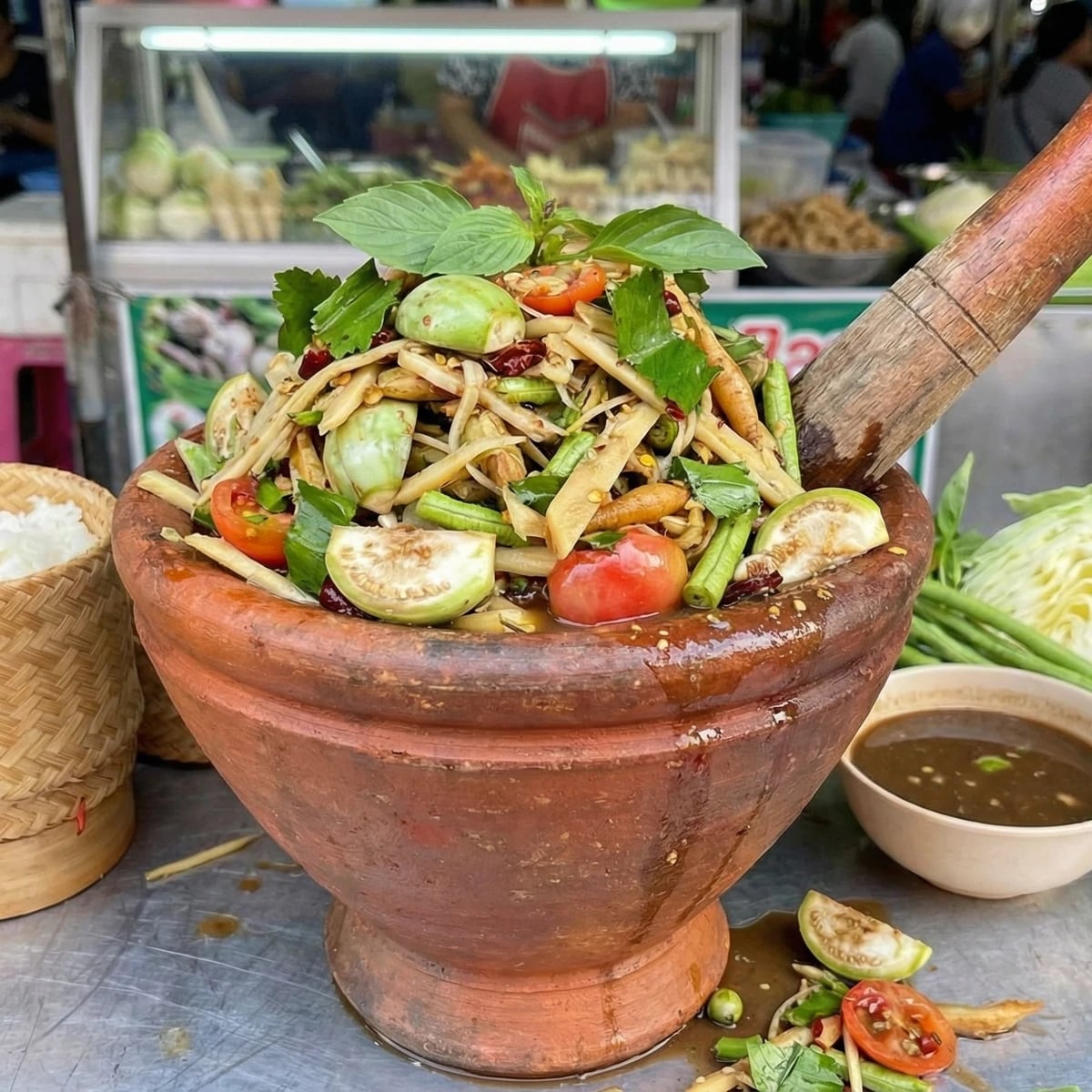
The forager's tam. Whatever the forest and garden give you goes into the krok: eggplant, bamboo, herbs, snails. The four pillars hold the chaos together. Isan's wildest pounded salad, and the proof that principles work even without a recipe.
Salads
Thai
Comfort Food
Special Occasion
30 min
Active Time
5 min cook•35 min total
Yield2 servings
Tam ba is the dish that proves Ajarn right. Principles, not recipes.
Think about it. Every other tam has a fixed ingredient list. Som tam Thai is green papaya. Tam sua is fermented rice noodles. Tam khao pod is corn. But tam ba? Tam ba is whatever the forest gives you today. Thai eggplant one week. Bamboo shoots the next. Wild herbs, yard-long beans, snails if you found them by the rice paddy. The main ingredient changes with the season, the region, the morning's walk. So how do you make it taste right every single time?
The four pillars. Nam pla for salt. Nam tan pip for sweet (barely, this is Isan, not Central Thai). Manao for sour. Prik for heat. And underneath it all, pla ra: the fermented fish that anchors the entire flavor. That funk is the backbone. It's what ties together ten different vegetables that have no business being in the same mortar. Ajarn always said the pillars aren't a formula. They're a governing system. Tam ba is where you feel that truth in your hands.
I made this at a Fai Thai workshop last year and half the room looked nervous. They'd never seen a tam with this many ingredients. I told them: forget the list. Pound garlic and chilies first. That's your base. Add the hard vegetables, bruise them. Add the soft ones, bruise them less. Dress with pla ra, fish sauce, lime, a touch of sugar. Pound, taste, adjust. The method is the same as every tam your grandmother ever made. The ingredients are just wilder.
That's the beauty of tam ba. It's not chaos. It's the system applied to whatever nature provides. My mother's generation didn't need a supermarket. They walked to the edge of the field, picked what was growing, and pounded it into something that followed the same rules as every other dish on the table. If you understand the principles, the forest feeds you.
Tam ba (ตำป่า, literally "forest pound") originates from the rural Isan (northeastern Thailand) and Lao tradition of foraging wild ingredients from forests and rice paddies. Before commercial agriculture standardized Thai produce, Isan families pounded whatever seasonal plants, herbs, and small animals they gathered that day, making tam ba the original template from which more specialized tam variations (som tam, tam sua, tam khao pod) later emerged. The inclusion of snails (hoi), bamboo shoots (no mai), and wild eggplant (makhuea) reflects a subsistence cuisine where nothing foraged was wasted and the mortar was the tool that made disparate ingredients cohere into a single balanced dish.
The technique, the tradition, and the story behind every dish.
bird's eye chilies (prik khi nu)adjust to tolerance
5-8
pla ra (fermented fish)liquid strained, or use whole pieces
2 tablespoons
fish sauce (nam pla)
1 tablespoon
lime juice (nam manao)
2 tablespoons (about 2 limes)
palm sugar (nam tan pip)
1 teaspoon
Thai pea eggplants (makhuea phuang)left whole or halved
6-8
bamboo shoots (no mai)sliced thin, blanched if fresh
1/2 cup
long beans (thua fak yao)cut into 1-inch pieces
3
cherry tomatoeshalved
5
Thai basil leaves (horapha)
1 small handful
sawtooth coriander (pak chi farang)roughly torn
1 small handful
krachai (fingerroot/lesser galangal)julienned
5-6 strips
lemongrass (takhrai)thinly sliced from tender base
1 stalk
kaffir lime leaves (bai makrut)chiffonaded very fine
4-5
blanched snails (hoi khom) (optional)blanched and cleaned, or substitute cooked shrimp
1/2 cup
sticky rice (khao niew)
for serving
raw vegetablescabbage wedges, long beans, Thai basil sprigs
for the side
Equipment Needed
•Large clay mortar with wooden pestle (krok din), at least 8 inches diameter
•Long spoon for tossing and folding
•Small pot for blanching bamboo shoots and snails
Instructions
1
Pound the aromatic base
In a large clay mortar (krok din) with wooden pestle, pound the garlic and bird's eye chilies into a rough paste. Not smooth. You want pieces. The garlic should be crushed and fragrant, the chilies split and releasing their heat into the mortar. This is the foundation of every single tam. Every variation starts here. Garlic, chilies, krok din. Krok ก่อน.
Tam ba uses a clay mortar with a wooden pestle, not granite. The wood bruises gently. Granite would pulverize the eggplant and bamboo. Clay and wood. That's the som tam mortar. Every vendor in Isan knows this.
2
Bruise the hard vegetables
Add the long beans first. Give them five or six firm strikes to crack and bruise them. Then the Thai pea eggplants. A few pounds to split them open so they absorb the dressing. Then the bamboo shoots. Same treatment: bruise, don't destroy. The krachai strips go in now too. You're building layers of texture. Hard things go in first because they need more force. Every ingredient gets pounded just enough. No further.
3
Add the pla ra dressing
Add the pla ra, fish sauce, lime juice, and palm sugar to the mortar. Use the pestle to stir and dissolve the sugar, working the dressing into the vegetables. The pla ra is the backbone of this dish. It's what makes tam ba taste like the Isan countryside. The funk is the point. If you strain your pla ra, you get a cleaner flavor. If you use the whole liquid with bits of fish, it's bolder. Both are correct. Taste now. The balance should lean salty-sour with the pla ra providing depth underneath. Adjust: more lime if it's flat, more fish sauce if it needs salt, a pinch more sugar only if the sourness is cutting too hard.
Pla ra is non-negotiable in tam ba. Extra fish sauce is not a substitute. Fish sauce gives you clean salinity. Pla ra gives you fermented depth, that earthy, funky, almost meaty quality that grounds the whole dish. They do different things. You need both.
4
Add the soft ingredients
Add the tomato halves and bruise them lightly so they release some juice into the dressing. Two or three strikes, that's it. They should be cracked open, not crushed to pulp. If you're using snails (hoi khom) or shrimp, add them now and fold them in gently with the pestle and a spoon. They're already cooked. They just need to be incorporated, not pounded.
5
Fold in the herbs
Add the sliced lemongrass, chiffonaded kaffir lime leaves, torn sawtooth coriander, and Thai basil leaves. These do not get pounded. Toss and fold them in with a spoon and one or two gentle turns of the pestle. The herbs are aromatic finishing, not structural. They should stay green, fragrant, and mostly whole. The lemongrass gives citrus. The bai makrut gives floral lift. The pak chi farang gives that sharp green bite. Together they make it smell like the forest.
The herbs are what separate tam ba from every other tam. Without the handful of fresh wild herbs folded in at the end, it's just another pounded salad. With them, it's the forest in a mortar. Don't skip the krachai or the pak chi farang. They're harder to find outside Thailand, but they're what make this dish itself.
6
Taste, adjust, and serve
Final taste. Sour should lead. Salty behind it. The pla ra funk sitting low in the background. Heat building. A whisper of sweet keeping everything from being harsh. If it needs anything, add it now. Lime goes in last, lime goes in slowly. Ajarn always said that. Scoop the tam ba out of the mortar onto a plate or serve it right in the krok. Sticky rice on the side, always. Raw cabbage, extra long beans, and basil sprigs for eating between bites. Eat immediately. Like every tam, this does not hold. The lime starts breaking everything down within minutes.
Chef Tips
•Tam ba is the original tam. Before green papaya became the default, Isan families pounded whatever they found. The ingredient list I've given you is a template, not a fixed recipe. If you find fresh bamboo, use it. If you have wing beans instead of long beans, pound those. If you foraged some wild mushrooms, throw them in. The method stays the same. Garlic and chilies first. Hard vegetables next. Dress with pla ra, fish sauce, lime, sugar. Fold in herbs. Pound, taste, adjust. Principles, not recipes.
•Pla ra (ปลาร้า) quality varies wildly. Find a Thai grocery and buy a reputable brand, or better yet, buy it from an Isan shop. The liquid should smell fermented and funky but not rotten. If it smells like death, it's gone bad. If it smells like a clean, earthy funk, that's correct. Some cooks boil their pla ra briefly before using it to mellow the intensity and kill bacteria. In Isan, many use it raw. Your call, but if you're new to pla ra, boiling it for two minutes is a reasonable step.
•Krachai (กระชาย, fingerroot or lesser galangal) is the ingredient most people outside Thailand will struggle to find. It looks like a cluster of thin brown fingers and has a sharp, medicinal, slightly peppery flavor unlike any other Thai herb. Frozen krachai from a Thai grocery is acceptable. Dried is not. If you truly cannot find it, leave it out rather than substitute. Nothing else tastes like krachai.
•The snails (hoi khom, หอยขม) are traditional in rural Isan tam ba but entirely optional. They're small freshwater snails gathered from rice paddies. If you can't source them, cooked shrimp or even just extra vegetables work fine. The snails are a foraging tradition, not a governing principle.
Advance Preparation
•Bamboo shoots can be blanched a day ahead and refrigerated. Fresh bamboo shoots must be blanched to remove bitterness. Vacuum-packed or canned bamboo shoots (rinsed well) work in a pinch.
•Snails should be blanched and cleaned ahead of time if using. Remove from shells and rinse thoroughly.
•All herbs should be washed and prepped before you start pounding. Once the krok is going, you don't stop to chiffonade bai makrut.
•Tam ba cannot be made ahead. The lime juice degrades the vegetables within minutes and the herbs wilt. Pound it, serve it, eat it. That's the rule for every tam.
Frequently Asked Questions
Nutrition Information
1 serving (about 220g)
Calories
110 calories
Total Fat
1 g
Saturated Fat
0 g
Trans Fat
0 g
Unsaturated Fat
1 g
Cholesterol
25 mg
Sodium
1330 mg
Total Carbohydrates
16 g
Dietary Fiber
4 g
Sugars
6 g
Protein
11 g
Where cooking meets culture.
Culinary guides, cultural storytelling, and the editorial depth that makes cooking meaningful.