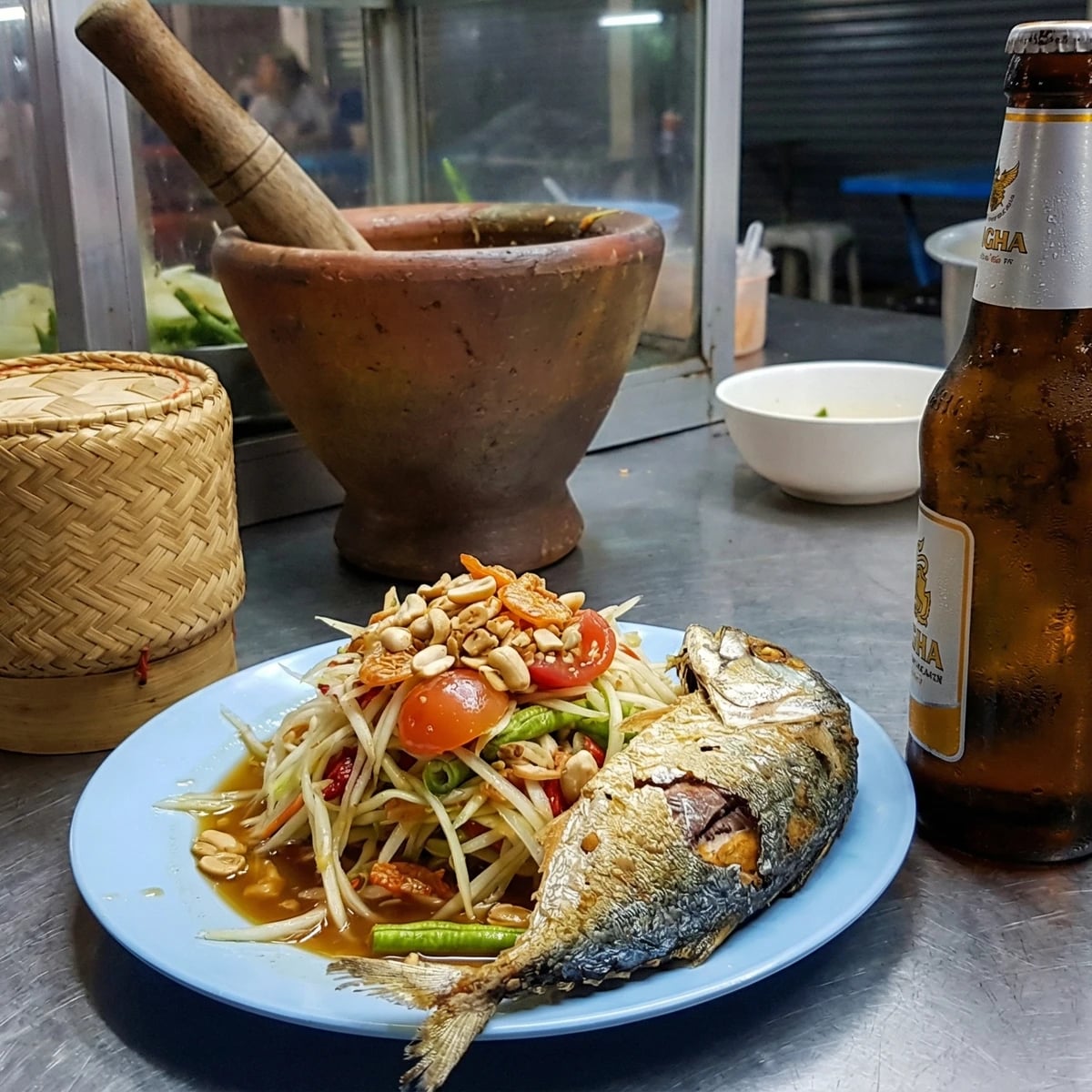
The stall meal that taught me Thai food is a system: pounded papaya dressed by the four pillars, fried mackerel flaked in by hand, sticky rice on the side. One plate, every principle.
Salads
Thai
Weeknight
Comfort Food
25 min
Active Time
10 min cook•35 min total
Yield2 servings
Pla too is the fish of the Thai working class. Fried until the skin crackles and the flesh inside stays sweet and moist. At my mother's stall in Khlong Toei, every second order of som tam came with pla too on the side. Not on a separate plate. On the same plate, leaning against the mortar's worth of pounded papaya, the fish's belly split open and ready to be pulled apart with your fingers.
This is the dish that shows you how the four pillars work as a complete meal. The som tam brings the sour, salt, sweet, and heat. The pla too brings protein and fat. The sticky rice brings the starch that holds the whole thing together in your hand. Three components, one system. Every som tam stall in Bangkok sells this exact combination because it works. It's not a menu pairing. It's architecture.
Ajarn always said that Thai food is engineered to be eaten together, not in courses. Tam pla too is proof. You tear off a piece of fish, press it into the papaya with your fingers, pinch it onto a ball of sticky rice, and eat. The fish oil coats the papaya strands. The lime juice cuts through the richness. The chili sits on top of everything. One bite, all four pillars plus protein plus starch. That's the design.
The pounding follows the same governing technique as every tam in this collection. Garlic and chilies first. Long beans and tomatoes next. Then the papaya. Bruise, don't pulverize. The krok din does the work. Your job is to control it: strike, toss, taste, adjust. The mackerel is cooked separately, fried whole in a wok until the skin is bronze and shattering. It joins the plate, not the mortar. You break it apart as you eat. That integration, fish into salad, bite by bite, is what makes tam pla too more than som tam with a side of fish.
Pla too (Rastrelliger brachysoma, short mackerel) is Thailand's most consumed fish, so embedded in daily life that the phrase 'pla too' is slang for something cheap and ordinary. The tradition of pairing fried pla too with som tam likely solidified in Bangkok's Isan migrant communities in the 1960s-70s, when northeastern workers brought their mortar-and-pestle salads to the capital and local fried mackerel became the affordable protein that completed the meal. The fish is always sold pre-steamed in round bamboo trays at Thai markets, a preservation method dating back generations, then fried to order at the stall.
The technique, the tradition, and the story behind every dish.
•Large clay mortar with wooden pestle (krok din), at least 8 inches diameter
•Long spoon for tossing
•Wok for frying the mackerel
•Wire rack for draining
Instructions
1
Fry the mackerel
Score each pla too twice on both sides with a sharp knife, cutting to the bone. Heat about 2 inches of vegetable oil in a wok over medium-high heat until it shimmers. Slide the fish in carefully and fry without moving them for 3-4 minutes per side. You want the skin deep bronze and shattering to the touch, the flesh inside still moist and sweet. Don't crowd the wok. One fish at a time if your wok is small. Drain on a rack, not paper towels. Paper traps oil against the skin and kills the crispness.
Pla too at Thai markets comes pre-steamed in round bamboo trays. If you find these, they're already cooked through. You're just frying for texture and flavor at that point, about 3 minutes per side until the skin crackles. If using raw mackerel, fry a minute longer per side and make sure the flesh is opaque to the bone.
2
Pound the aromatics
In a large clay mortar (krok din) with the wooden pestle, pound the garlic and chilies to a rough paste. Not smooth. You want visible chunks. The garlic should be crushed but still have structure. The chilies should be split open and bruised, seeds exposed. That's your aromatic base. Every tam in this collection starts here. Krok ก่อน.
3
Add long beans and dried shrimp
Drop the long bean pieces into the mortar. Give them 4-5 firm strikes. You're cracking them, not mashing them. They should split slightly and soften without losing their shape. Add the dried shrimp and peanuts. A few lighter pounds to crack them open and release their oils. Broken, not powdered.
4
Build the dressing
Add the fish sauce, palm sugar, and lime juice to the mortar. Use the pestle to stir and dissolve the sugar into the liquid. This is your dressing: nam pla for salt, nam tan pip for sweet, manao for sour. That's the law. Taste it now. It should hit sour first, salty second, sweet underneath. This is the som tam Thai balance, where the palm sugar is more present than the Isan version but still subordinate to the acid. Adjust before the papaya goes in. Once the papaya is in, the dressing distributes and you lose the ability to fine-tune.
Ajarn always said: add sour last, add sour slowly. With tam, I break that rule slightly because the lime, fish sauce, and sugar go in together as a dressing. But the principle holds: if you overshoot the lime, you can't pull it back. Start with 2 tablespoons and work up.
5
Pound the papaya
Add the shredded green papaya and tomato halves to the mortar. Now the rhythm: strike down with the pestle, toss and fold with a long spoon in your other hand. You're bruising the papaya so it absorbs the dressing while keeping its crunch. The tomatoes should burst slightly, releasing juice into the mix. Ten to fifteen strikes. Toss after every two or three. The papaya should look glossy and slightly limp but still have backbone. Taste a strand. Crunchy, dressed, balanced. If it's there, stop pounding. Overworked papaya goes slack and watery. That's the line.
The mortar for tam is clay (krok din), not granite (krok hin). The wooden pestle bruises. The rough unglazed interior of the clay grips the ingredients. Every som tam vendor in Thailand uses clay and wood. Granite is for curry pastes. Different tool, different job.
6
Plate and serve immediately
Turn the pounded salad out onto a plate. Lean the fried mackerel against the mound, belly facing up, skin still crackling. Arrange the raw cabbage wedges, extra long beans, and morning glory on the side. Sticky rice in its kratip basket alongside. Serve immediately. Som tam does not hold. The lime breaks down the papaya within minutes. This is a dish that's built to be eaten right now, standing at the stall or sitting on a plastic stool. Tear the mackerel with your fingers, fold it into the papaya, pinch everything onto sticky rice. One bite: sour, salt, sweet, heat, crispy fish skin, cool crunch. That's the system at work.
Chef Tips
•Pla too is Thailand's everyday fish. Short mackerel, cheap, sweet-fleshed, perfect for frying. If you can't find pla too, use Indian mackerel or any small, oily, whole fish that fries well. The key is the skin: it needs to go crispy enough to shatter. The flesh stays moist inside. That contrast between crackling skin and soft fish is what makes pla too work with the crunchy, acidic som tam.
•This is som tam Thai, the Central Thai adaptation, which means peanuts and dried shrimp are in the mortar and the palm sugar is more generous than the Isan original. The Isan version (som tam lao) uses pla ra (fermented fish) instead of dried shrimp, skips the peanuts, and keeps the sugar minimal. Both are correct. They're different dishes from different regions. If you want the Isan version, that's a separate recipe with separate rules.
•The fish doesn't go in the mortar. It goes on the plate. You break it apart with your hands as you eat. The fish oil and the flaked flesh mix into each bite of som tam and sticky rice. That integration is the whole point of tam pla too. It's not som tam with a side of fish. It's one dish that assembles itself in your hand.
•How many chilies? That's between you and your tolerance. Five prik khi nu gives moderate heat. Thai street vendors ask every customer: 'Phet mak mai?' (เผ็ดมากไหม, How spicy?). The dish is designed to be adjusted. Start with three if you're cautious. Go to ten if you know yourself. The heat is a pillar, not a fixed amount.
Advance Preparation
•Green papaya can be shredded and stored in cold water for up to 2 hours. Drain thoroughly and pat dry before pounding. Wet papaya dilutes the dressing.
•The mackerel can be fried up to 30 minutes ahead and left on the rack at room temperature. The skin will lose some crackle but reheating isn't necessary. It's eaten at room temperature anyway.
•The som tam itself cannot be made ahead. Pound it, plate it, eat it. The lime juice starts breaking down the papaya within minutes. If it sits, you get soup, not salad.
Frequently Asked Questions
Nutrition Information
1 serving (about 365g)
Calories
415 calories
Total Fat
25 g
Saturated Fat
5 g
Trans Fat
0 g
Unsaturated Fat
19 g
Cholesterol
70 mg
Sodium
1530 mg
Total Carbohydrates
25 g
Dietary Fiber
5 g
Sugars
10 g
Protein
25 g
Where cooking meets culture.
Culinary guides, cultural storytelling, and the editorial depth that makes cooking meaningful.