Culinary Explorer

A cooking platform built around craft, culture, and the stories behind what we eat.
Discover Culinary Explorer
Green Mango Pounded Salad (Tam Mamuang)

Green Mango Pounded Salad (Tam Mamuang)

Created by

Green mango brings its own acid to the mortar before the lime even arrives. Sour on sour. The four pillars still hold, but here the sour pillar runs the show. Tam at its sharpest.

Salads
Thai
Weeknight
Quick Meal
15 min
Active Time
0 min cook15 min total
Yield2 servings

Every tam follows the same four pillars. Fish sauce for salt. Palm sugar for sweet. Lime for sour. Chili for heat. But tam mamuang does something no other tam does: it doubles down on sour. Green papaya is neutral. It's a blank canvas that absorbs whatever dressing you give it. Green mango walks into the mortar already loaded. It's sour before you squeeze a single lime.

That changes the entire balance equation. Ajarn always said: add sour last, add sour slowly, because you can't pull it back. With tam mamuang, the acid is built into the main ingredient. Malic acid from the unripe mango, citric acid from the lime: two different acids layering on each other, creating a sourness that's sharper and more complex than anything papaya can produce. If you dress this the way you dress som tam, you'll pucker so hard you won't taste anything else. Pull back on the lime. Let the mango do the talking.

At Khlong Toei, the vendors who make tam mamuang know this in their hands. They use less lime, a touch more palm sugar to round the edges, and they let the mango's own sourness carry the dish. The best ones shred the mango thicker than papaya because mango fibers are denser, firmer, and hold up differently under the pestle. You're not going for those delicate, wispy strands. You want strips with backbone that crack and bruise without collapsing.

The technique is identical to any tam: pound garlic and chilies first, bruise the long beans, build the dressing, add the main ingredient last. Krok ก่อน. But the calibration is different. The mango tells you how much lime it needs, and the answer is always less than you think. This is the dish that teaches you the system isn't rigid. The principles flex. They respond to the ingredient. That's why they're principles and not recipes.

Tam mamuang belongs to the broader family of pounded salads that originated in Isan and Laos, where seasonal fruits and vegetables were routinely substituted into the mortar depending on what was available. Green mango (mamuang dip, มะม่วงดิบ) has been a staple souring agent in Thai cooking for centuries, used in curries and relishes long before it became a tam ingredient. The dish gained wider popularity in Central Thailand alongside the som tam migration of the mid-20th century, though Isan versions remain sharper and less sweet, leaning into the mango's natural malic acid rather than masking it with palm sugar.

The technique, the tradition, and the story behind every dish.

Discover Culinary Explorer

Ingredients

green (unripe) mango (mamuang dip)

Quantity

2 cups

shredded into thick strips

garlic

Quantity

3 cloves

bird's eye chilies (prik khi nu)

Quantity

3, or more to taste

dried shrimp (goong haeng)

Quantity

2 tablespoons

unsalted roasted peanuts

Quantity

1 tablespoon

cherry tomatoes

Quantity

5

halved

long beans (thua fak yao)

Quantity

2

cut into 1-inch pieces

fish sauce (nam pla)

Quantity

1½ tablespoons

palm sugar (nam tan pip)

Quantity

1 tablespoon

lime juice (nam manao)

Quantity

1½ tablespoons (about 1 lime)

sticky rice (khao niew)

Quantity

for serving

Equipment Needed

  • Large clay mortar with wooden pestle (krok din), at least 8 inches diameter
  • Long spoon for tossing
  • Thai papaya shredder or sharp knife for mango

Instructions

  1. 1

    Pound the aromatics

    Drop the garlic and chilies into your clay mortar (krok din). Pound them to a rough, chunky paste. Not smooth. You want the garlic crushed and the chilies split open, seeds exposed, oils released. The aroma should hit your nose immediately: raw garlic heat and chili burn. That's your aromatic base, the same foundation that governs every tam in the family. Three chilies for moderate heat. Five if you want to feel alive. Your call.

    Always use the krok din (clay mortar with wooden pestle) for tam, not the granite krok hin. The wooden pestle bruises. Granite crushes. Tam needs irregular texture: some pieces whole, some cracked, nothing reduced to mush.
  2. 2

    Bruise the long beans

    Add the long bean pieces to the mortar. Give them three or four firm strikes with the pestle. You want them cracked and slightly softened, not flattened. They should still have snap when you bite down. The bruising opens up the cell walls just enough to let the dressing in while keeping structure. If they look mangled, you went too hard.

  3. 3

    Crack the shrimp and peanuts

    Add the dried shrimp and roasted peanuts. A few light strikes. You're cracking them open so they release their oils into the mortar. The dried shrimp should break into rough pieces. The peanuts should split, not disintegrate. This takes three or four hits, no more. Restraint is the technique here.

  4. 4

    Build the dressing

    Add the palm sugar, fish sauce, and lime juice to the mortar. Use the pestle to stir and dissolve the sugar into the liquid. Taste it now, before the mango goes in. It should be salty first, sweet second, with the lime barely registering. Why? Because the mango is about to bring a wall of acid. If your dressing is already sour, the finished dish will be one-dimensional. Trust the mango. Hold back on the lime.

    Ajarn always said: add sour last, add sour slowly. With tam mamuang, that rule matters more than ever. The mango itself is loaded with malic acid. The lime is citric acid. Two different acids on top of each other. Start with less lime than you think. You can always squeeze more at the end. You can't take it back.
  5. 5

    Pound the mango

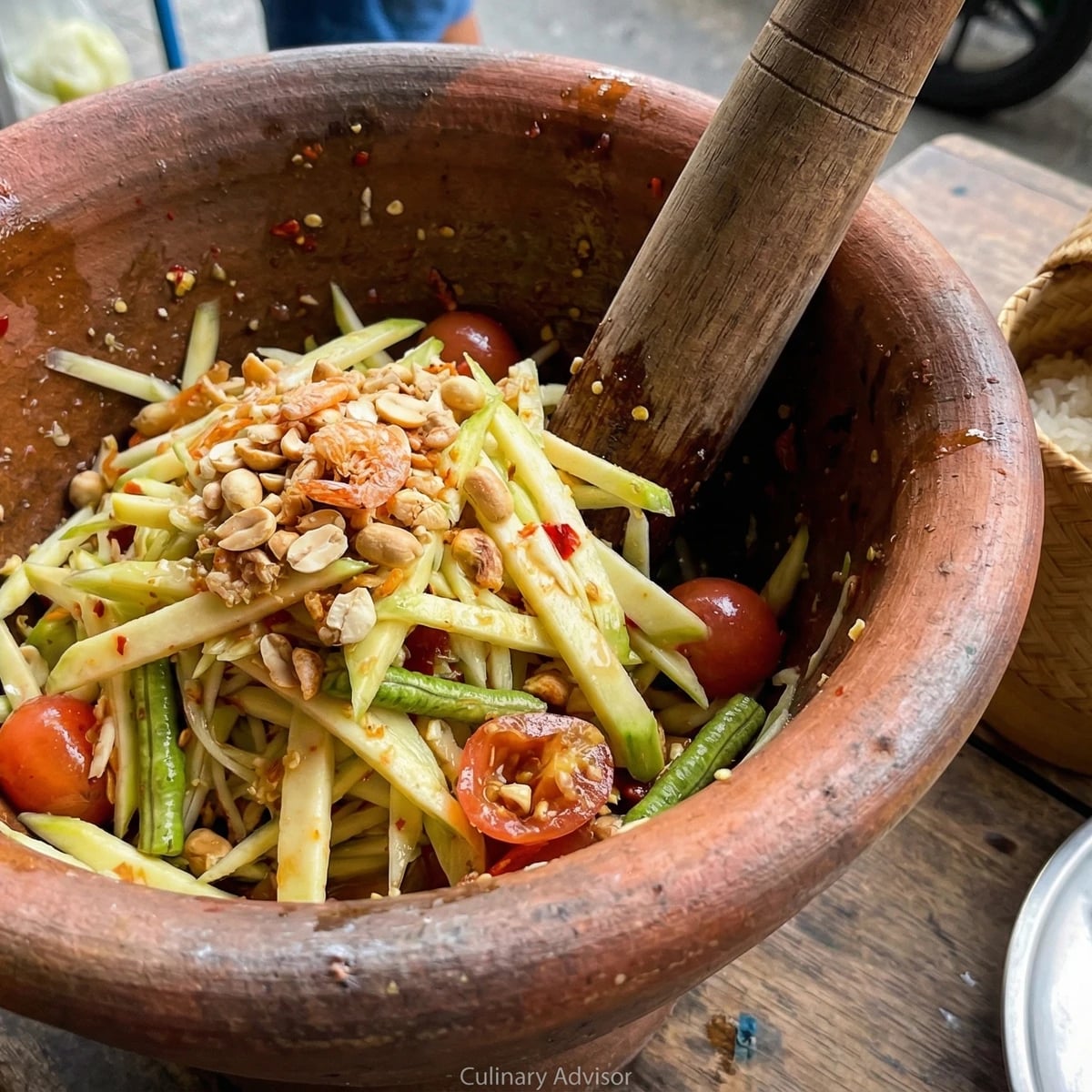
    Add the shredded green mango and the halved cherry tomatoes to the mortar. Now comes the rhythm. Strike down with the pestle, then use a long spoon in your other hand to toss and fold from the bottom. You're bruising the mango so the fibers crack and absorb the dressing, while the tomatoes burst and add their juice. Ten to fifteen strikes, tossing between each one. The mango should look glossy, slightly limp at the edges, but still firm and crunchy at the core. Some strands crushed. Some intact. That's the texture you want: irregular, alive, not uniform. Taste a strand. If it's sour and sharp with the salt and sugar riding underneath, the chili building at the back, you're done. Serve immediately in the mortar or on a plate. Tam mamuang does not wait. The acid breaks down the mango within minutes.

Chef Tips

  • Choose the right mango. You need rock-hard, completely unripe green mango with white or pale green flesh. If there's any yellow, any softness, any sweetness when you taste a raw piece, it's too ripe. The sourness IS the dish. A ripe mango will turn this into fruit salad. In Thailand, look for mamuang kiew sawoei (มะม่วงเขียวเสวย) or mamuang man (มะม่วงมัน) while they're still green and firm. Outside Thailand, any unripe mango variety works as long as it's truly hard and sour.
  • Shred the mango thicker than you'd shred papaya. Mango fiber is denser and more resilient. Thin strands will go soft too fast in the mortar. Cut strips about the width of a matchstick, maybe slightly wider. They should have body. You want to feel the crunch when you bite down, even after pounding. A Thai papaya shredder works, or use a knife to cut planks and then slice them into strips.
  • The Central Thai version of tam mamuang uses more palm sugar to balance the mango's acid, plus peanuts and dried shrimp. The Isan version pulls the sugar back and lets the sourness run sharp, sometimes adding pla ra (fermented fish) for a deeper, funkier salt. The recipe here sits in the middle. If you want it Isan-sharp, cut the palm sugar in half and squeeze the lime with a lighter hand. If you want it Central Thai-sweet, add another half tablespoon of sugar. The system is flexible. The principles stay.
  • Serve tam mamuang with sticky rice (khao niew) and raw vegetables: cabbage wedges, long beans, fresh mint. Tear off a piece of sticky rice, pinch some tam on top, add a leaf of something green. That's a bite. The combination is the point. The starchy rice tames the acid. The raw vegetables add crunch and freshness. Don't eat this with a fork on a plate by itself. You're missing the design.

Advance Preparation

  • Green mango can be shredded and stored in cold water for up to 1 hour. Drain thoroughly and pat dry before using. Wet mango dilutes the dressing.
  • Tam mamuang cannot be made ahead. The double acid (mango plus lime) breaks down the texture fast. Pound it, eat it. Five minutes on the table is fine. Thirty minutes and it's a different dish.

Frequently Asked Questions

Nutrition Information

1 serving (about 350g)

Calories
270 calories
Total Fat
3 g
Saturated Fat
1 g
Trans Fat
0 g
Unsaturated Fat
2 g
Cholesterol
35 mg
Sodium
1135 mg
Total Carbohydrates
52 g
Dietary Fiber
4 g
Sugars
14 g
Protein
10 g

Note: Chef personas and recipes are created with AI assistance. Cook with care: follow safe food-handling practices, check doneness with a thermometer when needed, and adapt for allergies and your kitchen.

Where cooking meets culture.

Culinary guides, cultural storytelling, and the editorial depth that makes cooking meaningful.

Discover Culinary Explorer

More from Isan Som Tam & Pounded Salads

Browse the full collection