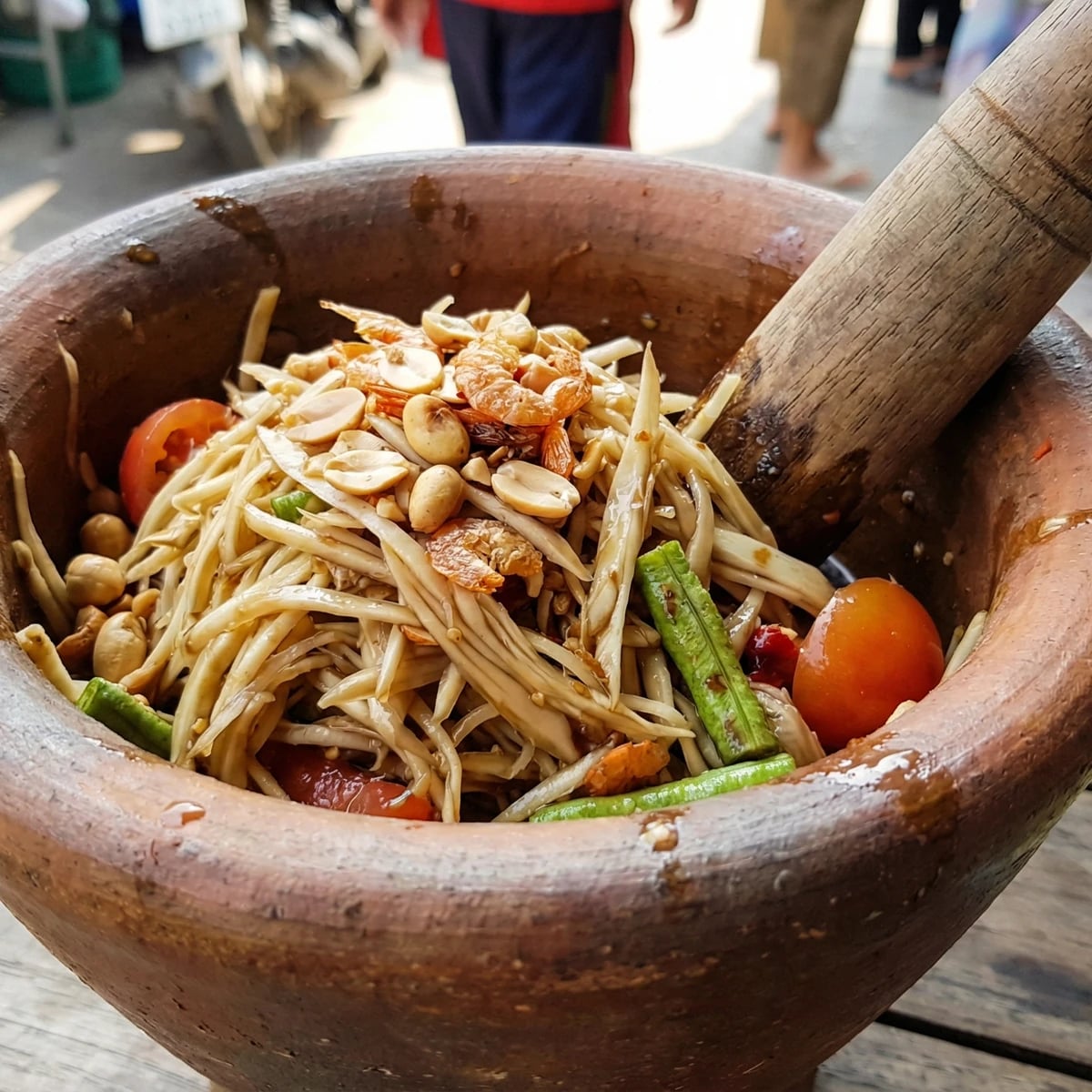
Tam is a technique, not a recipe for papaya. Young jackfruit proves it: boiled, shredded, pounded in the krok din until the fibers drink the dressing whole. The four pillars hold no matter what goes in the mortar.
Salads
Thai
Weeknight
Budget Friendly
30 min
Active Time
20 min cook•50 min total
Yield2 servings
Tam is not som tam. Let me say that again. Tam is the technique. Som tam is one expression of it. The moment you understand that, a whole world opens up.
Most people outside Thailand hear "pounded salad" and think green papaya. That's like hearing "stir-fry" and thinking only pad thai. The krok din doesn't care what goes in it. Papaya, corn, cucumber, glass noodles, green mango, crab, fruit. And this one: young jackfruit. Khanun on (ขนุนอ่อน), the unripe fruit boiled until it goes tender and shreds apart like pulled meat. It's cheap, it's filling, and those long fibers do something papaya can't. They hold onto the dressing like a sponge. Every strand carries the full hit of fish sauce, lime, chili, and sugar straight to your mouth.
Ajarn always said: "I don't teach you how to cook through recipes. I want you to learn the principles and understand." Tam khanun is the proof. Same governing technique as every other tam. Pound garlic and chilies first to form the aromatic base. Add long beans and tomatoes. Then the main ingredient. Bruise, don't pulverize. Dress with fish sauce for salt, lime for sour, palm sugar for sweet (light hand, this is Isan-leaning), chili for heat. The four pillars hold. The main ingredient changes. The system stays the same.
This is the dish I make when I want to show workshop students that principles transfer. If you can make som tam, you can make tam khanun. If you can make tam khanun, you can make tam taeng (cucumber), tam khao pod (corn), tam mamuang (green mango). You're not learning thirty recipes. You're learning one technique with thirty faces. That's the system talking.
Tam khanun is an Isan and Lao preparation that predates the national popularity of som tam thai. Young jackfruit (khanun on) has been a staple protein substitute in northeastern Thailand for generations, particularly among rural households where the fruit grows abundantly and meat was historically scarce. While som tam thai gained international fame as the Central Thai adaptation of the pounded salad, tam khanun remained a regional dish tied to Isan markets and home kitchens, only recently gaining broader recognition through social media and the street food revival.
The technique, the tradition, and the story behind every dish.
fresh or canned in brine (not syrup), boiled and shredded
garlic
Quantity
3 cloves
bird's eye chilies (prik khi nu)
Quantity
5
or adjust to taste
long beans (thua fak yao)
Quantity
2
cut into 1-inch pieces
cherry tomatoes
Quantity
5
halved
dried shrimp (goong haeng)
Quantity
1 tablespoon
unsalted roasted peanuts
Quantity
1 tablespoon
fish sauce (nam pla)
Quantity
2 tablespoons
palm sugar (nam tan pip)
Quantity
1 tablespoon
lime juice (nam manao)
Quantity
3 tablespoons (about 2 limes)
sticky rice (khao niew)
Quantity
for serving
raw cabbage and long beans
Quantity
for eating
Ingredient
Quantity
young jackfruit (khanun on)fresh or canned in brine (not syrup), boiled and shredded
300g
garlic
3 cloves
bird's eye chilies (prik khi nu)or adjust to taste
5
long beans (thua fak yao)cut into 1-inch pieces
2
cherry tomatoeshalved
5
dried shrimp (goong haeng)
1 tablespoon
unsalted roasted peanuts
1 tablespoon
fish sauce (nam pla)
2 tablespoons
palm sugar (nam tan pip)
1 tablespoon
lime juice (nam manao)
3 tablespoons (about 2 limes)
sticky rice (khao niew)
for serving
raw cabbage and long beans
for eating
Equipment Needed
•Large clay mortar with wooden pestle (krok din), at least 8 inches diameter
•Long spoon for tossing
•Large pot for boiling jackfruit (if using fresh)
Instructions
1
Prepare the jackfruit
If using fresh young jackfruit, peel it and cut it into chunks. Your hands will get sticky from the latex, so oil them first or wear gloves. Boil the chunks in water for 15-20 minutes until a fork slides through easily. Drain and let it cool enough to handle. Pull the jackfruit apart into long shreds with your fingers or two forks, working along the grain of the fibers. You want strands, not chunks. Those fibers are the whole point. They absorb dressing like nothing else in the tam family. If using canned young jackfruit in brine, drain it, rinse well, and shred the same way. Skip the boiling.
Never buy canned jackfruit in syrup. That's ripe jackfruit for desserts. You want young jackfruit in brine or water: pale, firm, no sweetness. The can should say 'young' or 'green' jackfruit. If it smells like Juicy Fruit gum, it's the wrong one.
2
Pound the aromatic base
In your krok din (clay mortar), pound the garlic and bird's eye chilies to a rough paste. Not smooth. Chunky, with visible pieces of garlic still there. This is the aromatic foundation that every tam shares. The garlic should be crushed and fragrant, the chilies split open and releasing heat. You can smell when it's right. If the back of your throat doesn't tingle from the chili fumes, pound harder.
Five chilies is moderate heat by Isan standards. At the stall, the vendor asks you: 'How many?' Start with three if you're cautious, work up. The principle is that heat is a pillar. It belongs in the dish. But the dosage is personal.
3
Add long beans and tomatoes
Drop the long bean pieces into the mortar. Give them three or four firm strikes with the pestle. You're bruising, not mashing. They should crack and soften slightly but still hold their shape. Add the halved cherry tomatoes. A couple of light pounds to split them open and release their juice into the base. That juice becomes part of the dressing. Don't skip the tomatoes. They provide acid and body that complements the lime.
4
Crack the shrimp and peanuts
Add the dried shrimp and roasted peanuts. Pound lightly, two or three strikes, just enough to crack them open. The dried shrimp release a salty, briny depth. The peanuts give fat and crunch. Both of them broken, not powdered. You should see pieces.
5
Build and taste the dressing
Add the fish sauce, palm sugar, and lime juice to the mortar. Use the pestle to stir and dissolve the sugar into the liquid. Taste the dressing pooling at the bottom. Sour should lead. Salty right behind it. Sweet barely there, just enough to round the edges. This is Isan-leaning, so keep the sugar restrained. If it tastes like candy, you've gone too far. Adjust now, before the jackfruit goes in. More lime for brightness. More fish sauce for depth. Ajarn always said: "Add sour last, add sour slowly." But in tam, the lime can go in here because you're going to taste and adjust in real time.
Palm sugar matters. Granulated white sugar dissolves too fast and gives a flat, one-note sweetness. Palm sugar has caramel depth and dissolves slowly, which means it integrates with the dressing rather than sitting on top of it. This isn't snobbery. It's chemistry.
6
Pound the jackfruit
Add the shredded young jackfruit to the mortar. Now the real work begins. Pound and toss. Strike down with the pestle, then use a long spoon in your other hand to fold and turn the mixture. The jackfruit fibers will start absorbing the dressing immediately. That's why this tam hits different. Papaya stays crunchy and holds the dressing on its surface. Jackfruit drinks it in. Every fiber swells with fish sauce, lime, and chili. Ten to fifteen strikes, tossing between each one. The jackfruit should be glossy, well-dressed, and slightly softened but still fibrous. Not mushy. Taste a strand. If it's salty, sour, spicy, and the texture is meaty and satisfying, you're done. If it needs more of anything, add it now.
7
Serve immediately
Scoop the tam khanun onto a plate or serve it straight from the mortar. Put a kratip of sticky rice next to it. Tear off a piece of rice, pinch some tam on top, eat. Cabbage and long beans on the side for crunch and a break from the heat. Eat it now. Tam doesn't wait. The lime starts changing the texture within minutes. This is food that's alive for about fifteen minutes after pounding. After that, it's leftovers. Make it, eat it, make more if you want more.
Chef Tips
•Young jackfruit (khanun on) is the unripe fruit, pale and starchy, with none of the tropical sweetness of ripe jackfruit. Fresh is best if you can find it at a Southeast Asian market. The canned version in brine works fine for weeknight cooking. Just drain, rinse, shred, and you've skipped the boiling. No shame in the can. The technique in the mortar is what makes it tam.
•Tam khanun is Isan proof that the pounded salad technique is infinitely adaptable. The same aromatic base (garlic, chilies, long beans, tomatoes) works with green papaya, green mango, corn, glass noodles, cucumber, and dozens of other ingredients. Learn the technique once, and you can tam anything in season. That's what Ajarn meant by principles, not recipes.
•If you want the full Isan experience, add a spoonful of pla ra (fermented fish) to the dressing. The funk transforms the dish. But that's a different version, closer to tam pla ra territory. This recipe keeps it in som tam Thai style with dried shrimp and peanuts for accessibility. Know the difference. The peanuts and dried shrimp tell you this is the Central Thai adaptation.
•The texture of the pounded jackfruit should remind you of pulled meat. It's fibrous, chewy, substantial. That's why tam khanun is so popular as a budget meal. It's filling in a way that papaya isn't. With sticky rice, it's a complete lunch for almost nothing.
Advance Preparation
•Fresh young jackfruit can be boiled and shredded up to a day ahead. Store the shredded jackfruit in the fridge in a sealed container. Bring to room temperature before pounding.
•If using canned jackfruit, drain, rinse, and shred it up to a few hours ahead. Keep it covered.
•Tam khanun cannot be assembled ahead. The lime juice starts breaking down the jackfruit fibers within minutes of dressing. Pound, eat, done. That's the rule for every tam.
Frequently Asked Questions
Nutrition Information
1 serving (about 280g)
Calories
165 calories
Total Fat
3 g
Saturated Fat
1 g
Trans Fat
0 g
Unsaturated Fat
2 g
Cholesterol
15 mg
Sodium
1485 mg
Total Carbohydrates
26 g
Dietary Fiber
4 g
Sugars
10 g
Protein
8 g
Where cooking meets culture.
Culinary guides, cultural storytelling, and the editorial depth that makes cooking meaningful.