
Chef Lupita
Birria Tacos with Consome
Jalisco's goat birria, born around Cocula and carried into Guadalajara's markets, slow-braised in ancho, guajillo, cascabel, and chile de arbol, then tucked into corn tortillas crisped in its own red fat.
A cooking platform built around craft, culture, and the stories behind what we eat.
Created by
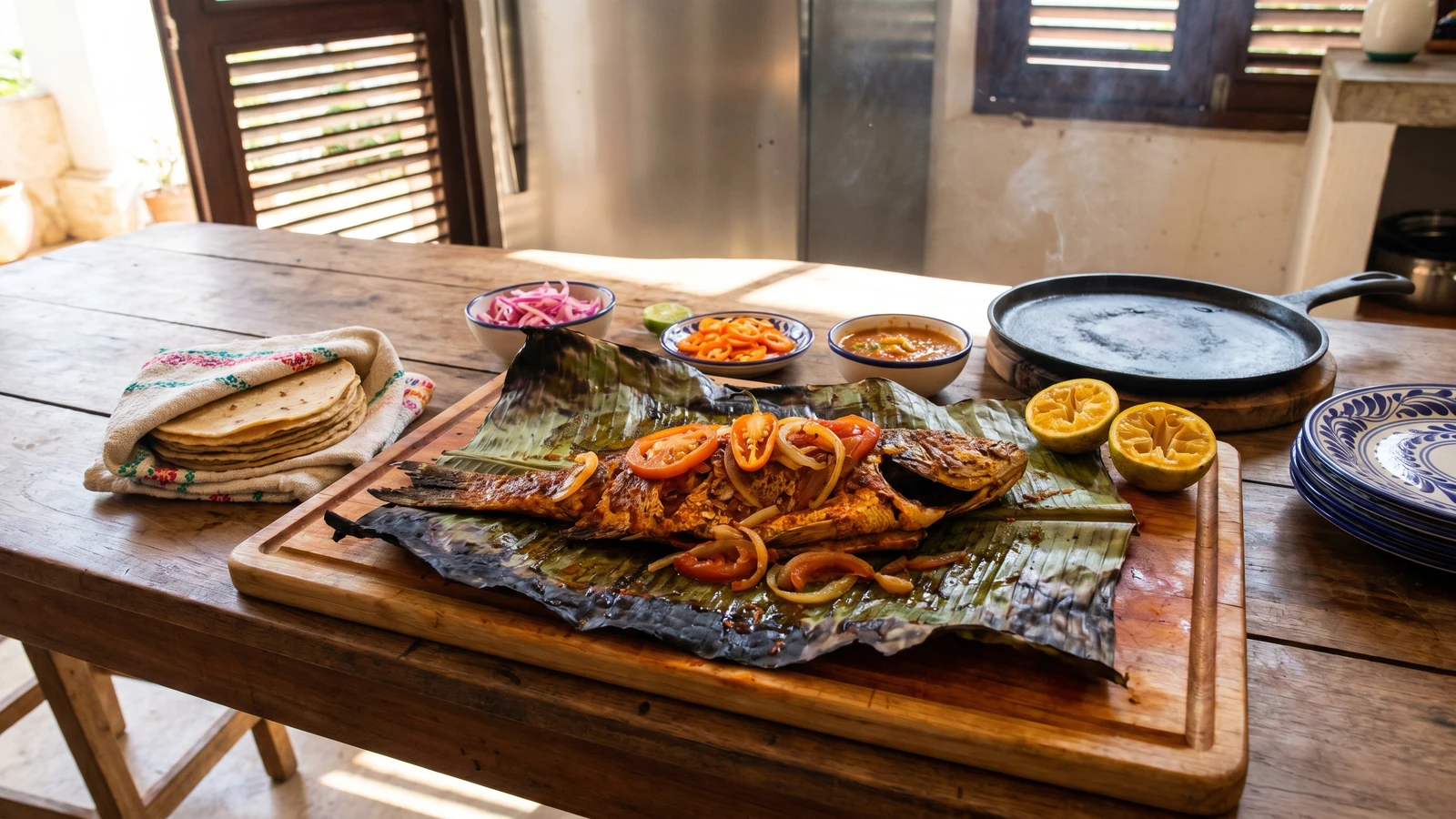
Quintana Roo's coastal tacos. Whole fish rubbed in recado rojo and naranja agria, wrapped in banana leaf, grilled over charcoal until the leaf chars black, then flaked into warm tortillas with pickled red onion and habanero.
Tikinxic is from Quintana Roo and the Yucatan Peninsula. The name comes from the Maya: tik-in-xic, dry-chile fish, the way the recado clings to the flesh once the leaf is opened. You will see it on Isla Mujeres, on Holbox, in the palapas of the Riviera Maya, anywhere a fisherman pulls a mero off the line and the cook has a piece of banana leaf and a comal of charcoal. This is Caribbean Mexico, not central Mexico. The grammar is different. No mole. No chile ancho. The Peninsula speaks in recado, sour orange, banana leaf, and habanero.
The recado rojo is what makes this dish. Achiote, naranja agria, garlic, oregano yucateco, allspice, black pepper. You can buy the paste pre-made from a Yucatecan brand and you should, unless you have the patience to grind annatto seeds in a molcajete for an hour. The naranja agria is the other pillar. Not orange juice. Not lime juice. The bitter orange that grows in patios across Merida and Valladolid and was brought from Spain through Cuba. If you cannot find it, the mix I give you in the ingredients gets close. It is a compromise, not an upgrade.
The banana leaf does two jobs. It seals the fish so the recado steams into the flesh, and it gives the fish that faint vegetal sweetness only a leaf can carry. You pass it over the flame first so it does not crack. My notebook has a margin note from a señora at Mercado 28 in Cancun: pasarla por la lumbre rapidito, no la quemes. Quickly, do not burn it. She would not write you a recipe. She wrote me that one line because I asked her three times. Saber cocinar es saber vivir.
You eat tikinxic with the leaf open on the table, flaking the fish straight into warm corn tortillas with pickled red onion and slivers of fresh habanero. No cheddar. No sour cream. No flour tortillas. The Peninsula has its own grammar and this is how the sentence ends.
Tikinxic is a direct descendant of pre-Columbian Maya cooking practices in which fish and game were wrapped in banana or maxan leaves and cooked over coals or in earthen pits, a technique parallel to the better-known pib (underground oven) used for cochinita. The name tikinxic, sometimes written tikin-xic or tikin xic, is Yucatec Maya for 'dry chile fish,' referring to the way the achiote-based recado adheres to the flesh after cooking. Achiote itself, derived from the seeds of the Bixa orellana tree native to the tropical Americas, was used by the Maya for both food coloring and ceremonial body paint long before the Spanish arrival, and its survival as the defining ingredient of Yucatecan cuisine is one of the clearest pre-Columbian continuities in modern Mexican regional cooking.
Quantity
2 pounds
pin bones removed
Quantity
3 ounces
Quantity
3/4 cup
or 1/2 cup orange juice mixed with 1/4 cup lime juice and 2 tablespoons grapefruit juice
Quantity
4
Quantity
1 teaspoon
preferably oregano yucateco
Quantity
1/2 teaspoon
Quantity
1/2 teaspoon
Quantity
1 1/2 teaspoons
Quantity
2 tablespoons
melted
Quantity
4 to 6
passed over an open flame to soften
Quantity
1
sliced into thick rounds
Quantity
2
sliced
Quantity
1
halved (do not seed if you want the heat)
Quantity
18
warmed on a comal
Quantity
1 cup
Quantity
1
thinly sliced, for serving
Quantity
for serving
Quantity
for serving
| Ingredient | Quantity |
|---|---|
| whole mero (grouper) or mojarra fillets, skin onpin bones removed | 2 pounds |
| achiote paste (recado rojo) | 3 ounces |
| fresh naranja agria juiceor 1/2 cup orange juice mixed with 1/4 cup lime juice and 2 tablespoons grapefruit juice | 3/4 cup |
| garlic cloves | 4 |
| dried Mexican oreganopreferably oregano yucateco | 1 teaspoon |
| ground allspice | 1/2 teaspoon |
| ground black pepper | 1/2 teaspoon |
| kosher salt | 1 1/2 teaspoons |
| manteca de cerdomelted | 2 tablespoons |
| large banana leavespassed over an open flame to soften | 4 to 6 |
| large white onionsliced into thick rounds | 1 |
| Roma tomatoessliced | 2 |
| fresh chile habanerohalved (do not seed if you want the heat) | 1 |
| hand-pressed corn tortillaswarmed on a comal | 18 |
| cebolla morada encurtida (pickled red onion) (optional) | 1 cup |
| fresh chile habanero (optional)thinly sliced, for serving | 1 |
| salsa xnipec (optional) | for serving |
| lime wedges (optional) | for serving |
Break the achiote paste into a blender. Add the naranja agria juice, garlic, oregano yucateco, allspice, black pepper, salt, and melted manteca de cerdo. Blend until the paste loosens into a thick, brick-red marinade the color of wet terracotta. It should coat the back of a spoon. If it looks too tight, add a tablespoon more naranja agria. The recado is the dish. Make it sloppy and the fish tastes thin.
Lay the fish fillets in a shallow ceramic dish. Pour the recado over the top and turn the fillets to coat every surface, including the skin side. Cover and refrigerate for at least 30 minutes and up to 2 hours. Longer than that and the naranja agria begins to cure the flesh and you lose the texture. Tikinxic is not ceviche. The fish should still feel raw when you pull it from the marinade.
Pass each banana leaf briefly over an open gas flame, turning it constantly, until the surface changes from matte green to a glossy darker green and the leaf becomes pliable. This takes about 10 seconds per leaf. Wipe each leaf clean with a damp cloth. Skip this step and the leaves crack the moment you fold them. The señoras on Isla Mujeres pass them over a comal. The flame is faster.
Lay two overlapping banana leaves on a work surface, shiny side up, forming a wide cross. Lay half the sliced onion and half the tomato in the center. Place the marinated fillets on top, skin side down. Pour any remaining recado over the fillets. Top with the rest of the onion, tomato, and the halved habanero. Fold the leaves over the fish into a tight rectangular package, then tie with kitchen twine or strips of banana leaf. Make a second package with the remaining fish.
Build a medium-hot charcoal fire. Mesquite or hardwood lump, not briquettes. Place the banana-leaf packages directly on the grate. Grill 10 to 12 minutes per side, turning once carefully with a wide spatula. The outer leaves will char black in places and that is what you want. That char is the flavor. The fish inside is steaming in its own recado and the leaf is doing the work. A gas grill works in a pinch but the smoke from the charcoal is half of what makes this tikinxic. No me vengas con atajos.
Carefully unwrap one corner of a package. The fish should flake easily with a fork and the flesh should be a deep orange-red, stained through by the achiote. If it still looks translucent at the center, rewrap and give it another 3 to 4 minutes on the grill. Mero is forgiving. Mojarra is not. Pull it the moment it flakes.
Open the banana leaves at the table. Let your guests see the fish in its char-edged green wrapper. That presentation is part of the meal. Flake the fish into rough pieces with a fork, keeping some of the cooked onion and tomato with each pull. Pile into warm corn tortillas, two flakes of fish per taco. Top with cebolla morada encurtida, a few slivers of fresh habanero for whoever can take it, a spoon of salsa xnipec, and a squeeze of lime. Cada estado, su propia cocina, and this one belongs to the Caribbean coast.
1 serving (about 370g)
Culinary guides, cultural storytelling, and the editorial depth that makes cooking meaningful.
Discover Culinary ExplorerChef Lupita
Jalisco's goat birria, born around Cocula and carried into Guadalajara's markets, slow-braised in ancho, guajillo, cascabel, and chile de arbol, then tucked into corn tortillas crisped in its own red fat.

Chef Lupita
Sonora's working morning burrito: chicharrón de cáscara stewed in chile colorado with diced potato, rolled tight in a paper-thin tortilla sobaquera and eaten standing up at the carreta.

Chef Lupita
Mocorito's pork chilorio, shredded and confited in lard with chile ancho and pasilla, rolled into a thin handmade flour tortilla. The burrito Sinaloa sends out into the world.

Chef Lupita
Sonora's morning burrito of mashed pinto frijoles puercos and melted queso asadero, wrapped in a paper-thin sobaquera and seared on the comal until the cheese pulls in long strings.