
Chef Lupita
Birria Tacos with Consome
Jalisco's goat birria, born around Cocula and carried into Guadalajara's markets, slow-braised in ancho, guajillo, cascabel, and chile de arbol, then tucked into corn tortillas crisped in its own red fat.
A cooking platform built around craft, culture, and the stories behind what we eat.
Created by
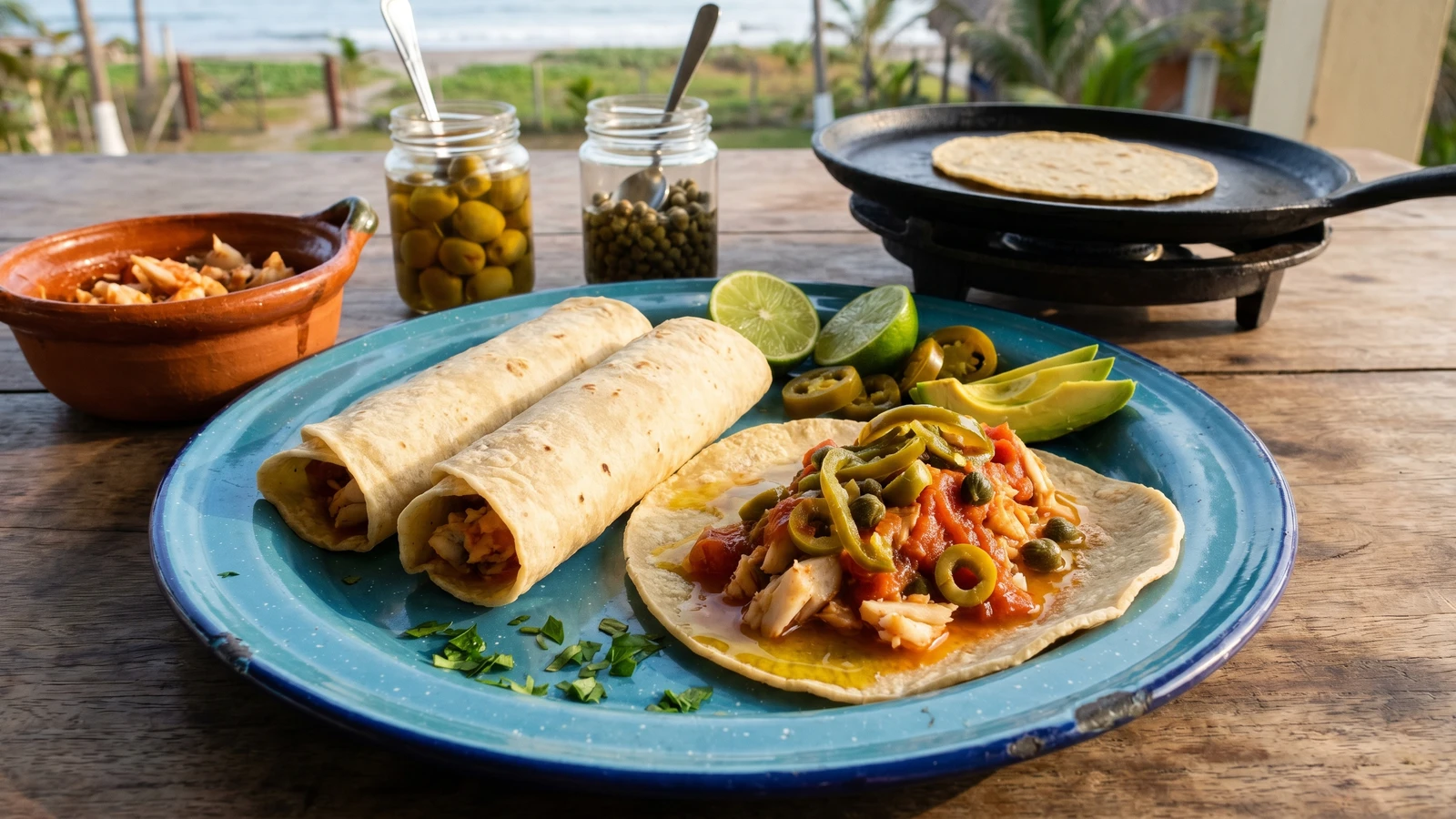
Tacos de minilla from the port of Alvarado: yesterday's fish hashed with tomato, green olive, caper, and pickled jalapeño, then rolled into warm corn tortillas. The Spanish hand on Gulf seafood, and proof nothing on this coast is wasted.
This is from Alvarado, the port town where the Papaloapan river empties into the Gulf, an hour south of the city of Veracruz. The alvaradeños are fishermen, and they have the sharpest, saltiest tongues in Mexico. They cook the way they talk: direct, generous, nothing wasted.
Minilla is what you do with yesterday's fish. You poach a sierra or a robalo, eat the good fillets one day, and the next day what is left gets hashed with tomato, green olive, caper, and pickled jalapeño until it becomes something new. Look at that pantry. Olive, caper, olive oil. That is not the central highlands. On this coast the Spanish landed first and stayed longest, and the Mediterranean never left the kitchen. Here the fat is aceite de oliva, not manteca. No me vengas con atajos: a real Spanish olive oil, green olives you chop yourself, capers that still smell of the brine.
I collected this in the Mercado de Alvarado, from a señora who sold fried fish and kept a pot of minilla going for the regulars. Her secret was patience. Make it today, eat it tomorrow. The tomato and the olive and the chile need a night to come together. My mother was from Jalisco and never made minilla in her life, but she kept the same law in her kitchen: you do not throw fish away. You turn it into something better.
This is La Tercera Raíz on a plate. Indigenous corn, Spanish olive, and the African hand that worked this port for three centuries. Roll it into a warm corn tortilla. Not flour. The tortilla is the one thing the Spaniards never managed to replace. Saber cocinar es saber vivir.
The Spanish founded Villa Rica de la Vera Cruz in 1519, making Veracruz the first European settlement on the American mainland and the port through which the entire Mediterranean pantry, olives, capers, almonds, raisins, and olive oil, entered Mexico. Minilla belongs to the same thrift tradition as Spanish escabeche and picadillo: a way to stretch cooked fish through Lent by hashing it with a preserved-pantry sofrito, a technique that took deep root in the fishing towns of the Sotavento. Veracruz was also the principal port of entry for enslaved Africans during the colonial period, and the anthropologist Gonzalo Aguirre Beltrán, born in nearby Tlacotalpan, built the scholarship that gave Mexico the term La Tercera Raíz, the third root, for the African heritage woven through the food and culture of this coast.
Quantity
1 1/2 pounds
skin and bones removed
Quantity
1/2
for poaching
Quantity
2
for poaching
Quantity
1
for poaching
Quantity
1 teaspoon
for poaching
Quantity
1/3 cup
Quantity
1 large
finely chopped
Quantity
4
finely minced
Quantity
1 1/2 pounds
finely chopped
Quantity
1/2 cup
chopped
Quantity
1/4 cup
drained
Quantity
4 to 5
seeded and chopped, plus 2 tablespoons of their brine
Quantity
1/3 cup
Quantity
1/3 cup
Quantity
2
Quantity
1 teaspoon
Quantity
1 teaspoon
Quantity
1/2 cup
chopped
Quantity
to taste
Quantity
12 to 16
warmed
Quantity
for serving
Quantity
for serving
Quantity
for serving
Quantity
for serving
| Ingredient | Quantity |
|---|---|
| firm white fish fillets (sierra or robalo)skin and bones removed | 1 1/2 pounds |
| white onionfor poaching | 1/2 |
| garlic clovesfor poaching | 2 |
| bay leaffor poaching | 1 |
| kosher saltfor poaching | 1 teaspoon |
| Spanish olive oil | 1/3 cup |
| white onionfinely chopped | 1 large |
| garlic clovesfinely minced | 4 |
| ripe tomatoes (jitomate)finely chopped | 1 1/2 pounds |
| pitted green manzanilla oliveschopped | 1/2 cup |
| capers (alcaparras)drained | 1/4 cup |
| pickled jalapeños (chiles jalapeños en escabeche)seeded and chopped, plus 2 tablespoons of their brine | 4 to 5 |
| raisins (pasas) | 1/3 cup |
| slivered almonds (almendras) | 1/3 cup |
| bay leaves (laurel) | 2 |
| dried thyme (tomillo) | 1 teaspoon |
| dried marjoram (mejorana) | 1 teaspoon |
| flat-leaf parsley (perejil)chopped | 1/2 cup |
| kosher salt and black pepper | to taste |
| corn tortillaswarmed | 12 to 16 |
| lime wedges (optional) | for serving |
| sliced avocado (optional) | for serving |
| extra pickled jalapeños (optional) | for serving |
| frijoles negros refritos (optional) | for serving |
Fill a wide pot with enough water to cover the fish. Add the half onion, two garlic cloves, one bay leaf, and the salt. Bring to a bare simmer, never a boil. Slide in the fillets and poach gently for 8 to 10 minutes, until the fish turns opaque and flakes at the touch of a fork. Lift it out, let it cool, then flake it with your fingers and pull out every last bone and bit of skin. If you are working with yesterday's cooked fish, the way Alvarado intended, skip straight to the sofrito. You already have what you need.
Warm the olive oil in a wide terracotta cazuela or heavy skillet over medium heat. Add the chopped onion with a pinch of salt and cook until soft and translucent, about 8 minutes. Do not let it brown. You want it sweet, not toasted. Add the minced garlic and cook one minute more, just until it turns fragrant. On this coast the fat is aceite de oliva, not manteca. That is the Spanish hand, and it starts here.
Add the chopped tomato. Cook over medium heat, stirring now and then, until the tomato collapses, darkens to a deep brick red, and the oil starts to pool at the edges of the pan, 15 to 20 minutes. This is the heart of the dish. Rush it and the minilla tastes raw and watery. Let it cook until it looks like a jam, not a sauce. You will know it is ready when a spoon dragged across the bottom leaves a clean trail for a second.
Stir in the olives, capers, pickled jalapeños with their brine, raisins, almonds, bay leaves, thyme, and marjoram. This is where the dish announces where it comes from. Salt, brine, a little sweet, and a thread of heat all at once. Simmer for 5 minutes so the flavors marry before the fish goes in.
Add the flaked fish and fold it through gently. You are binding it, not mashing it. Lower the heat and simmer for 8 to 10 minutes, until the fish drinks up the tomato and the mixture holds together when you drag a spoon across the pan. If it looks dry, add a splash of the poaching liquid. Stir in the chopped parsley at the end. Perejil, not cilantro. The Spanish hand again. Taste for salt and black pepper now, while you can still fix it.
Here is the part most recipes skip. Pull the pan off the heat and let the minilla rest, ideally until the next day. This is the day-after dish for a reason. The tomato, the olive, and the chile need a night in the refrigerator to settle into the fish. Eaten straight from the pan it is good. Eaten the next day it is right. Así se hace y punto.
Warm the corn tortillas on a dry comal until soft and pliable, with a few toasted spots at the edges. Rewarm the minilla gently if it has been chilled. Spoon a line of it down the center of each tortilla, roll it, and serve. Lime on the side, avocado if you have it, a few extra pickled jalapeños for the ones who want more heat. Put a pot of frijoles negros alongside. Black beans, not pinto. This is the Gulf, not the north.
1 serving (about 400g)
Culinary guides, cultural storytelling, and the editorial depth that makes cooking meaningful.
Discover Culinary ExplorerChef Lupita
Jalisco's goat birria, born around Cocula and carried into Guadalajara's markets, slow-braised in ancho, guajillo, cascabel, and chile de arbol, then tucked into corn tortillas crisped in its own red fat.

Chef Lupita
Sonora's working morning burrito: chicharrón de cáscara stewed in chile colorado with diced potato, rolled tight in a paper-thin tortilla sobaquera and eaten standing up at the carreta.

Chef Lupita
Mocorito's pork chilorio, shredded and confited in lard with chile ancho and pasilla, rolled into a thin handmade flour tortilla. The burrito Sinaloa sends out into the world.

Chef Lupita
Sonora's morning burrito of mashed pinto frijoles puercos and melted queso asadero, wrapped in a paper-thin sobaquera and seared on the comal until the cheese pulls in long strings.