
Chef Lupita
Birria Tacos with Consome
Jalisco's goat birria, born around Cocula and carried into Guadalajara's markets, slow-braised in ancho, guajillo, cascabel, and chile de arbol, then tucked into corn tortillas crisped in its own red fat.
A cooking platform built around craft, culture, and the stories behind what we eat.
Created by
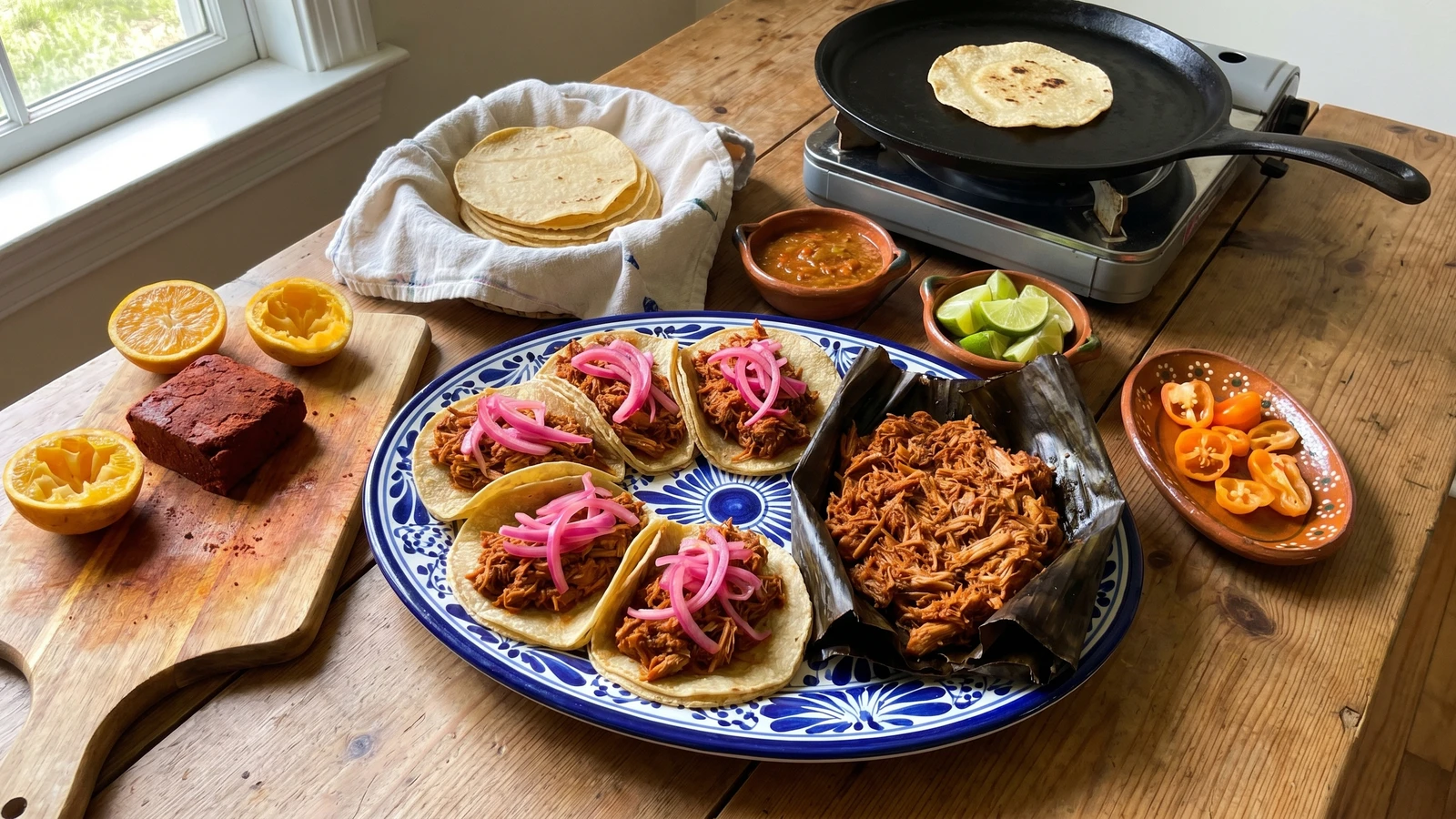
Yucatán's Sunday-morning taco. Pork marinated in achiote and naranja agria, wrapped in banana leaf, slow-cooked until it falls apart, piled on a warm corn tortilla with cebolla morada and habanero.
Cochinita pibil is from Yucatán. Not Mexico, Yucatán. The Peninsula has its own grammar, its own larder, its own way of doing things, and cochinita is its most famous sentence. The word pibil comes from pib, the Mayan earth oven, a stone-lined pit where the wrapped meat cooks slowly over hot coals buried in the ground. The home oven is a translation, not the original. Respect that.
The color comes from recado rojo, the brick-red paste of achiote seeds, allspice, oregano, and garlic that the cooks of Mérida and Valladolid have been grinding for generations. The sour comes from naranja agria, the bitter Seville orange that grows in backyard trees across the Peninsula. The fragrance comes from banana leaf. Take any of those three away and you have something else. You do not have cochinita.
My mother did not cook Yucatecan food. She was from Jalisco, and the Peninsula was as far from her kitchen as another country. I learned this dish from a señora named Doña Manuela who sold cochinita tacos out of a panucheria in the Mercado Lucas de Gálvez in Mérida. She watched me wrap my first banana leaf packet and shook her head until I did it right. The leaves overlap. The pork goes in with every drop of marinade. The packet seals shut. The pib does the rest. Cada estado, su propia cocina, and this one belongs to the women of the Peninsula.
The taco is the Sunday-morning form. In Mérida, families line up at panucherias before nine in the morning for cochinita served on warm corn tortillas with a tangle of cebolla morada encurtida and a small dish of habanero salsa on the side. Saber cocinar es saber vivir, and on Sunday in Yucatán, this is how you live.
Cochinita pibil is the direct descendant of a pre-Columbian Mayan method of cooking game, originally venison, peccary, and wild turkey, in stone-lined earth ovens called pib, wrapped in banana or palm leaves and buried with hot coals. The Spanish introduction of pigs in the 16th century replaced the wild game with cerdo, and the recado rojo evolved to incorporate Old World spices, including allspice, cumin, and cloves, that arrived through Mérida's colonial trade routes. The achiote seed itself, called k'uxub in Yucatec Maya, was used by the pre-conquest Maya as a body paint, a religious offering, and a food coloring centuries before it entered the culinary canon of the Peninsula.
Quantity
4 pounds
cut into 3-inch chunks
Quantity
1 block (3.5 ounces)
Quantity
1 cup
or 2/3 cup orange juice mixed with 1/3 cup white grapefruit juice and 2 tablespoons lime juice
Quantity
8
peeled
Quantity
1 tablespoon
Quantity
1 teaspoon
Quantity
1 teaspoon
preferably Yucatecan
Quantity
1/2 teaspoon
Quantity
1/4 teaspoon
Quantity
1/4 cup
melted
Quantity
1 large package
thawed if frozen
Quantity
1 medium
sliced into thin half-moons
Quantity
1 cup
Quantity
1 teaspoon
Quantity
1 teaspoon
Quantity
4
stemmed
Quantity
1/2 cup
Quantity
1/2 teaspoon
Quantity
24 to 30
warmed on the comal
Quantity
for serving
| Ingredient | Quantity |
|---|---|
| boneless pork shouldercut into 3-inch chunks | 4 pounds |
| recado rojo (achiote paste) | 1 block (3.5 ounces) |
| fresh naranja agria juiceor 2/3 cup orange juice mixed with 1/3 cup white grapefruit juice and 2 tablespoons lime juice | 1 cup |
| garlic clovespeeled | 8 |
| kosher salt | 1 tablespoon |
| ground allspice | 1 teaspoon |
| dried Mexican oreganopreferably Yucatecan | 1 teaspoon |
| ground cumin | 1/2 teaspoon |
| ground cloves | 1/4 teaspoon |
| manteca de cerdo (pork lard)melted | 1/4 cup |
| banana leavesthawed if frozen | 1 large package |
| red onionsliced into thin half-moons | 1 medium |
| naranja agria juice (for pickling the onions) | 1 cup |
| kosher salt (for the onions) | 1 teaspoon |
| dried Mexican oregano (for the onions) | 1 teaspoon |
| fresh chile habanerostemmed | 4 |
| naranja agria juice (for the salsa) | 1/2 cup |
| kosher salt (for the salsa) | 1/2 teaspoon |
| hand-pressed corn tortillaswarmed on the comal | 24 to 30 |
| lime wedges (optional) | for serving |
Break the block of recado rojo into a blender. Add the naranja agria juice, garlic, salt, allspice, oregano, cumin, cloves, and melted manteca. Blend on high until you have a smooth, deep red marinade the color of brick. The achiote will stain everything it touches, your blender, your cutting board, your fingers. That stain is the dish. Do not be afraid of it.
Place the pork chunks in a large bowl or zip-top bag. Pour the recado marinade over the meat. Turn each piece so every surface is coated in red. Cover and refrigerate overnight, at least 8 hours, ideally 12 to 24. The achiote needs time to penetrate the muscle. A quick marinade gives you stained meat, not flavored meat. No me vengas con atajos.
Pass each banana leaf carefully over an open gas flame for a few seconds per side, or warm them on a hot comal. They will turn from matte to glossy, soften, and release a green, grassy smell. That smell is the Peninsula. The leaves become pliable and stop cracking when you fold them. This is not optional. The banana leaf is what makes this cochinita and not roast pork.
Heat the oven to 325F. Line a heavy Dutch oven or deep cazuela with overlapping banana leaves, letting them drape generously over the sides. You want enough leaf to wrap completely back over the top. Traditionally, this is done in a pib, a stone-lined pit in the earth, and the women of the Peninsula have cooked it that way for centuries. The home oven is a compromise. The banana leaf is not.
Scrape the marinated pork and every drop of marinade into the leaf-lined pot. Spread it in an even layer. Fold the overhanging banana leaves back over the meat one by one, tucking them in so the pork is fully enclosed in a green packet. Cover the pot tightly with its lid or with foil pressed against the leaves. The pork will steam in its own juices and the achiote. No liquid escapes. No air gets in.
Slide the pot into the oven and forget about it for three and a half to four hours. Do not open it. Do not check on it. The leaves are doing the work. You will know it is ready when you can smell the achiote and banana leaf through the kitchen and a fork sinks into the meat with no resistance. Pull the pot out and let it rest, still covered, for 20 minutes.
While the cochinita rests, make the cebolla morada encurtida. Put the sliced red onion in a heatproof bowl. Cover with boiling water for 10 seconds, then drain. This takes the raw bite off without cooking the onion. Return to the bowl with the naranja agria juice, salt, and oregano. Let it sit at room temperature for at least 30 minutes. The onion will turn bright pink, almost neon. Pickled onions are not a garnish on this dish. They are half the recipe.
This is the Yucatecan salsa called ixni-pek or salsa de chile habanero, depending on whose mother taught you. Roast the habaneros directly over a flame or on the comal until the skins blister and char in spots. Drop them, still warm, into a small bowl with the naranja agria juice and salt. Mash them roughly with the back of a spoon, leaving the seeds. The habanero is not for show. It is the heat that defines Yucatecan food, fruity, sharp, immediate. Handle with care and wash your hands twice.
Open the banana leaves at the table if you can. The smell when the packet opens is the whole dish in one breath. Shred the pork with two forks right in the pot, mixing it back into the achiote-stained juices that have pooled at the bottom. That liquid is sauce. Do not drain it. The meat should look wet, red-orange, and stained through, not dry.
Warm the corn tortillas on a dry comal until they puff and pick up a few brown spots, about 30 seconds per side. Stack them in a cloth servilleta to keep them warm. Each person builds their own taco: a generous spoonful of cochinita, a tangle of pink pickled onions, a small spoonful of habanero salsa if they can take it. Lime on the side. Eat with your hands. Así se hace y punto.
1 serving (about 260g)
Culinary guides, cultural storytelling, and the editorial depth that makes cooking meaningful.
Discover Culinary ExplorerChef Lupita
Jalisco's goat birria, born around Cocula and carried into Guadalajara's markets, slow-braised in ancho, guajillo, cascabel, and chile de arbol, then tucked into corn tortillas crisped in its own red fat.

Chef Lupita
Sonora's working morning burrito: chicharrón de cáscara stewed in chile colorado with diced potato, rolled tight in a paper-thin tortilla sobaquera and eaten standing up at the carreta.

Chef Lupita
Mocorito's pork chilorio, shredded and confited in lard with chile ancho and pasilla, rolled into a thin handmade flour tortilla. The burrito Sinaloa sends out into the world.

Chef Lupita
Sonora's morning burrito of mashed pinto frijoles puercos and melted queso asadero, wrapped in a paper-thin sobaquera and seared on the comal until the cheese pulls in long strings.