
Chef Lupita
Birria Tacos with Consome
Jalisco's goat birria, born around Cocula and carried into Guadalajara's markets, slow-braised in ancho, guajillo, cascabel, and chile de arbol, then tucked into corn tortillas crisped in its own red fat.
A cooking platform built around craft, culture, and the stories behind what we eat.
Created by
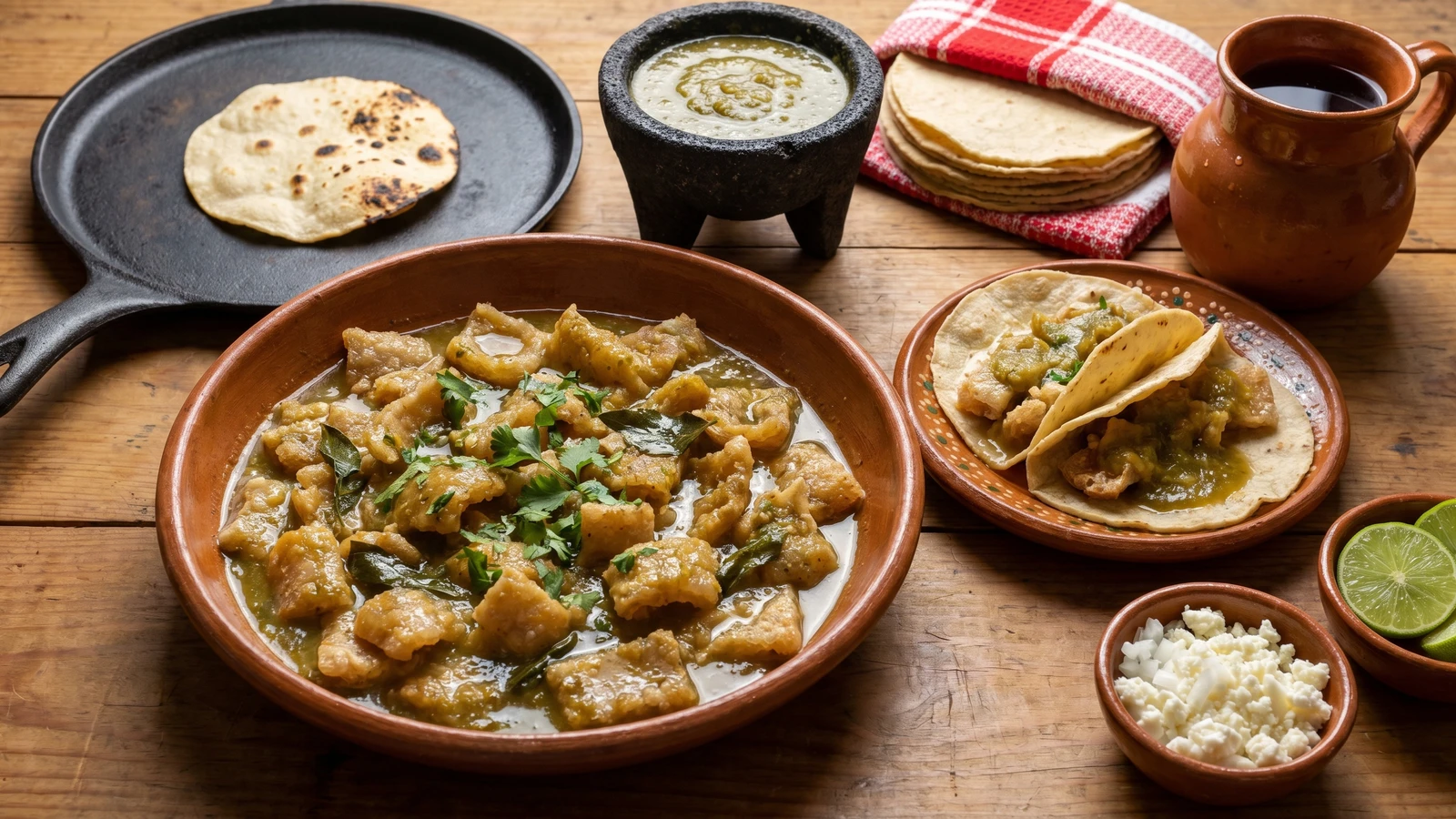
The fonda guisado of central Mexico: real puffed chicharrón simmered tender in a charred tomatillo and serrano salsa verde, ladled from the cazuela onto warm corn tortillas with raw white onion and a squeeze of lime.
This is a guisado from central Mexico. From Ciudad de México, from the State of Mexico, from Hidalgo, from Puebla. It lives in the fondas, those small family-run lunch counters where a woman cooks five or six guisados every morning and ladles them out of clay cazuelas into corn tortillas until the pots are empty. Chicharrón en salsa verde is almost always one of those pots.
The salsa is tomatillo, charred on the comal until the skins blister and the flesh turns olive. Serrano, garlic, onion, cilantro, all blended with texture and then fried in lard until the color deepens and the kitchen smells like a fonda at noon. The chicharrón goes in last and drinks the salsa for ten minutes until it is tender but still holding its shape. That balance, soft but not mush, is the whole technique.
Real chicharrón matters. I mean the kind sold by the kilo at the carniceria, light and puffed and golden, with the air pockets that let it drink the salsa. The hard, dense cracklings sold in supermarket bags are a different product. They will not soften. They will not surrender. If you cannot find real chicharrón, go to a Mexican butcher and ask, or wait until you can. A substitution is a compromise, not an upgrade.
My mother kept this recipe in her notebook from her years working a comida corrida in Colonia Roma before I was born. Twenty pesos for soup, a guisado over rice, beans, tortillas, and a small dessert. The chicharrón en salsa verde was the Wednesday guisado. She wrote in the margin: 'epazote, sí o sí.' She was right. Without the epazote, the dish is fine. With it, the dish is from here. Cada estado, su propia cocina.
Chicharrón en salsa verde belongs to the guisado tradition of central Mexico, a category of stewed dishes that developed in the post-revolutionary expansion of urban working-class fondas during the early 20th century, when home cooks turned the morning's market chiles, tomatoes, and tomatillos into mid-day meals for laborers and clerks who ate away from home. Chicharrón itself predates the conquest in concept, since pre-Columbian peoples rendered animal fats and crisped skins, but the pork version that defines the dish today emerged after the Spanish introduction of pigs in the 16th century and became a butcher-shop staple across the Bajío and the Valley of Mexico. The pairing of chicharrón with salsa verde took hold as a fonda specialty because it solved a practical problem elegantly: a humble, shelf-stable ingredient transformed in twenty minutes into a substantial hot dish for the lunch rush.
Quantity
1 pound
broken into large bite-sized pieces
Quantity
1 1/2 pounds
husked and rinsed
Quantity
3 to 4
stemmed (or 2 chile jalapeño for less heat)
Quantity
1/2 medium, plus 1/4 cup diced for serving
Quantity
3
unpeeled
Quantity
1/2 cup, packed, plus more for serving
Quantity
2 tablespoons
Quantity
1 sprig (about 6 leaves)
Quantity
1 teaspoon, plus more to taste
Quantity
1/2 cup
Quantity
12
warmed on a comal
Quantity
for serving
Quantity
for serving
| Ingredient | Quantity |
|---|---|
| chicharrón de cerdo (puffed pork rind)broken into large bite-sized pieces | 1 pound |
| fresh tomatilloshusked and rinsed | 1 1/2 pounds |
| fresh chile serranostemmed (or 2 chile jalapeño for less heat) | 3 to 4 |
| white onion | 1/2 medium, plus 1/4 cup diced for serving |
| garlic clovesunpeeled | 3 |
| fresh cilantro leaves and tender stems | 1/2 cup, packed, plus more for serving |
| manteca de cerdo (pork lard) | 2 tablespoons |
| fresh epazote | 1 sprig (about 6 leaves) |
| kosher salt | 1 teaspoon, plus more to taste |
| water or unsalted chicken broth | 1/2 cup |
| hand-pressed corn tortillaswarmed on a comal | 12 |
| lime wedges (optional) | for serving |
| crumbled queso fresco (optional) | for serving |
Heat a dry comal or heavy skillet over medium-high. Place the husked tomatillos, the half onion, the unpeeled garlic, and the serranos directly on the hot surface. Turn them as the skin blackens in patches and the tomatillos soften and start to weep their juice. About 8 to 10 minutes. The tomatillos should be slack and olive-colored, not raw green. The char is not a garnish. It is the flavor that makes salsa verde taste like a guisado and not like a smoothie.
Slip the garlic out of its papery skin. Transfer everything from the comal, tomatillos, onion, garlic, and chiles, to the blender along with the cilantro and 1/2 teaspoon of salt. Blend in short pulses. You want texture, not a puree. The salsa should still have small flecks of tomatillo and cilantro visible. A blender works fine here. No me vengas con atajos, but this is not one of them.
Heat the lard in a wide clay cazuela or heavy skillet over medium-high until it shimmers. Pour the blended salsa in all at once. It will sputter and hiss. Stand back. Cook for 5 to 7 minutes, stirring often, until the color deepens from pale green to a darker olive and the salsa thickens enough to coat the back of a spoon. La manteca es el sabor. This step is what turns raw salsa into guisado. Skip it and the chicharrón will float in a thin broth that tastes flat.
Pour in the water or chicken broth and stir to combine. Tear the epazote leaves and drop them in. Bring to a gentle simmer. Taste for salt now. The salsa should be aggressive, a little sour, a little smoky, a little hot, because the chicharrón is going to soak up a lot of it and tame everything down.
Lower the chicharrón pieces into the simmering salsa, pushing them down so the salsa coats every piece. Reduce the heat to medium-low. Cover partially and cook for 8 to 12 minutes. The chicharrón will drink the salsa and soften. You are looking for the moment when the pieces are tender enough to bite through cleanly but still hold their shape. A few minutes too long and they collapse into mush. Watch the pot.
While the chicharrón finishes, heat the comal over medium-high. Warm each corn tortilla for about 20 seconds per side. They should puff slightly and pick up a few light char spots. Stack them in a hand-woven servilleta to keep them warm and pliable. A cold tortilla ruins a hot taco. Así se hace y punto.
Bring the cazuela to the table on a wooden trivet. Set out the warm tortillas, the diced onion, extra cilantro, lime wedges, and queso fresco if you are using it. Each person spoons the chicharrón en salsa verde down the center of a tortilla, tops it with onion and cilantro, squeezes a little lime, and eats it standing up if they want to. This is a fonda dish. It is meant to be eaten the moment it hits the tortilla, before the salsa can soak through. Recetas probadas y garantizadas.
1 serving (about 300g)
Culinary guides, cultural storytelling, and the editorial depth that makes cooking meaningful.
Discover Culinary ExplorerChef Lupita
Jalisco's goat birria, born around Cocula and carried into Guadalajara's markets, slow-braised in ancho, guajillo, cascabel, and chile de arbol, then tucked into corn tortillas crisped in its own red fat.

Chef Lupita
Sonora's working morning burrito: chicharrón de cáscara stewed in chile colorado with diced potato, rolled tight in a paper-thin tortilla sobaquera and eaten standing up at the carreta.

Chef Lupita
Mocorito's pork chilorio, shredded and confited in lard with chile ancho and pasilla, rolled into a thin handmade flour tortilla. The burrito Sinaloa sends out into the world.

Chef Lupita
Sonora's morning burrito of mashed pinto frijoles puercos and melted queso asadero, wrapped in a paper-thin sobaquera and seared on the comal until the cheese pulls in long strings.