
Chef Lupita
Birria Tacos with Consome
Jalisco's goat birria, born around Cocula and carried into Guadalajara's markets, slow-braised in ancho, guajillo, cascabel, and chile de arbol, then tucked into corn tortillas crisped in its own red fat.
A cooking platform built around craft, culture, and the stories behind what we eat.
Created by
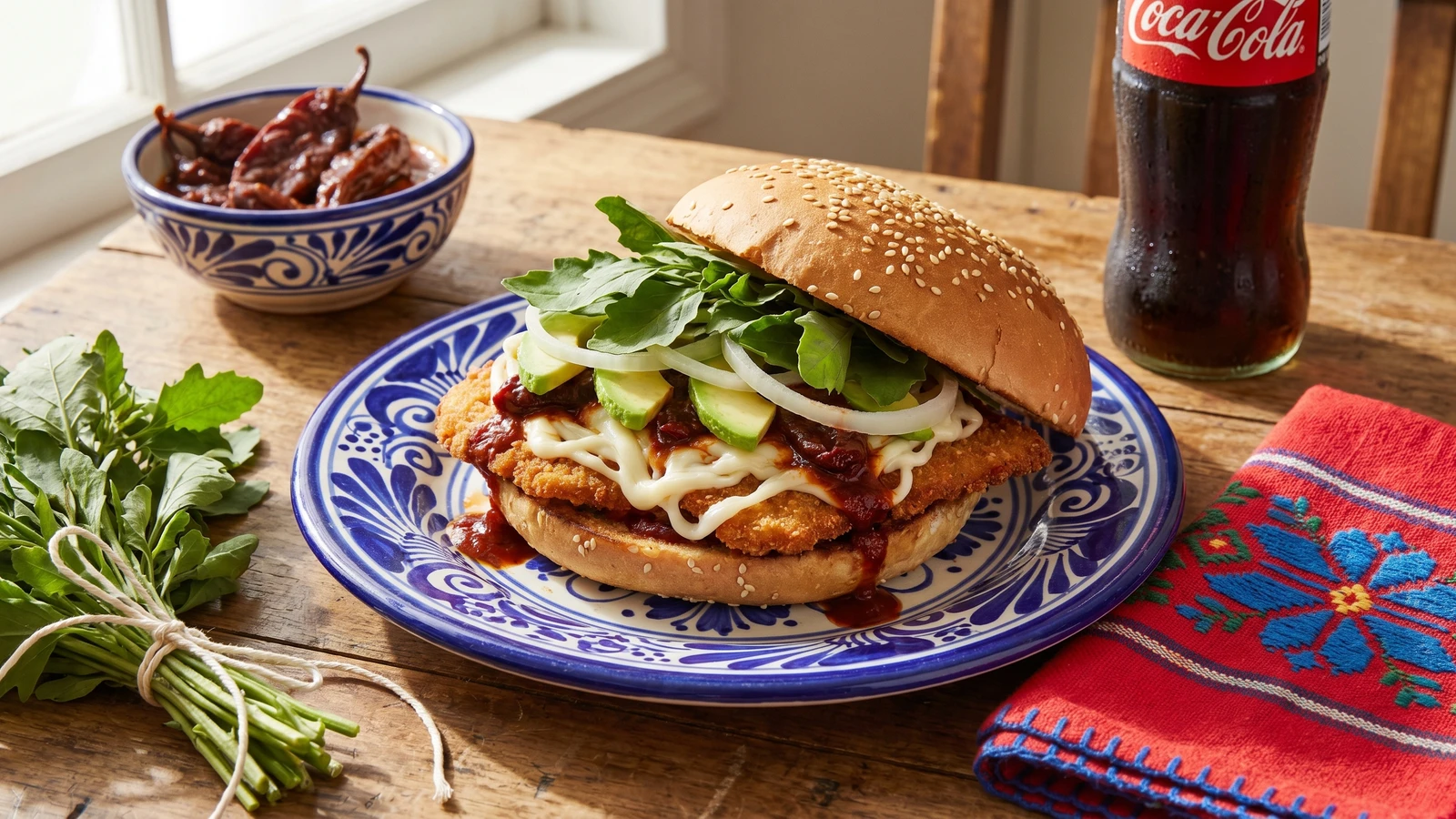
Puebla's round sesame cemita, stacked with crisp milanesa, strings of Oaxacan quesillo, ripe avocado, smoky chipotle adobado, and the herb that makes it real, pápalo. Anybody who calls this a torta has not been to Puebla.
The cemita is from Puebla. From the city itself, from the Mercado El Carmen and the stalls at the Mercado de Sabores where the cemiteras have been building these sandwiches the same way for generations. Anybody who calls this a torta has not been to Puebla. The cemita is a different bread, a different build, a different dish.
The bread is the dish. A round, domed, sesame-crusted roll with a hard crust and a dense yellow crumb made with egg and lard. Without a real cemita, you do not have a cemita. You have a sandwich. The name of the dish is the name of the bread, and the bread was built specifically to hold what goes inside: a wide flat milanesa, a generous tangle of quesillo from Oaxaca, slices of avocado, raw white onion, chiles chipotles in adobo, and the herb that makes the whole thing sing, pápalo.
Pápalo is not cilantro. Do not substitute cilantro. Pápalo, also called papaloquelite, is a wild herb with a flavor between cilantro, arugula, and rue, and it is what tells your tongue you are eating a cemita and not anything else. It grows in the milpas around Puebla and Tlaxcala. In Mexican mercados you find it tied in bunches in summer and early fall. If you cannot find it, do not make this with cilantro and call it a cemita. Make it when pápalo is in season. Mexican grandmothers cook with what the mercado is selling today, not what looks good on a Pinterest board.
My mother did not make cemitas, she was from Jalisco, and the cemita does not travel. But I learned the build from a cemitera named Doña Lupe at Mercado El Carmen, a woman who has been making them since 1972 and who sells out by two in the afternoon. She told me three things and I will tell them to you now: the bread is non-negotiable, the chipotle has to be adobado not in vinegar, and you put the pápalo last so the heat from the milanesa does not wilt it. Así se hace y punto.
The cemita arrived in Puebla with French and Lebanese bakers in the 19th century, and its name traces to the Latin 'simila,' the fine wheat flour used by Roman bakers, the same root that gives English 'semolina.' Pueblan bakers adapted the European round roll by enriching it with egg and lard and crowning it with sesame seeds, producing a bread sturdy enough to be carried by farmers and workers as a portable meal. The sandwich itself was codified in the early 20th century in the markets of Puebla, with the inclusion of pápalo, an herb cultivated by the Nahua and Otomi peoples of the central highlands since pre-Columbian times, marking it as a distinctly Pueblan creation rather than a European import.
Quantity
4
round, domed, glossy, crusted with sesame seeds
Quantity
4 (about 4 ounces each)
pounded to 1/4 inch
Quantity
1 cup
Quantity
2
beaten with 1 tablespoon water
Quantity
2 cups
Quantity
1 teaspoon, for the breading
Quantity
1/2 teaspoon
Quantity
1 cup, for frying
Quantity
8 ounces
pulled into long strings
Quantity
2
halved, pitted, and thinly sliced
Quantity
1
sliced into very thin rings
Quantity
1 bunch
leaves stripped from the stems
Quantity
6 to 8, plus a spoonful of the adobo sauce
Quantity
for serving
| Ingredient | Quantity |
|---|---|
| cemita rollsround, domed, glossy, crusted with sesame seeds | 4 |
| thin pork or beef milanesaspounded to 1/4 inch | 4 (about 4 ounces each) |
| all-purpose flour | 1 cup |
| large eggsbeaten with 1 tablespoon water | 2 |
| fine plain breadcrumbs (pan molido) | 2 cups |
| kosher salt | 1 teaspoon, for the breading |
| freshly ground black pepper | 1/2 teaspoon |
| lard (manteca de cerdo) or neutral oil | 1 cup, for frying |
| Oaxacan quesillopulled into long strings | 8 ounces |
| ripe Hass avocadoshalved, pitted, and thinly sliced | 2 |
| small white onionsliced into very thin rings | 1 |
| fresh pápaloleaves stripped from the stems | 1 bunch |
| chiles chipotles in adobo | 6 to 8, plus a spoonful of the adobo sauce |
| lime wedges (optional) | for serving |
Place each piece of meat between two sheets of plastic wrap. Pound with a flat mallet from the center outward until each piece is an even 1/4 inch thick. Pound, do not tear. The milanesa for a cemita is thin enough to cook in a minute and wide enough to cover the bread. If the meat is thicker, the bread will go cold while the inside is still raw. So no, this step is not optional.
Three shallow plates. Flour in the first. Beaten egg in the second. Breadcrumbs seasoned with the salt and black pepper in the third. Season each milanesa with a little salt on both sides before you start. Dredge each one in flour, shake off the excess, dip in egg until coated, then press firmly into the breadcrumbs on both sides. Press the crumbs in. A loose breading falls off the moment it hits the lard.
Heat the lard in a wide heavy skillet over medium-high until it shimmers and a breadcrumb dropped in sizzles instantly. La manteca es el sabor. Lay in one or two milanesas at a time, never crowd the pan. Fry for about 90 seconds per side until deep gold and crisp. Lift onto a wire rack set over a sheet pan. Do not stack them on paper towels. Paper towels trap steam and turn the breading soggy.
Split each cemita horizontally with a serrated knife. The crumb inside should be dense and yellow, not airy like a bolillo. If your bread is fluffy and white inside, you do not have a cemita, you have a hamburger bun pretending. The crust must be hard and the sesame seeds must be visible across the top. Do not toast the cemita. The bread holds the sandwich together with its own structure.
On the bottom half of the cemita, lay a generous mound of quesillo pulled into long strings. The cheese goes under the milanesa so the heat softens it. Place the hot milanesa on top of the quesillo. Then sliced avocado across the meat, then thin rings of white onion. Spoon two or three chiles chipotles in adobo across the top with a little of their dark red sauce. Cover the whole thing with a generous handful of pápalo leaves. Then the top half of the cemita. Press down once with your palm. So sabe la cemita.
Cut each cemita in half on the diagonal with a serrated knife. Serve at once, while the milanesa is hot, the quesillo is melting from the heat above it, and the pápalo is fresh. A cemita waits for nobody. The bread is built to hold the weight, the pápalo is at its peak the moment it is torn, and the chipotle perfumes the bread the longer it sits, but only by minutes. Eat it. Recetas probadas y garantizadas.
1 serving (about 340g)
Culinary guides, cultural storytelling, and the editorial depth that makes cooking meaningful.
Discover Culinary ExplorerChef Lupita
Jalisco's goat birria, born around Cocula and carried into Guadalajara's markets, slow-braised in ancho, guajillo, cascabel, and chile de arbol, then tucked into corn tortillas crisped in its own red fat.

Chef Lupita
Sonora's working morning burrito: chicharrón de cáscara stewed in chile colorado with diced potato, rolled tight in a paper-thin tortilla sobaquera and eaten standing up at the carreta.

Chef Lupita
Mocorito's pork chilorio, shredded and confited in lard with chile ancho and pasilla, rolled into a thin handmade flour tortilla. The burrito Sinaloa sends out into the world.

Chef Lupita
Sonora's morning burrito of mashed pinto frijoles puercos and melted queso asadero, wrapped in a paper-thin sobaquera and seared on the comal until the cheese pulls in long strings.