Culinary Explorer

A cooking platform built around craft, culture, and the stories behind what we eat.
Discover Culinary Explorer
Gringas de Pastor

Gringas de Pastor

Created by

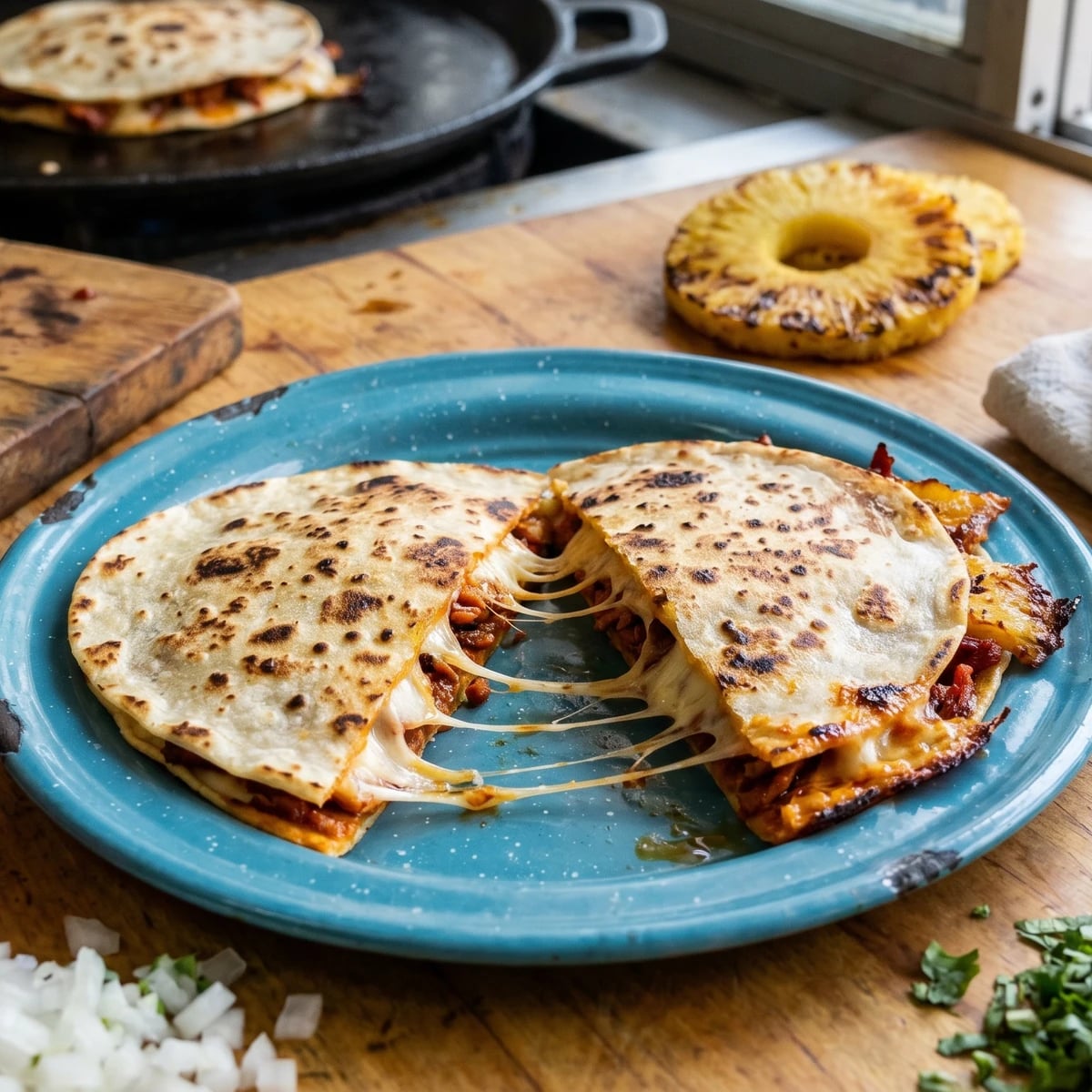
Mexico City's al pastor pork and stringy Oaxaca quesillo pressed between two flour tortillas and griddled on the comal until the cheese pulls in long strings. The taqueria's richer cousin, born on a Roma sidewalk after midnight.

Sandwiches & Wraps
Mexican
Game Day
Quick Meal
Comfort Food
30 min
Active Time
25 min cook24 hr 55 min total
Yield6 gringas

Gringas are from Ciudad de México. Specifically from the al pastor taquerias of Colonia Roma, Condesa, and the Centro, where the trompo turns from noon until two in the morning and the flour tortilla is what separates this from a regular taco. Pastor goes on a corn tortilla. Gringa goes on flour. That is the rule and the dish is named for it.

The story everyone repeats: a fair-skinned customer, a gringa, walked up to a Roma trompo decades ago and asked for her pastor on a flour tortilla with cheese instead of corn. The taquero made it and put it on the menu. Nobody knows if the story is true. The name stuck either way. What you need to know is that gringa is not a Tex-Mex quesadilla. The al pastor is the dish. The cheese and the flour tortilla are the frame.

Al pastor itself is not Mexican in origin. It came from Lebanese immigrants who arrived in Puebla and Ciudad de México in the early twentieth century with their vertical spit and their shawarma technique. Mexican cooks took the spit, swapped lamb for pork, added the adobo of guajillo and ancho and achiote, and topped the trompo with a pineapple. Within a generation, it became one of the defining dishes of the capital. Esto no es comida de un solo México. Pastor is what happens when CDMX absorbs an immigrant tradition and makes it its own.

You do not have a trompo. Do not pretend otherwise. What you have is a comal, a hot pan, and patience. Marinate the pork overnight, sear it in batches over high heat, chop it fine, char a piece of pineapple, and griddle the whole thing inside flour tortillas with real Oaxaca quesillo. Not cheddar. Not mozzarella. Quesillo. The string cheese from Oaxaca that pulls when it melts. La cocina no es decoración, es trabajo.

Al pastor is the Mexican adaptation of shawarma, brought to Mexico by Lebanese immigrants who arrived in significant numbers in Puebla and the Federal District between 1880 and 1940. The earliest pastor stands in Mexico City appeared in the 1960s, with most food historians pointing to the Bravo family's taqueria in Colonia Portales as one of the first to standardize the achiote-marinated pork on the vertical trompo. The gringa is a later variant, a CDMX taqueria innovation of the 1970s or 1980s whose origin is debated but whose name almost certainly refers to the flour tortilla, historically associated with norteño cuisine and with foreign or fair-skinned customers who preferred wheat over corn.

The technique, the tradition, and the story behind every dish.

Discover Culinary Explorer

Ingredients

boneless pork shoulder

Quantity

2 pounds

sliced into 1/4-inch thick steaks

pork fat (lardo) or thick-cut bacon

Quantity

1/2 pound

for the trompo layering

dried chile guajillo

Quantity

6

stemmed and seeded

dried chile ancho

Quantity

3

stemmed and seeded

dried chile de arbol

Quantity

2

stemmed

achiote paste (recado rojo)

Quantity

3 tablespoons

white vinegar

Quantity

1/2 cup

fresh pineapple juice

Quantity

1/2 cup

fresh orange juice

Quantity

1/4 cup

garlic cloves

Quantity

4

dried Mexican oregano

Quantity

1 teaspoon

ground cumin

Quantity

1 teaspoon

ground cloves

Quantity

1/2 teaspoon

kosher salt

Quantity

1 teaspoon, plus more to taste

white onion

Quantity

1 medium

halved (half for marinade, half diced for serving)

manteca de cerdo (pork lard)

Quantity

2 tablespoons

fresh pineapple

Quantity

1 small

peeled and sliced into 1/2-inch rings

flour tortillas

Quantity

12

8-inch size

quesillo (Oaxaca string cheese)

Quantity

1 pound

pulled into thin strands

fresh cilantro

Quantity

1 bunch

leaves chopped

limes

Quantity

4

cut into wedges

salsa verde cruda (optional)

Quantity

for serving

salsa de chile de arbol (optional)

Quantity

for serving

Equipment Needed

  • Large cast iron comal or heavy skillet, at least 12 inches
  • Heavy chef's knife for chopping the pastor
  • Wide spatula for pressing and flipping the gringa
  • High-powered blender for the adobo
  • Fine-mesh strainer

Instructions

  1. 1

    Toast the chiles

    Heat a dry comal or heavy skillet over medium. Toast the guajillo, ancho, and arbol chiles separately, about 20 to 30 seconds per side. The skins puff and the kitchen smells like a chile vendor's stall at La Merced. That is the oil waking up. Burned chile turns the adobo bitter. If one goes black, throw it out.

    The arbol is small and burns fast. Pull it before the guajillo and ancho. You want color and aroma, never smoke.
  2. 2

    Build the adobo al pastor

    Place the toasted chiles in a heatproof bowl and cover with hot tap water. Hot, not boiling. Soak for 20 minutes until the skins soften. Drain and transfer to a blender with the achiote paste, vinegar, pineapple juice, orange juice, garlic, oregano, cumin, cloves, salt, and the half onion. Blend until completely smooth and the color is a deep brick red. Pass it through a fine-mesh strainer. The achiote is what gives al pastor that red that nobody else has. Without it, you have adobo. Not pastor.

  3. 3

    Marinate the pork overnight

    Lay the pork steaks flat in a deep dish or a large resealable bag. Pour the adobo over the meat and turn each piece so every surface is coated. Refrigerate for at least 12 hours and up to 24. The acid in the pineapple and vinegar tenderizes the pork and the achiote works its way into the meat. No me vengas con atajos. A two-hour marinade gives you weak color and weak flavor.

  4. 4

    Cook the pastor on a comal

    You do not have a trompo at home. Neither does anyone except the taquero on the corner. You have a comal. Heat a large heavy skillet or cast iron comal over medium-high until it is very hot. Add the manteca. Working in batches, lay the marinated pork steaks flat and cook for 2 to 3 minutes per side, until the edges char and the adobo caramelizes against the iron. Transfer to a cutting board. Lay the pineapple rings on the same hot surface and char for a minute per side until they take on dark grill marks.

    The trompo at a taqueria builds char by dripping fat. At home, you build char with high heat and a heavy pan. Do not crowd the comal. If the meat steams instead of sears, your pastor will be pale and sad.
  5. 5

    Chop the pastor and pineapple

    Pile the cooked pork on the cutting board and chop it fine with a heavy knife, the way the taquero does at the trompo. The pieces should be small enough to fit easily inside a folded tortilla. Chop the charred pineapple into small dice and toss it in with the meat. The pineapple acidity cuts through the fat and the cheese. That contrast is the dish.

  6. 6

    Layer the gringa

    Wipe the comal clean and return it to medium heat. Lay one flour tortilla flat. Cover it with a generous layer of pulled quesillo, edge to edge. Scatter a heaping portion of the chopped pastor and pineapple over the cheese. Add another layer of quesillo on top so the meat is sandwiched between two layers of melting cheese. Cap with a second flour tortilla and press down gently with a spatula.

  7. 7

    Griddle until the cheese pulls

    Cook the gringa for 2 to 3 minutes per side, pressing down with the spatula. The bottom tortilla turns golden with brown freckles and the cheese melts into the meat. Flip carefully and griddle the second side. You know it is ready when you lift a corner and the quesillo pulls into long strings. Slide it onto a cutting board and cut it in quarters or halves. Serve immediately. A gringa that sits gets rubbery and the cheese tightens.

  8. 8

    Dress and serve

    Top each gringa with diced raw white onion and chopped cilantro. Serve with lime wedges, salsa verde cruda, and salsa de chile de arbol on the side. Each person dresses their own. Eat with your hands while the cheese is still pulling. Así se hace y punto.

Chef Tips

  • Quesillo is non-negotiable. The string cheese from Oaxaca pulls and melts the way no other cheese does. If your market sells Oaxaca cheese in a ball, pull it apart by hand into thin strands before it goes on the tortilla. Mozzarella is a compromise, not an upgrade. Cheddar is a different dish entirely.
  • Use real flour tortillas, the kind sold in Mexican markets, soft and pliable with visible flour on the surface. Tortillas from a supermarket bag that bend like cardboard will tear when you flip the gringa.
  • The pineapple has to be fresh and the char has to be real. Canned pineapple is too sweet and too soft. A taquero shaves slices from a whole pineapple sitting on top of the trompo. You sear yours on the comal. Same idea.
  • Make the adobo a day ahead and let the pork marinate the full 24 hours. Time is the technique here. There is no shortcut for this.

Advance Preparation

  • The adobo can be made up to 3 days ahead and refrigerated in a sealed container. The flavor only deepens.
  • The pork must marinate at least 12 hours and up to 24. This is not negotiable.
  • Cooked and chopped pastor keeps in the refrigerator for 3 days. Reheat on a hot comal with a splash of its juices. The gringa itself must be assembled and griddled to order. A pre-assembled gringa goes soggy.

Frequently Asked Questions

Nutrition Information

1 serving (about 410g)

Calories
1215 calories
Total Fat
80 g
Saturated Fat
30 g
Trans Fat
0 g
Unsaturated Fat
48 g
Cholesterol
200 mg
Sodium
1800 mg
Total Carbohydrates
60 g
Dietary Fiber
5 g
Sugars
8 g
Protein
64 g

Note: Chef personas and recipes are created with AI assistance. Cook with care: follow safe food-handling practices, check doneness with a thermometer when needed, and adapt for allergies and your kitchen.

Where cooking meets culture.

Culinary guides, cultural storytelling, and the editorial depth that makes cooking meaningful.

Discover Culinary Explorer

More from Central Mexican Tacos, Cemitas & Handhelds

Browse the full collection