
Chef Lupita
Birria Tacos with Consome
Jalisco's goat birria, born around Cocula and carried into Guadalajara's markets, slow-braised in ancho, guajillo, cascabel, and chile de arbol, then tucked into corn tortillas crisped in its own red fat.
A cooking platform built around craft, culture, and the stories behind what we eat.
Created by
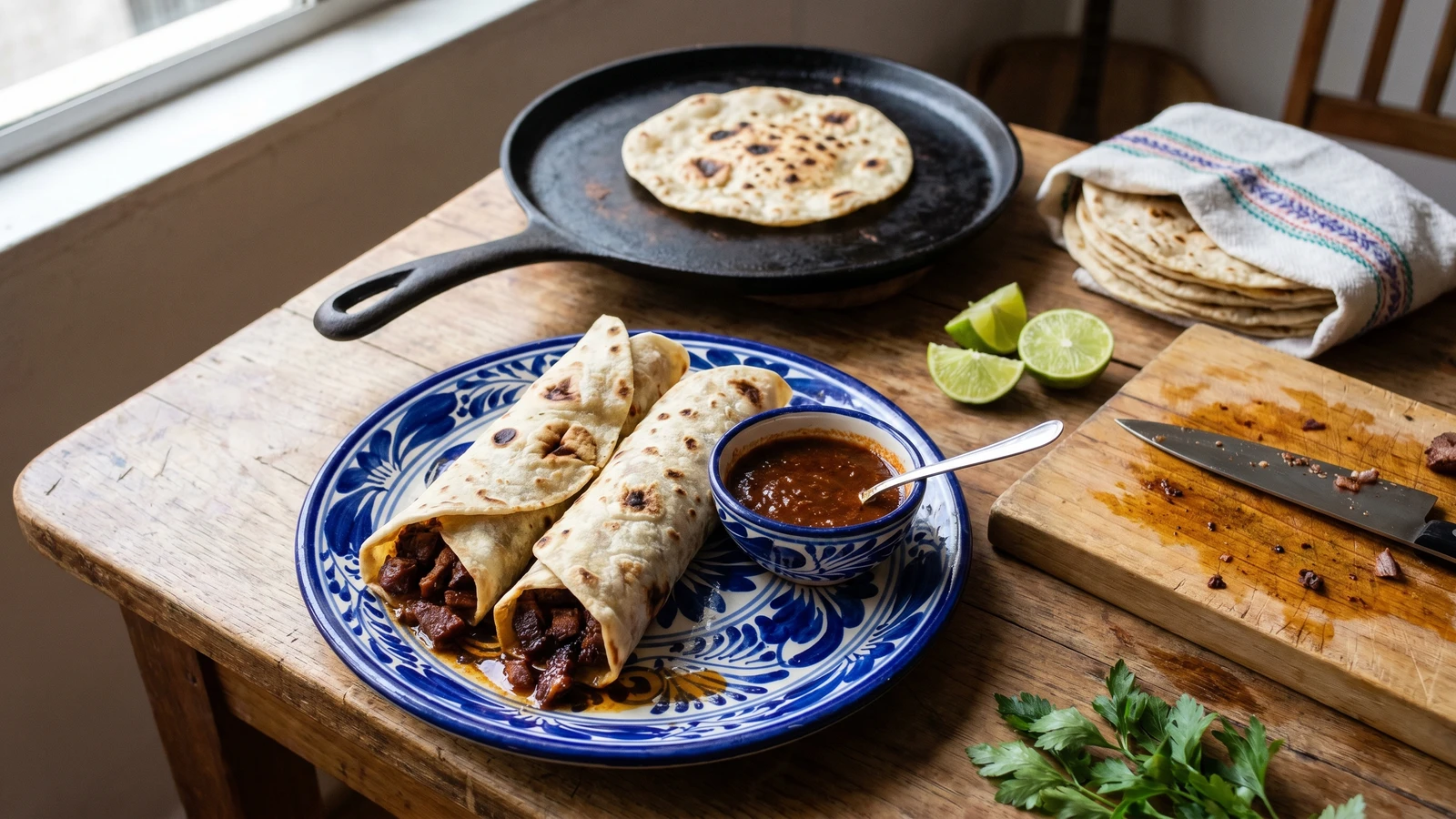
Puebla's Lebanese-rooted taco: marinated pork shoulder seared dark, folded into thick pan árabe flatbread, dressed with smoky chipotle morita salsa. The grandfather of al pastor, and not a piece of pineapple in sight.
Tacos árabes are from Puebla. Not from Mexico City. Not from the north. From the city of Puebla, specifically from the centro, where Lebanese immigrants arrived in the 1930s and brought with them their shawarma trompo, their flatbread, and their way with garlic, oregano, and vinegar. They settled, they cooked, and Puebla absorbed the dish the way Puebla absorbs everything: by making it its own.
This is the ancestor of al pastor. Before the achiote, before the pineapple, before the chilango trompo turned red, there was the Lebanese trompo in Puebla turning slowly with marinated pork. The pork came from the Spanish. The trompo came from Lebanon. The bread, pan árabe, is the cousin of khubz, thicker than a flour tortilla and softer than a pita. The salsa, smoky chipotle morita, is the Mexican hand on a Lebanese-Mexican dish. If you put pineapple anywhere near these tacos, you have made al pastor. You have not made tacos árabes.
I spent two weeks in Puebla collecting versions of this dish. La Oriental claims to be the original. Tacos Bagdad serves them with the parsley still on the plate, a hand from the Lebanese cooks who started it. Every poblano family that grew up on these tacos has an opinion about the salsa, the bread, the chop of the meat. What everyone agrees on: pan árabe, not tortilla. Chipotle salsa, not green. Pork, not lamb. And no pineapple. Cada estado, su propia cocina, and this one belongs to Puebla.
Tacos árabes trace to the 1930s wave of Lebanese Christian immigration to Puebla, particularly from the region around Beirut and the Bekaa Valley, and are most often attributed to the Galeana family, who opened the original Tacos Bagdad restaurant in the centro of Puebla in 1933. The dish is the direct ancestor of tacos al pastor: a generation later, the children of Lebanese immigrants in Mexico City adapted the vertical trompo by swapping pork shoulder marinated in achiote and dried chile for the Lebanese-style marinade, and crowned the spit with a pineapple. The pan árabe used in Puebla is a wheat flatbread developed locally from Lebanese khubz traditions and is the reason these tacos are wrapped, not folded; corn tortillas, the default for nearly every other Mexican taco, do not appear on a proper taco árabe.
Quantity
3 pounds
sliced into 1/4-inch steaks
Quantity
6
Quantity
1 tablespoon
Quantity
1 teaspoon
Quantity
1 teaspoon
freshly ground
Quantity
2 teaspoons
Quantity
1/4 cup
Quantity
2 tablespoons
Quantity
1
crumbled
Quantity
1 medium
halved (one half for marinade, one half for cooking)
Quantity
2 tablespoons
Quantity
4 cups, plus more for the work surface
Quantity
1 1/2 teaspoons
Quantity
2 teaspoons
Quantity
1 1/4 cups
Quantity
3 tablespoons
Quantity
1
Quantity
8
stemmed
Quantity
4
stemmed and seeded
Quantity
3
Quantity
3
unpeeled
Quantity
1/4 medium
Quantity
1 teaspoon
Quantity
1 teaspoon
Quantity
for serving
Quantity
for serving
| Ingredient | Quantity |
|---|---|
| boneless pork shouldersliced into 1/4-inch steaks | 3 pounds |
| garlic cloves (for marinade) | 6 |
| dried Mexican oregano | 1 tablespoon |
| ground cumin | 1 teaspoon |
| black pepperfreshly ground | 1 teaspoon |
| kosher salt (for marinade) | 2 teaspoons |
| white vinegar (for marinade) | 1/4 cup |
| olive oil (for marinade) | 2 tablespoons |
| bay leafcrumbled | 1 |
| white onionhalved (one half for marinade, one half for cooking) | 1 medium |
| pork lard (manteca de cerdo) | 2 tablespoons |
| all-purpose flour | 4 cups, plus more for the work surface |
| kosher salt (for dough) | 1 1/2 teaspoons |
| granulated sugar | 2 teaspoons |
| warm water | 1 1/4 cups |
| olive oil (for dough) | 3 tablespoons |
| large egg | 1 |
| dried chile chipotle moritastemmed | 8 |
| dried chile guajillostemmed and seeded | 4 |
| Roma tomatoes | 3 |
| garlic cloves (for salsa)unpeeled | 3 |
| white onion (for salsa) | 1/4 medium |
| kosher salt (for salsa) | 1 teaspoon |
| white vinegar (for salsa) | 1 teaspoon |
| lime wedges (optional) | for serving |
| chopped fresh parsley (optional) | for serving |
In a blender, combine the six garlic cloves, oregano, cumin, black pepper, two teaspoons salt, vinegar, two tablespoons olive oil, crumbled bay leaf, and half of the white onion. Blend until smooth. Lay the pork steaks in a glass dish and pour the marinade over them, turning each one to coat. Cover and refrigerate at least six hours, better overnight. This is not al pastor. There is no achiote. There is no pineapple. The Lebanese cooks who brought this dish to Puebla in the 1930s used oregano and vinegar, and that is what we use now.
In a large bowl, whisk the flour, one and a half teaspoons salt, and sugar. Make a well in the center. Add the warm water, three tablespoons olive oil, and the egg. Mix with your hand until a shaggy dough forms. Turn out onto a lightly floured surface and knead for ten minutes, until smooth and elastic. The dough should be soft but not sticky. Rub a little olive oil over it, return to the bowl, cover with a damp cloth, and let it rest for one hour at room temperature. This is not a tortilla. This is the cousin of khubz, the flatbread the Lebanese immigrants brought with them when they settled in the city of Puebla.
Heat a dry comal or heavy skillet over medium. Toast the morita chiles for about twenty seconds per side. They puff and turn fragrant. The morita is what gives this salsa its smoke. The morita is a red jalapeño that has been smoked over wood and dried, and it is the single ingredient that defines salsa para tacos árabes. Do the same with the guajillo. Place all the toasted chiles in a bowl, cover with hot tap water, and soak for fifteen minutes.
While the chiles soak, return the comal to medium-high heat. Char the Roma tomatoes, unpeeled garlic, and onion quarter directly on the dry surface, turning until they are blistered and blackened in patches. The tomatoes should collapse a little. The garlic should soften inside its papery skin. This is ten minutes of work and it builds the foundation of the salsa.
Drain the soaked chiles. Peel the charred garlic. Combine the chiles, tomatoes, garlic, onion, salt, vinegar, and half a cup of the chile soaking liquid in a blender. Blend until smooth but not perfectly silky. You want a salsa with body. Taste for salt. The salsa should be smoky, deep red-brown, slightly tangy, and hot but not punishing. This is the salsa for tacos árabes. No me vengas con atajos and no me vengas with bottled chipotle sauce.
Divide the rested dough into six to eight equal balls, each about the size of a large lime. On a lightly floured surface, roll each ball into a round about eight inches across and a quarter inch thick. Thicker than a tortilla, thinner than a pita. Let the rolled rounds rest under a cloth for ten minutes while you heat the comal. Resting relaxes the gluten so the bread will not shrink back when it hits the heat.
Heat a dry comal or large skillet over medium-high. Lay one round of dough onto the hot surface. Cook for about a minute, until the underside has light brown spots and small bubbles rise across the top. Flip and cook the second side for another minute. The bread should be soft and pliable, with a few golden blisters but no crisp char. Stack them on a clean cloth and keep them covered while you cook the rest. A pan árabe that has gone hard cannot wrap a taco.
Heat a heavy cast iron skillet or plancha over medium-high until very hot. Add the lard. When it shimmers, lay the marinated pork steaks in a single layer. Do not crowd the pan. Work in batches. Sear for two to three minutes per side, until the edges are dark mahogany and the surface has caught some color. The high heat is doing what a vertical trompo would do: caramelizing the marinade onto the meat. La manteca es el sabor. Transfer the cooked pork to a cutting board.
Stack the seared pork steaks and chop them coarsely with a sharp knife. You want pieces with edges, not a fine mince. Mound a generous portion of pork down the center of a warm pan árabe. Add a spoonful of the cooked onion. Roll the bread tightly around the filling, the way the cooks at La Oriental and Tacos Bagdad do it in the centro of Puebla. The pan árabe folds, it does not break. Serve immediately with the chipotle salsa on the side, a few lime wedges, and chopped parsley if you want it. The parsley is a Lebanese hand still on the dish. Así se hace y punto.
1 serving (about 290g)
Culinary guides, cultural storytelling, and the editorial depth that makes cooking meaningful.
Discover Culinary ExplorerChef Lupita
Jalisco's goat birria, born around Cocula and carried into Guadalajara's markets, slow-braised in ancho, guajillo, cascabel, and chile de arbol, then tucked into corn tortillas crisped in its own red fat.

Chef Lupita
Sonora's working morning burrito: chicharrón de cáscara stewed in chile colorado with diced potato, rolled tight in a paper-thin tortilla sobaquera and eaten standing up at the carreta.

Chef Lupita
Mocorito's pork chilorio, shredded and confited in lard with chile ancho and pasilla, rolled into a thin handmade flour tortilla. The burrito Sinaloa sends out into the world.

Chef Lupita
Sonora's morning burrito of mashed pinto frijoles puercos and melted queso asadero, wrapped in a paper-thin sobaquera and seared on the comal until the cheese pulls in long strings.