
Chef Lupita
Birria Tacos with Consome
Jalisco's goat birria, born around Cocula and carried into Guadalajara's markets, slow-braised in ancho, guajillo, cascabel, and chile de arbol, then tucked into corn tortillas crisped in its own red fat.
A cooking platform built around craft, culture, and the stories behind what we eat.
Created by
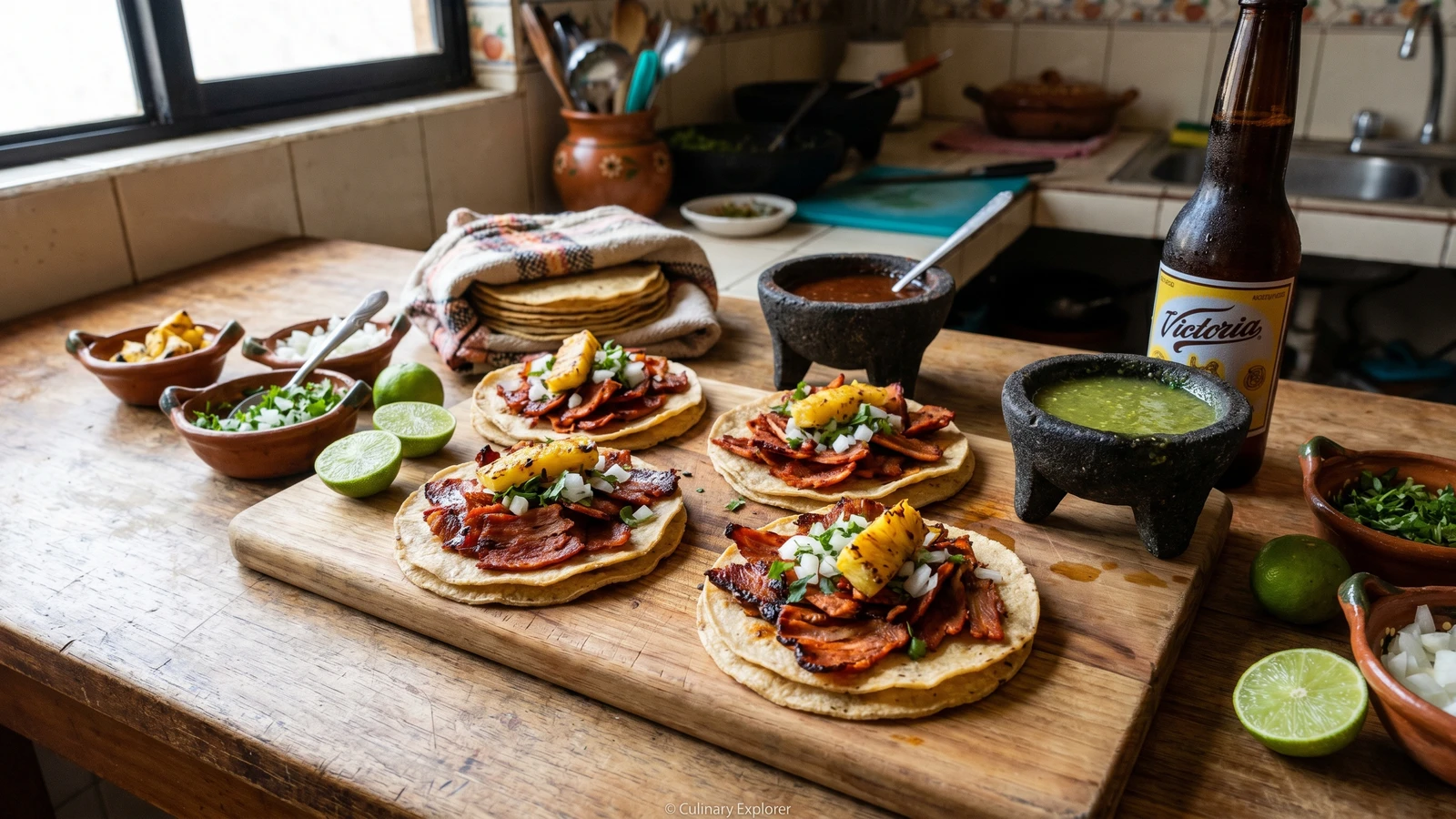
Mexico City's signature taco: adobo-stained pork shaved off the spinning trompo, dressed with charred pineapple, raw white onion, and cilantro. The taquería at night, brought home to your kitchen.
Al pastor belongs to Mexico City. Not to Puebla, even though the chiles came from there. Not to Lebanon, even though the spinning spit did. The dish as we know it, the trompo wheeling under a flame at a corner taquería on Calle Bucareli or Avenida Alvaro Obregon, the taquero shaving curls of red-stained pork onto two small tortillas with one hand and tossing a chunk of charred pineapple on top with the other, that is Chilango cuisine. Cada estado, su propia cocina, and this one is ours.
The adobo is the dish. Guajillo and ancho for color and depth, a few arbol for backbone, achiote for the red stain and the earthy floor, vinegar and pineapple juice for the acid that tenderizes, canela and clove for the warmth that whispers of the Lebanese origin. Most recipes outside Mexico get this wrong. They use too much achiote and end up with a flat orange paste. They skip the toasting and end up with raw chile flavor. They marinate for an hour and wonder why the meat tastes shy. The adobo needs time. Overnight, minimum. That is not a suggestion.
The pineapple has to be charred. Raw pineapple on al pastor is the mark of a kitchen that has never watched a taquero work. At a real al pastor stand, the pineapple sits on top of the trompo, caramelizing in the fat that drips down. When the taquero shaves off the meat, he flicks a piece of that caramelized pineapple onto the tortilla in the same motion. Sweet, acid, smoke, fat, all in one bite. You do not have a trompo. Char the pineapple on a screaming-hot comal until it is almost black at the edges. Recetas probadas y garantizadas.
My mother did not make al pastor. It was street food, and street food is what you ate when you were out, not what you cooked at home. But I have spent enough nights at the taquerías of Colonia Roma and Colonia Condesa, watching the same taqueros work the same trompos for years, to know how it should taste. Smoky. Slightly sweet. Acidic. With enough fat on the edges to stain the second tortilla red. Saber cocinar es saber vivir, and learning to cook al pastor at home is learning to recreate one of the most specific flavors any city has ever produced.
Tacos al pastor evolved in Mexico City in the 1930s and 1940s from the shawarma brought by Lebanese immigrants, primarily Christian Maronites who arrived through the port of Veracruz in the early 20th century. The original Lebanese tacos arabes, still served in Puebla, used pita-like bread, lamb, and yogurt; Mexico City taqueros made the dish their own by switching to pork (forbidden in the Lebanese tradition), substituting corn tortillas, and adapting the seasoning with native chiles and achiote sourced from Yucatán. The addition of pineapple atop the trompo is a uniquely Chilango innovation with no Lebanese precedent, and the dish was fully codified in the 1960s when taquerías like El Tizoncito in Condesa claimed to have invented the modern version, a claim still disputed by older stands across the capital.
Quantity
3 pounds
sliced 1/4 inch thick against the grain
Quantity
1/2 pound
sliced 1/4 inch thick
Quantity
6
stemmed and seeded
Quantity
3
stemmed and seeded
Quantity
2
stemmed
Quantity
3 tablespoons
Quantity
1/3 cup
Quantity
1/2 cup
Quantity
1/4 cup
Quantity
1 tablespoon
Quantity
6
Quantity
1 teaspoon
Quantity
1 teaspoon
Quantity
1/2 teaspoon
Quantity
1/2 teaspoon
Quantity
1/2 teaspoon
Quantity
1 tablespoon
Quantity
1 tablespoon, plus more for cooking
Quantity
1/2
peeled and sliced into 1/2-inch rings
Quantity
24
Quantity
1 medium
finely diced
Quantity
1 bunch
chopped
Quantity
for serving
Quantity
for serving
Quantity
for serving
| Ingredient | Quantity |
|---|---|
| boneless pork shouldersliced 1/4 inch thick against the grain | 3 pounds |
| pork fatback or pork bellysliced 1/4 inch thick | 1/2 pound |
| dried chile guajillostemmed and seeded | 6 |
| dried chile anchostemmed and seeded | 3 |
| dried chile de arbolstemmed | 2 |
| achiote paste (recado rojo) | 3 tablespoons |
| white vinegar | 1/3 cup |
| fresh pineapple juice | 1/2 cup |
| fresh orange juice | 1/4 cup |
| fresh lime juice | 1 tablespoon |
| garlic cloves | 6 |
| ground cumin | 1 teaspoon |
| dried Mexican oregano | 1 teaspoon |
| ground cloves | 1/2 teaspoon |
| ground cinnamon (canela) | 1/2 teaspoon |
| ground black pepper | 1/2 teaspoon |
| kosher salt | 1 tablespoon |
| lard (manteca de cerdo) | 1 tablespoon, plus more for cooking |
| fresh pineapplepeeled and sliced into 1/2-inch rings | 1/2 |
| small hand-pressed corn tortillas | 24 |
| white onion (optional)finely diced | 1 medium |
| fresh cilantro (optional)chopped | 1 bunch |
| lime wedges (optional) | for serving |
| salsa verde cruda (optional) | for serving |
| salsa de chile de arbol (optional) | for serving |
Heat a dry comal or heavy skillet over medium. Toast the guajillo, ancho, and arbol chiles separately, about 20 to 30 seconds per side. The guajillo turns a deep brick color. The ancho puffs and goes glossy. The arbol takes seconds, so watch it. You want the oils to release, never the chile to blacken. The kitchen should smell like the chile vendor's stall at Mercado de Jamaica. That smell is the recipe waking up.
Place the toasted chiles in a heatproof bowl and cover with hot tap water. Hot water, not boiling. Boiling water cooks the skins and turns the adobo bitter. Let them sit for 20 minutes, weighted down with a small plate so they stay submerged. They should soften completely, the flesh pliable and the color saturated.
Drain the chiles, reserving 1/2 cup of the soaking liquid. Transfer the chiles to a blender. Add the achiote paste, vinegar, pineapple juice, orange juice, lime juice, garlic, cumin, oregano, cloves, canela, black pepper, salt, and the reserved soaking liquid. Blend on high for at least two minutes, until the adobo is silky and the color of dark brick stained with sun. Pass it through a fine-mesh strainer, pressing on the solids. The strained adobo should coat the back of a spoon. This is the marinade that built al pastor.
Lay the sliced pork shoulder and fatback in a wide glass or ceramic dish. Pour the adobo over the meat and turn each slice to coat completely. Every piece needs to be stained red. Cover and refrigerate for at least 8 hours, preferably overnight, up to 24 hours. The vinegar tenderizes, the achiote stains, the pineapple juice does the chemistry. Time is doing work here. Do not rush it.
Heat a heavy cast iron skillet or comal over medium-high until it is very hot. Place the pineapple rings in the dry skillet and cook without moving them for 3 to 4 minutes per side. You want deep black char marks and the sugar in the fruit to caramelize at the edges. Set the rings on a cutting board to cool. Once cool enough to handle, chop into small dice. The char is the point. Raw pineapple on al pastor is a tourist mistake.
You do not have a trompo at home, so you cook al pastor the way the taqueros do when the spit is off: hot pan, thin slices, hard sear. Heat a heavy cast iron skillet or plancha over medium-high until smoking. Add a teaspoon of lard. Working in batches, lay the marinated pork slices in a single layer. Do not crowd the pan. Sear for 2 to 3 minutes per side. The edges should crisp into dark, almost-burned lacquer. That is the carbon flavor that mimics the trompo. Transfer to a cutting board as each batch finishes.
Stack the seared pork slices and chop them into small irregular pieces, about the size of your fingernail. This is how the taquero serves it off the trompo: small enough that two or three pieces sit easily on a small tortilla. Return the chopped pork to the hot skillet for a final 60 seconds, stirring once, just to crisp the smallest edges and warm everything through. Toss in the diced charred pineapple at the end. Pull it off the heat.
Warm each corn tortilla directly on a dry comal for about 30 seconds per side, until soft and pliable with a few light brown spots. Stack them in a hand-woven servilleta to keep them warm. Build each taco with a small mound of pork and pineapple, a pinch of diced raw white onion, a pinch of chopped cilantro, a squeeze of lime, and salsa to the eater's preference. Two tortillas per taco if you are doing it properly, the way they do at the corner stand on Avenida Alvaro Obregon. Eat immediately. Standing up if possible. Así se hace y punto.
1 serving (about 350g)
Culinary guides, cultural storytelling, and the editorial depth that makes cooking meaningful.
Discover Culinary ExplorerChef Lupita
Jalisco's goat birria, born around Cocula and carried into Guadalajara's markets, slow-braised in ancho, guajillo, cascabel, and chile de arbol, then tucked into corn tortillas crisped in its own red fat.

Chef Lupita
Sonora's working morning burrito: chicharrón de cáscara stewed in chile colorado with diced potato, rolled tight in a paper-thin tortilla sobaquera and eaten standing up at the carreta.

Chef Lupita
Mocorito's pork chilorio, shredded and confited in lard with chile ancho and pasilla, rolled into a thin handmade flour tortilla. The burrito Sinaloa sends out into the world.

Chef Lupita
Sonora's morning burrito of mashed pinto frijoles puercos and melted queso asadero, wrapped in a paper-thin sobaquera and seared on the comal until the cheese pulls in long strings.