
Chef Lupita
Arroz Blanco Tabasqueno con Platano
Tabasco's everyday white rice, cooked loose and clean with onion and garlic, then crowned with sweet fried ripe plantain from the lowland kitchen.
A cooking platform built around craft, culture, and the stories behind what we eat.
Created by
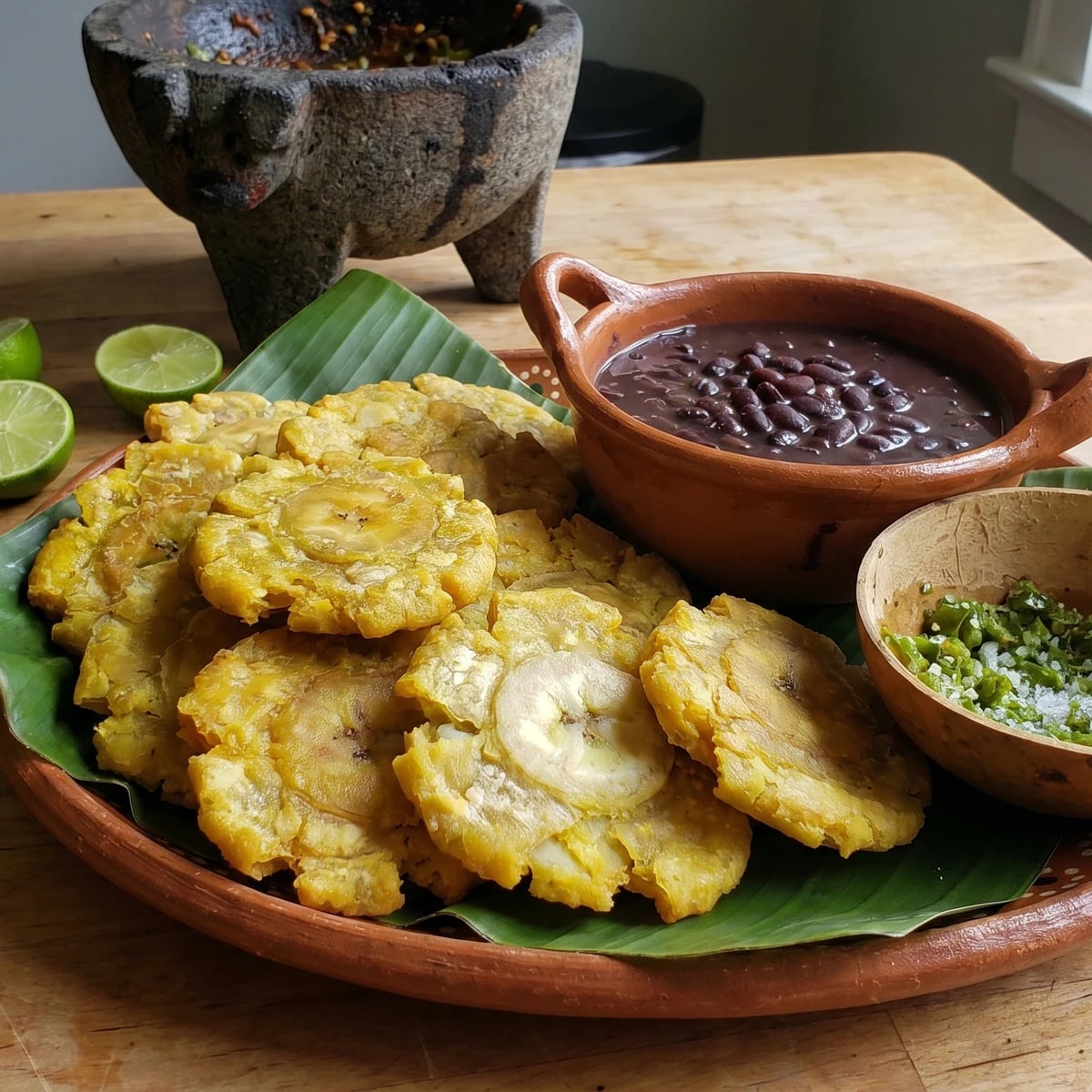
Tabasco's lowland plantain side, twice-fried in manteca until the edges turn crisp, then served with black beans, lime, and chile amashito from the market.
Tabasco, the humid lowlands along the Grijalva and Usumacinta rivers, knows what to do with a green plantain. This is not a sweet plantain dish. This is plátano macho verde, hard and starchy, fried once to soften, smashed flat, then fried again until the edges crack under your teeth and the center stays tender.
In Villahermosa and the Chontalpa, plantains are not decoration on the plate. They are daily food, sold in heavy green hands at the mercado beside hoja de plátano, chile amashito, yuca, cacao, and black beans. The chile that belongs here is amashito, tiny, fierce, and Tabasqueño. Not jalapeño. Not bottled hot sauce from somewhere else. Pregúntale a las señoras del mercado.
The technique is plain, but it is not careless. Cut the rounds thick. Fry them gently first so the inside cooks. Smash them while warm. Fry them hotter the second time so the surface turns crisp before the middle dries out. No me vengas con atajos. If you fry them once and call them done, you made fried plantain. You did not make tostones.
Serve them with frijol negro de olla, a squeeze of lime, and a little chile amashito crushed with salt. That is a Tabasco table: tropical, direct, and practical. Cada estado, su propia cocina.
Plantains arrived in New Spain after the conquest through Spanish and Portuguese Atlantic trade routes, then took root in the hot, wet regions of the Gulf and southeast where the crop grew easily. Tabasco became one of Mexico's major plantain-producing states in the 20th century, especially in the Chontalpa region, which made green and ripe plantain a common household starch rather than a special ingredient. Twice-fried green plantain techniques connect Tabasco to the wider Caribbean and Gulf coast, but the pairing with frijol negro and chile amashito gives this version its local identity.
Quantity
3 large
firm, fully green, peeled and cut into 1-inch rounds
Quantity
2 cups
or enough to fill a skillet 1 inch deep
Quantity
1 1/2 teaspoons
divided
Quantity
1/2 cup
Quantity
2
lightly crushed
Quantity
1 tablespoon
plus lime halves for serving
Quantity
1 cup
for serving
Quantity
6 to 8
crushed with salt, for serving
Quantity
2 tablespoons
for serving
| Ingredient | Quantity |
|---|---|
| green plantains (plátano macho verde)firm, fully green, peeled and cut into 1-inch rounds | 3 large |
| pork lard (manteca de cerdo)or enough to fill a skillet 1 inch deep | 2 cups |
| fine sea saltdivided | 1 1/2 teaspoons |
| warm water | 1/2 cup |
| garlic cloveslightly crushed | 2 |
| fresh lime juiceplus lime halves for serving | 1 tablespoon |
| warm frijol negro de olla (optional)for serving | 1 cup |
| fresh chile amashito (optional)crushed with salt, for serving | 6 to 8 |
| finely chopped cilantro (optional)for serving | 2 tablespoons |
Cut off both ends of each green plantain. Score the skin lengthwise in two or three places, just deep enough to reach the flesh. Pry the peel away with your thumb or the back of a spoon. Green plantain peel fights back. Good. That firmness is what gives you a tostón with structure.
Slice the peeled plantains into rounds about 1 inch thick. Do not cut them thin. Thin pieces dry out in the second fry and turn into chips. Tostones need a tender middle, and the thickness protects it.
Melt the manteca de cerdo in a heavy skillet over medium heat until it reaches 325F. You need about 1 inch of fat in the pan. La manteca es el sabor. It gives the plantain a clean, savory edge that plain oil does not. If the lard smokes, it is too hot. Lower the heat and wait.
Add the plantain rounds in one layer, leaving space between them. Fry for 3 to 4 minutes per side, until pale gold and soft enough that a fork meets only light resistance. They should not brown deeply yet. This first fry cooks the starch inside. Rush it and the center stays hard.
While the plantains fry, stir the warm water, crushed garlic, lime juice, and 1 teaspoon of the salt in a shallow bowl. This quick dip seasons the smashed plantains and helps the second fry crisp. It is not a bath. A few seconds is enough.
Lift the plantains from the fat and drain them briefly on a rack or paper towels. While still warm, smash each round to about 1/2 inch thick using a tostonera, the bottom of a heavy mug, or a flat tortilla press lined with plastic. Press straight down. If you crush at an angle, the edges split too much and burn.
Dip each smashed plantain quickly into the garlic-lime water, one second per side, then set it back on the rack. Blot any visible water from the surface. Water left on the plantain will make the lard spit. A seasoned tostón is good. A wet tostón is trouble.
Raise the lard to 375F. Fry the smashed plantains in batches for 2 to 3 minutes per side, until the edges are deep gold and crisp, with small rough ridges where the plantain split. The sound in the pan will sharpen as the moisture leaves the surface. That is when you watch closely.
Drain the tostones on a rack, not a closed plate, so the bottoms stay crisp. Sprinkle immediately with the remaining 1/2 teaspoon salt. Serve hot with warm frijol negro de olla, lime halves, cilantro, and chile amashito crushed with salt. Así se hace y punto.
1 serving (about 200g)
Culinary guides, cultural storytelling, and the editorial depth that makes cooking meaningful.
Discover Culinary Explorer
Chef Lupita
Tabasco's everyday white rice, cooked loose and clean with onion and garlic, then crowned with sweet fried ripe plantain from the lowland kitchen.

Chef Lupita
Comitán's golden rice from the Chiapas highlands, gently fried first, then steamed with saffron threads, chicken broth, onion, and garlic until each grain stays separate.

Chef Lupita
Tabasco's everyday red rice, long-grain grains fried in manteca, stained with tomato, and simmered in chicken broth until each grain stands separate.

Chef Lupita
Los Altos de Chiapas gives you tender calabacita, sweet elote, tomato, epazote, and a little chile Simojovel, cooked softly in manteca until the milpa tastes like itself.