Culinary Explorer

A cooking platform built around craft, culture, and the stories behind what we eat.
Discover Culinary Explorer
Syros Maidanosalata (Μαϊντανοσαλάτα Σύρου)

Syros Maidanosalata (Μαϊντανοσαλάτα Σύρου)

Created by

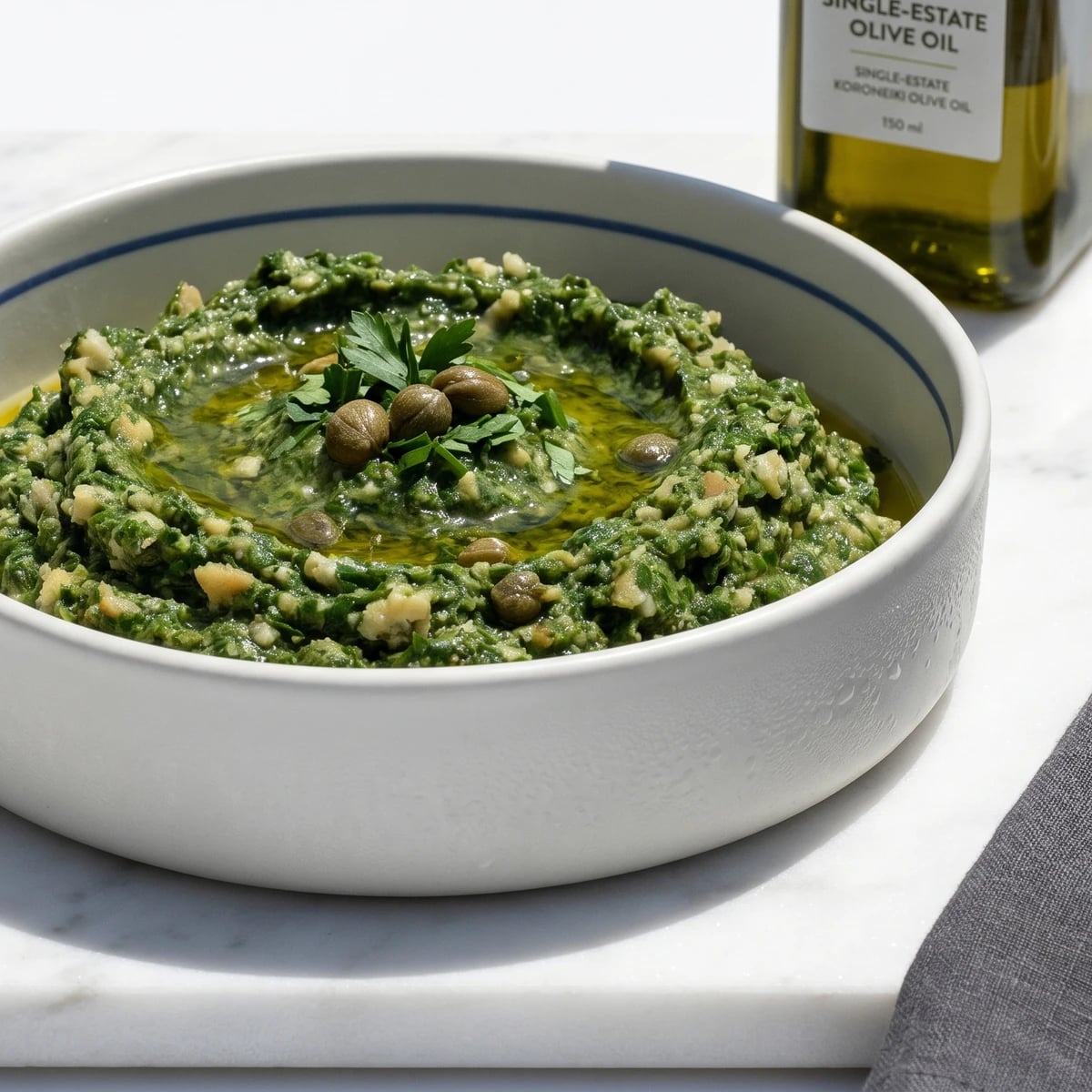
On Syros, whole bunches of parsley are pounded with garlic, stale bread, vinegar, capers, and olive oil into a bright green meze made for salt fish and a loaf of bread.

Appetizers & Snacks
Greek
Picnic
Budget Friendly
Make Ahead
20 min
Active Time
0 min cook1 hr 20 min total
Yield6 servings as a meze

Syros maidanosalata is parsley given the whole bowl, not a garnish scattered at the end. In the Cyclades, and especially on Syros, it becomes a sharp green spread pounded with garlic, stale bread, vinegar, capers, and olive oil. It sits close to pesto in the eye, but the soul is Greek and plain in the best way: bread for body, vinegar for bite, herbs by the fistful. The region is the dish's surname.

The one method that decides it is the bread. Soak it, squeeze it hard, then work it into the pounded parsley before you drizzle in the oil. Damp bread catches the oil and vinegar and gives the spread its body; wet bread makes it loose, and dry bread leaves it scratchy. That's the whole trick.

I make it when the table needs waking up: beside salt cod, grilled sardines, boiled potatoes, or just good bread. It is nistisimo, fit for the fasting table, and it keeps its color and bite long enough for a picnic if you cover the surface with a little oil. A recipe written down is a recipe saved, and this one deserves to stay as Syros made it.

Maidanosalata belongs to Syros in the Cyclades, especially the meze table of Ermoupoli, the port city that grew quickly after refugees from Chios, Psara, and other Aegean communities settled there during the Greek War of Independence. In a busy nineteenth-century port where salt fish, capers, stale bread, and herb bunches were ordinary provisions, parsley became the main ingredient rather than a garnish. That is its surprise: the green on the plate is the dish.

The technique, the tradition, and the story behind every dish.

Discover Culinary Explorer

Ingredients

flat-leaf parsley (maidanos)

Quantity

140g

leaves and tender stems, washed and dried very well

stale country bread

Quantity

80g

crusts removed

cold water

Quantity

as needed

for soaking the bread

garlic cloves

Quantity

2 cloves, about 10g

roughly chopped

red onion

Quantity

60g

roughly chopped

capers

Quantity

20g

rinsed and drained

white wine vinegar

Quantity

30ml

fresh lemon juice

Quantity

15ml

extra virgin Koroneiki olive oil

Quantity

120ml, plus 1 tablespoon

plus extra for finishing

fine sea salt

Quantity

1/2 teaspoon

plus more to taste

freshly ground black pepper

Quantity

1/4 teaspoon

country bread, rusks, boiled potatoes, or salt fish (optional)

Quantity

as needed

to serve

Equipment Needed

  • large mortar and pestle, 18-20cm, or food processor with pulse setting
  • salad spinner or clean kitchen towel for drying parsley

Instructions

  1. 1

    Dry the parsley

    Trim away only the tough lower parsley stems. Keep the tender stems, because they carry flavor. Wash the parsley in two changes of cold water, then spin it dry and spread it on a clean towel for 10 minutes. The leaves should feel dry to the touch before they go into the mortar or processor.

  2. 2

    Soak the bread

    Tear the stale bread into a bowl and cover it with cold water for 5 minutes. Lift it out and squeeze hard over the sink until it feels damp and pliable, not dripping. This is the step that decides the texture: damp bread catches the oil and vinegar and gives the spread its body; wet bread makes it loose, and dry bread leaves it rough.

    Use stale bread, not fresh soft bread. Fresh bread turns gummy before it can bind the parsley and oil.
  3. 3

    Pound the base

    In a large mortar, pound the garlic with the salt until it becomes a paste. Add the onion and capers and pound again until juicy and broken down. Add the parsley by the handful, pounding each addition before the next goes in. If you're using a food processor, pulse in short bursts and scrape often. Stop while it still looks like a coarse green spread, not parsley juice.

  4. 4

    Work in oil

    Add the squeezed bread, vinegar, lemon juice, and black pepper. Pound or pulse until the bread disappears into the parsley. Drizzle in the 120ml olive oil slowly, working the mixture the whole time, until it turns glossy and thick enough to sit on a spoon. Taste for salt and vinegar. It should be sharp, green, and awake.

  5. 5

    Rest and serve

    Spoon the maidanosalata into a shallow bowl and make a small well in the top. Cover and rest it for 30 to 60 minutes in the refrigerator so the garlic settles into the herbs. Before serving, bring it back toward cool room temperature and finish with a tablespoon of olive oil. Serve with salt fish, grilled sardines, boiled potatoes, rusks, or a loaf of good bread.

Chef Tips

  • Use flat-leaf parsley if you can. Curly parsley tastes duller and traps water in its leaves. Tender stems are welcome, woody stems are not. If the bunch smells tired, make another dip today. Parsley is the dish here.
  • A food processor is allowed. Use the pulse button and stop often to scrape the bowl. Let it run too long and you'll get a thin green sauce instead of the rough spread Syros means.
  • The garlic grows stronger as it sits, so don't double it unless your salt fish is very stubborn. Two good cloves are enough for the first day and plenty by the second.
  • This is a fasting-table dish, nistisimo, with no dairy, egg, or fish in the spread itself. Put it beside boiled potatoes, beans, or bread for Lent, and beside salt cod when the calendar allows.

Advance Preparation

  • Wash and dry the parsley up to 1 day ahead. Wrap it in a clean towel and refrigerate it so it stays crisp and dry.
  • Make the maidanosalata up to 24 hours ahead. Press a thin spoonful of olive oil over the surface, cover, and refrigerate.
  • For a picnic, pack it chilled and add the final olive oil just before serving.

Frequently Asked Questions

Nutrition Information

1 serving (about 75g)

Calories
225 calories
Total Fat
21 g
Saturated Fat
3 g
Trans Fat
0 g
Unsaturated Fat
18 g
Cholesterol
0 mg
Sodium
350 mg
Total Carbohydrates
9 g
Dietary Fiber
1 g
Sugars
1 g
Protein
2 g

Note: Chef personas and recipes are created with AI assistance. Cook with care: follow safe food-handling practices, check doneness with a thermometer when needed, and adapt for allergies and your kitchen.

Where cooking meets culture.

Culinary guides, cultural storytelling, and the editorial depth that makes cooking meaningful.

Discover Culinary Explorer

More from Greek Meze: Dips & Spreads

Browse the full collection