
Chef Jeong-sun
Aehobak-guk (애호박국, Korean Zucchini Soup)
A clean summer soup of Korean zucchini and salted shrimp, built on quick anchovy-kelp broth and finished before the half-moons lose their shape on a weeknight table.
A cooking platform built around craft, culture, and the stories behind what we eat.
Created by
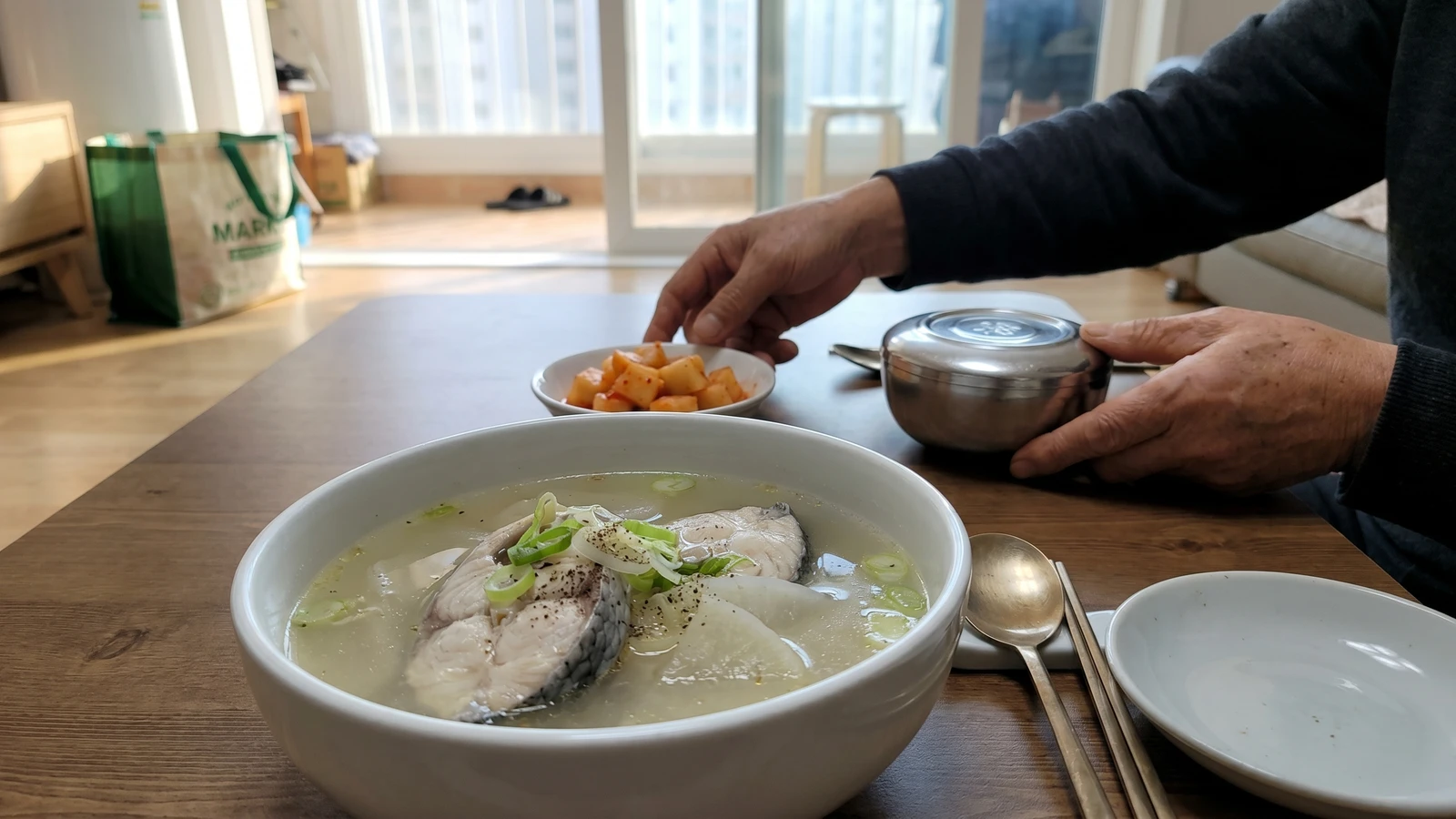
A clear Pyongyang soup built around grey mullet, cleaned with care, simmered gently with radish, and finished with salt and black pepper so the fish stays sweet and the broth stays bright.
Grey mullet asks you to cook the month you're standing in. In late autumn and winter the flesh is firm, the smell is clean, and the fishmonger should be able to show you bright gills and clear eyes without being asked twice. In summer, when mullet can turn muddy, Korean kitchens knew enough to change the pot. Technique first, then loyalty to the recipe.
Sungeo-guk belongs to Pyongyang, where the Taedong River fish were prized and the soup stayed pale. People who expect every Korean fish soup to be red with gochugaru misunderstand this bowl. Here the seasoning is salt and black pepper, and that means the fish has nowhere to hide. Clean it properly, simmer it gently, and let it taste like itself.
Notebook 41 says the mistake is boiling. Not seasoning, not garnish, boiling. A hard boil tears the fish, drags blood into the liquid, and gives you a cloudy broth with a tired smell. Tonight the dish asks for restraint: scrape the bloodline, pull the kelp early, skim without impatience, and measure the salt after the fish has given itself to the pot. 손맛 is real; I measure it anyway, so it can be handed on.
Sungeo-guk is most closely tied to Pyongyang and the Taedong River, where grey mullet moving between sea and river were prized enough that Taedonggang sungeo, Taedong River mullet, became shorthand for local quality. Unlike the red, spicy maeuntang common in many southern fish markets, the Pyongyang bowl is clear and seasoned mainly with salt and black pepper, a northern preference that keeps the fish and broth pale. After division, cooks outside the North had to make it with coastal grey mullet or another clean white fish, an adaptation of supply rather than of the soup's character.
Quantity
1 fish (800g to 1kg)
scaled, gutted, gills removed, cut crosswise into 2-inch pieces
Quantity
1 tablespoon
for scrubbing the fish
Quantity
1 tablespoon
Quantity
7 cups
Quantity
350g
peeled and cut into 1/2-inch half-moons
Quantity
1 piece, about 3 inches square
Quantity
3 thin slices
Quantity
2
lightly crushed
Quantity
2
cut into 2-inch lengths
Quantity
2
thinly sliced on the diagonal
Quantity
1 1/4 teaspoons, plus 1/4 teaspoon more only if needed
divided
Quantity
3/4 teaspoon
divided
| Ingredient | Quantity |
|---|---|
| whole grey mulletscaled, gutted, gills removed, cut crosswise into 2-inch pieces | 1 fish (800g to 1kg) |
| coarse sea saltfor scrubbing the fish | 1 tablespoon |
| cheongju or soju (optional) | 1 tablespoon |
| water | 7 cups |
| Korean radish (mu)peeled and cut into 1/2-inch half-moons | 350g |
| dried kelp (dasima) | 1 piece, about 3 inches square |
| fresh ginger | 3 thin slices |
| garlic cloveslightly crushed | 2 |
| scallion whitescut into 2-inch lengths | 2 |
| scallion greensthinly sliced on the diagonal | 2 |
| fine sea saltdivided | 1 1/4 teaspoons, plus 1/4 teaspoon more only if needed |
| freshly ground black pepperdivided | 3/4 teaspoon |
Rinse the mullet pieces under cold running water. Rub the skin, belly cavity, and head with the coarse sea salt, then rinse again. Use a spoon tip or your thumb to scrape away the dark bloodline along the backbone until the flesh looks clean. Pat dry, sprinkle with the cheongju or soju if using, and let it sit 10 minutes. Grey mullet can carry a muddy smell if it is old or poorly cleaned; the blood and slime are what cloud the soup first.
Put the water, radish, kelp, ginger, garlic, and scallion whites in a 4 to 5 quart pot. Set it over medium heat. The radish gives sweetness and the kelp gives body, but both must stay quiet. This is not a red fish stew and it is not anchovy broth wearing fish on top.
When the water reaches a gentle simmer, about 7 to 8 minutes, pull out the kelp. Leave it too long and it turns the broth slick. Simmer the radish and aromatics 12 minutes more, until the radish edges turn a little translucent. Lift out the ginger, garlic, and scallion whites if you want the cleanest bowl; leave the radish in.
Lower the heat to medium-low and slide in the mullet pieces, including the head if you have it. Keep the pieces in one layer as much as the pot allows. Do not stir. A hard boil breaks the flesh and turns the broth cloudy, so let the liquid move gently around the fish instead.
Simmer uncovered for 10 to 12 minutes, skimming foam from the surface whenever it gathers. The fish is ready when the flesh turns opaque and pulls from the bone with light pressure from a spoon. Skimming is not fussing. It is the difference between a bright Pyongyang-style soup and a pot that tastes tired before it reaches the table.
Add 1 teaspoon of the fine sea salt and 1/2 teaspoon of the black pepper. Taste the broth after 1 minute, when the salt has settled through it, then add the remaining 1/4 teaspoon salt if it needs sharpening. Add up to 1/4 teaspoon more salt only if your fish and radish were very sweet. Finish with the remaining 1/4 teaspoon black pepper. The pepper should be clear and present, not enough to gray the broth.
Scatter the sliced scallion greens over the soup and turn off the heat after 30 seconds. Let the pot rest 3 minutes so the broth settles. Ladle one or two pieces of fish, several radish slices, and clear broth into each bowl, then add a final pinch of black pepper at the table if you like. Serve with rice and mild kimchi, and warn everyone about the bones. That is care, not ceremony.
1 serving (about 580g)
Culinary guides, cultural storytelling, and the editorial depth that makes cooking meaningful.
Discover Culinary ExplorerChef Jeong-sun
A clean summer soup of Korean zucchini and salted shrimp, built on quick anchovy-kelp broth and finished before the half-moons lose their shape on a weeknight table.
Chef Jeong-sun
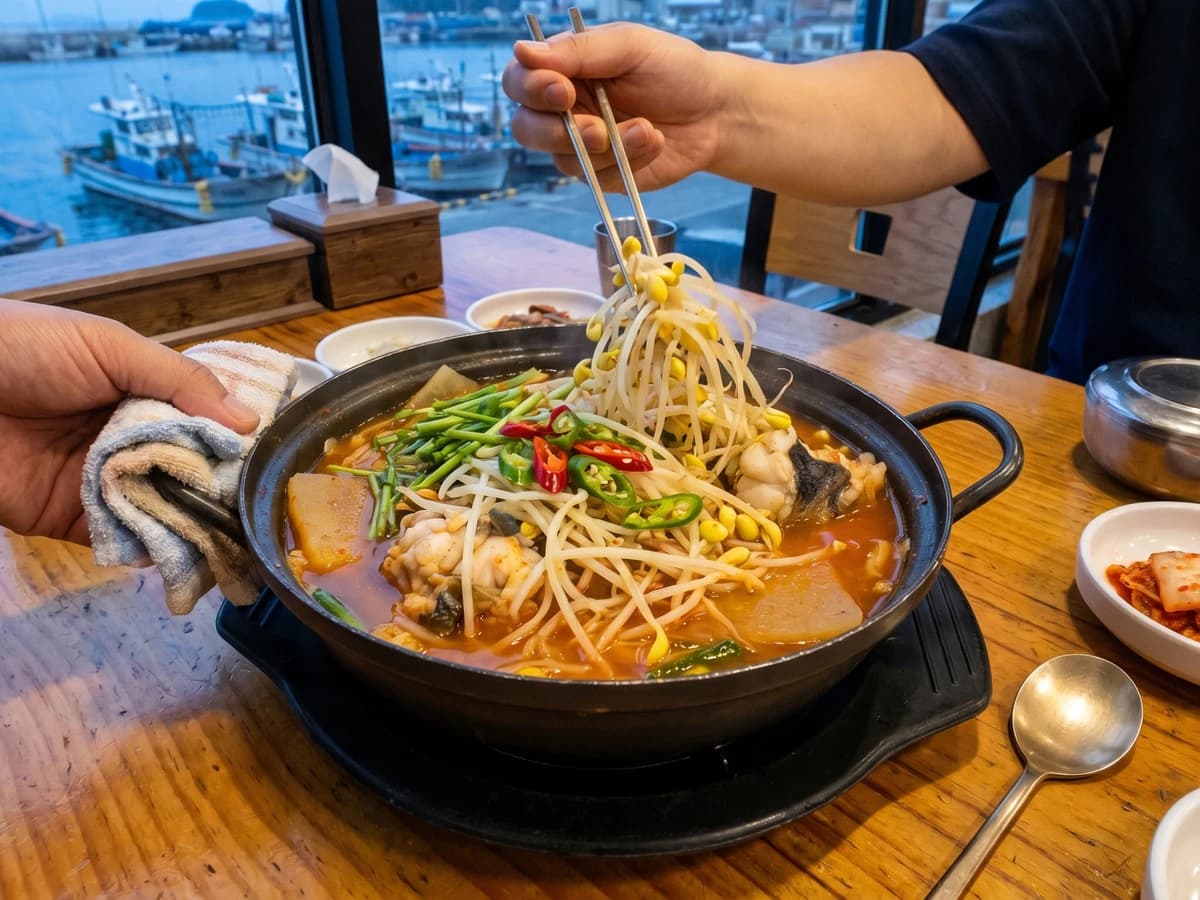
A Masan coast monkfish stew with firm white meat, gelatin at the bones, soybean sprouts for crunch, and a red broth seasoned to carry the fish, not bury it.

Chef Jeong-sun
A weeknight fish roe stew with radish and crown daisy in a clean spicy broth, where the whole success depends on adding the roe late enough that it sets tender, not chalky.

Chef Jeong-sun
Late-summer mallow leaves rubbed with salt until the bitter green water runs off, then simmered in a clean doenjang broth with dried shrimp, the quiet soup a Korean weeknight deserves.