
Chef Klaus
Ahle Wurst
North Hesse's old sausage is cured, not cooked: coarse pork, pepper, garlic, and cold weeks in a chamber until the slice turns firm enough for rye and cider.
A cooking platform built around craft, culture, and the stories behind what we eat.

Created by
The Munich mustard for Weißwurst: coarse brown seed, vinegar, sugar, and apple, left overnight so the bite settles into a round, mild spoonful.
Süßer Senf belongs to Bavaria first, and to the Weißwurst table most of all. Morning, pretzel, pale sausage, a small bowl of mustard. That doesn't make it a costume. Das ist kein Bierzelt. It's a practical sauce: sharp seed rounded with sugar so it sits beside mild veal sausage instead of bullying it.
German mustard splits hard by region. Düsseldorf and the Rhineland want it sharp, hot, and clean. Bavaria goes sweet and coarse, with brown mustard seed left visible under the spoon. Im Norden anders, im Süden anders. A single German mustard would be a lie told by a supermarket shelf.
The deciding technique is simple: grind the soaked seed only after it has taken up the vinegar and water, then let the finished mustard rest overnight. Dry seed ground too fine turns bitter and harsh; soaked seed breaks coarse, releases its heat more slowly, and mellows while the sugar and apple pull it round. Nicht aus dem Glas. This is ten minutes of work and one night's patience.
Watch the texture. You want a spoonable mustard with little cracked seeds still in it, not a yellow paste. Taste for sweet, sour, salt, then leave it alone. Das braucht seine Zeit, even when the work is quick.
Munich mustard maker Johann Conrad Develey is usually credited with creating Bavarian sweet mustard in 1854, using coarse mustard seed and caramelised sugar to make a milder, sweeter sauce than the sharper French and Rhenish styles. Weißwurst is traditionally dated to 1857 in Munich, so the famous pairing belongs to the mid-19th-century city, not to an ancient Alpine farmhouse. The regional split remains clear: Düsseldorf mustard stays hot and sharp, while Bavarian Weißwurstsenf is sweet, brown, coarse, and gentle.
Quantity
80g
Quantity
20g
Quantity
120ml
Quantity
60ml
Quantity
60g
Quantity
30g
finely grated
Quantity
1 teaspoon
Quantity
1 pinch
Quantity
1 pinch
| Ingredient | Quantity |
|---|---|
| brown mustard seeds | 80g |
| yellow mustard seeds | 20g |
| apple cider vinegar | 120ml |
| water | 60ml |
| brown sugar | 60g |
| applefinely grated | 30g |
| fine sea salt | 1 teaspoon |
| ground cloves | 1 pinch |
| ground allspice | 1 pinch |
Put the brown and yellow mustard seeds in a small bowl with the vinegar and water, then cover and leave them at room temperature for at least 8 hours. The seed has to swell before grinding; dry seed breaks hot and dusty, while soaked seed cracks cleanly and gives you the coarse Bavarian texture.
Put the brown sugar, grated apple, salt, cloves, and allspice in a small pan and warm gently for 3 to 5 minutes, just until the sugar dissolves and the apple softens. Keep it low, because scorched sugar makes the mustard bitter before the seed has even had its say.
Scrape the soaked mustard seed and all its liquid into a food processor or mortar, add the warm apple-sugar mixture, and grind until spoonable but still speckled with cracked seed. Stop before it becomes smooth. Weißwurstsenf should have body under the spoon, not the flat texture of a tube mustard.
Pack the mustard into a clean jar, cover it, and refrigerate overnight before judging it. Freshly ground mustard tastes louder than it will tomorrow; the rest lets the vinegar, sugar, and apple settle the heat. Taste after resting, then adjust with a few drops of vinegar for lift or a pinch of salt if it tastes dull. Würzen, Fett, Salz zum Schluss.
Serve cold or cool, in a small dish, with Weißwurst, pretzels, Leberkäse, cold roast pork, or a Brotzeit board. Use a clean spoon every time, because this is a fresh mustard with apple in it and it keeps best when the jar stays clean.
1 serving (about 17g)
Culinary guides, cultural storytelling, and the editorial depth that makes cooking meaningful.
Discover Culinary ExplorerChef Klaus
North Hesse's old sausage is cured, not cooked: coarse pork, pepper, garlic, and cold weeks in a chamber until the slice turns firm enough for rye and cider.

Chef Klaus
Baden's Vesper spread is nothing more than quark, cream, onion, and chives, but the whole dish depends on controlling the whey so the bowl stays spoonable beside hot potatoes.
Chef Klaus
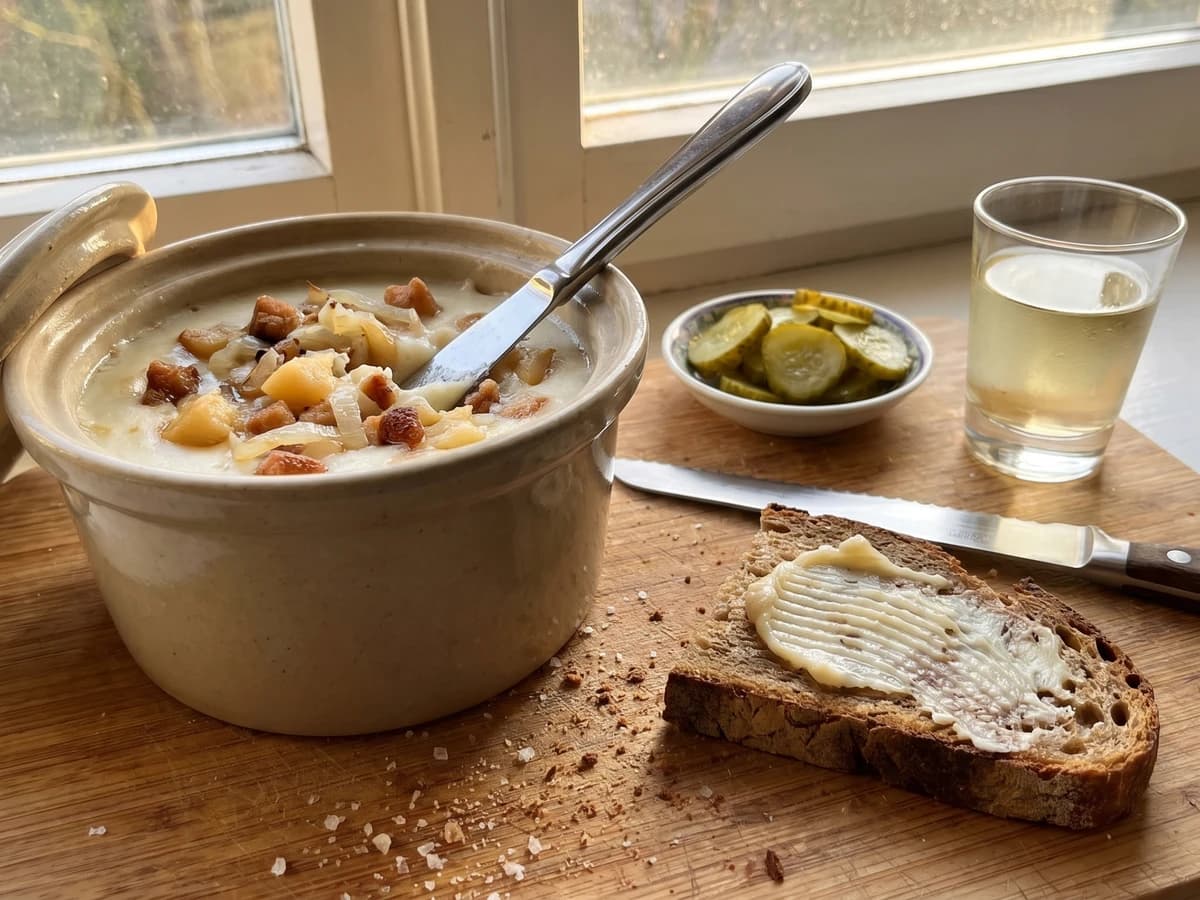
Baden's lard spread is thrift in a crock: pork fat rendered slowly, onion and apple added when the water is gone, and the crisp Grieben stirred back before it sets.

Chef Klaus
The Bavarian beer-garden salad that lives by the cut: thin sausage strips, raw onion, vinegar and oil, no cheese, rested long enough to taste like supper.